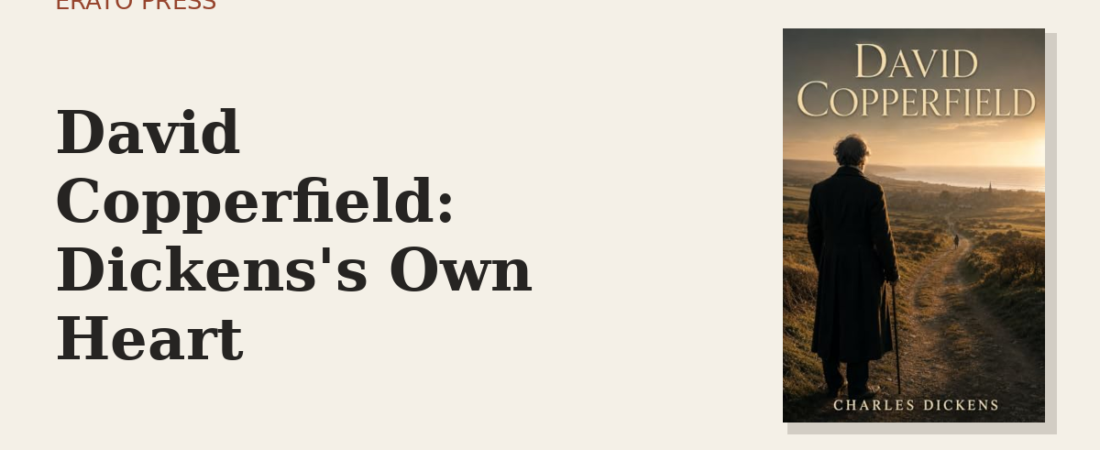
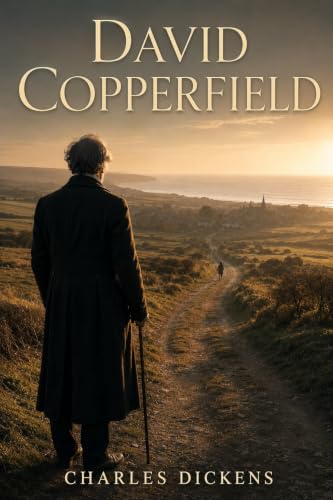
“Of all my books,” Dickens wrote, “I like this the best.” And he had reason to: into David Copperfield (1850) he poured more of his own life than into anything else he made — the blacking factory that shamed his childhood, the shorthand and the reporting, the making of a writer — lightly disguised as the story of an orphan boy who survives cruelty and poverty to become a novelist. It is the warmest and most autobiographical of his books, a first-person life story so full of unforgettable people that readers finish it feeling they have lived a second life. If Great Expectations is Dickens’s most perfect novel, David Copperfield is his most beloved — the one he, and generations of readers, loved most.
A life, from cruelty to calling
David’s story moves through the whole range of Dickens’s world: the idyllic early childhood shattered by his mother’s marriage to the cold Mr Murdstone; the misery of the warehouse and the road; the rescue by his fierce, donkey-hating aunt Betsey Trotwood; school, first love, work, marriage, loss, and the slow discovery of his vocation as a writer. It is the classic shape of the bildungsroman, the novel of formation, and Dickens fills it with the emotional truth of remembered experience — the helplessness of a child before adult cruelty, the intensity of first infatuation, the grief of early loss — rendered so vividly that they feel like one’s own memories. Few novels give a reader so complete a sense of a human life lived from the inside.
The immortal cast
And around David wheels the greatest gallery of characters Dickens ever assembled. Mr Micawber, endlessly in debt and endlessly hopeful that “something will turn up,” one of the great comic creations in English — and a loving portrait of Dickens’s own improvident father. Uriah Heep, oily and “‘umble,” the most memorable hypocrite in fiction, whose false modesty masks a cold ambition. The steadfast Peggotty and the tragic Little Em’ly; the child-wife Dora and the wise Agnes; the mad, kite-flying Mr Dick. Each is drawn with the surplus of life that is Dickens’s signature — larger than reality and truer than it, figures who have escaped their book to become part of the language. For readers new to Dickens, our guide to where to start makes the case that this is the novel that best shows why the world fell in love with him.
The writer made
Beneath the comedy and the incident runs the book’s quiet true subject: how a wounded child becomes an artist. David’s suffering is not wasted; it is transmuted, through the discipline of work and the healing of love, into the sympathy and observation that make him a novelist. Dickens is telling the secret story of his own salvation — how the boy humiliated in the blacking factory turned the whole of his pain into the fuel of his art. The novel’s faith that a life, however bruised, can be redeemed by earnest effort and true feeling is Victorian to its core, and irresistible. When David at last finds his calling and his true love, the reader who has lived his whole life with him feels the earned rightness of it.
Why read it now
Because it is the most companionable of great novels — the one you live inside rather than merely admire — and because its portrait of a child’s-eye world, its unforgettable people, and its faith in the redeeming power of work and love have lost none of their warmth. Long, yes, but never a chore; it is the book that has made more readers into Dickens lovers than any other.
Frequently asked questions
How autobiographical is it?
Deeply. Dickens drew on his own childhood humiliation in a blacking warehouse, his years as a shorthand reporter, and his path to authorship — reshaping the raw material of his life into fiction. It is the closest thing we have to his spiritual autobiography.
Is it a good place to start with Dickens?
An excellent one — warmer and more personal than his darker late novels, packed with his most beloved characters, and told in an intimate first person that carries you easily through its length.
Who is Uriah Heep?
The novel’s great villain — a clerk whose relentless, cringing professions of being “umble” mask a cold, grasping ambition. His name has entered English as a byword for oily hypocrisy, and he is among Dickens’s most unforgettable creations.
Read the Erato Press edition →
and live the second life Dickens loved best.
Enjoyed this piece?
Get the next one — our essays on the classics and news of each new Erato Press edition — straight to your inbox.