There is a moment early in Cranford when a cow, having tumbled into a lime-pit and lost most of her hair, is dressed by her devoted owner in a flannel waistcoat and drawers and walked sedately through the town, and the ladies of Cranford debate the propriety of the costume with perfect seriousness. It is a very funny scene, and it would be easy to read the whole book as a string of such gentle absurdities, a museum of provincial eccentricity arranged for our affectionate amusement. That reading is not wrong, but it misses almost everything. Beneath the comedy of the cow’s waistcoat runs a far harder subject, and Elizabeth Gaskell knew exactly what she was doing.
The argument of this essay is that Cranford is a comedy with iron in it. Its surface is the small change of village life, the etiquette of card-parties and the management of a single best gown, but its real subject is economic precariousness and the dignified concealment of poverty among genteel women who have outlived the men and the money that once sustained them. The laughter Gaskell invites is never contempt; it is the recognition of how human beings keep their footing when the ground has quietly given way beneath them. To read Cranford as mere whimsy is to accept the ladies’ own polite fiction that nothing serious is at stake. Gaskell wants us to see through it, kindly.

A republic of women
The first sentence tells you the central fact of this world: “Cranford is in possession of the Amazons.” The men have gone, dead, or away making the money that the women must live on the dwindling remains of, and what is left is a society run almost entirely by women past the age of marriage. This is itself a quietly radical premise for a mid-Victorian novel. Gaskell removes the marriage plot, the great engine of nineteenth-century fiction, and asks what a community of women looks like when courtship is no longer its organizing business. The answer is a republic of careful, observant, fiercely particular spinsters and widows, governed by an elaborate constitution of manners that everyone obeys and no one wrote down.
Miss Matty Jenkyns, who gradually becomes the book’s center of gravity, is the great achievement of this design. She is timid, easily flustered, governed for half her life by the opinions of her formidable late sister Deborah, and she is also, by the end, one of the most quietly moving figures in English fiction. Gaskell’s comedy works by accretion: we laugh at Miss Matty’s terror of sleeping in a bed that might conceal a man underneath, at her conviction that reading by candlelight is an extravagance, and then, almost imperceptibly, the laughter turns into something like love, because we have come to understand the whole frightened, gallant economy of her inner life.
The iron beneath the lace
What makes the comedy bearable, and finally serious, is that Gaskell never lets us forget the money. The ladies of Cranford practice what one of them calls “elegant economy,” an exquisite system of pretending that one’s poverty is a matter of taste rather than necessity. They agree, without ever saying so, that wealth is vulgar and that nobody mentions being poor; they walk home from evening parties carrying their own lanterns because carriages are an expense they cannot admit they cannot afford; they offer a single, carefully apportioned plate of refreshment and call it a preference for simplicity. Gaskell renders these arrangements with a comic precision that is also a form of tenderness. The pretenses are funny, but they are also the scaffolding by which dignity is held upright over an abyss of genteel destitution.
The iron shows plainest in the novel’s turn toward Miss Matty’s ruin. When the bank in which she holds her small capital fails, she is left with almost nothing, and the comedy briefly drops away to reveal what it had been protecting us from all along: a woman in late middle age, with no skills the world values and no man to provide, facing actual want. Gaskell’s handling of this is masterly. Miss Matty’s response is not despair but a scrupulous, almost luminous honesty, she insists on honoring a failed bank’s note for a frightened farmer, giving away gold she can no longer spare because it is the right thing to do. The town, in turn, organizes a secret subscription to keep her, each lady contributing what she cannot afford and disguising the charity as something else, because to name it would wound. The whole social machinery of pretense, which the novel has spent chapters gently mocking, is revealed in this crisis to be a machinery of mutual care.
Community against change
Gaskell wrote Cranford while she was also writing the great industrial novels that made her reputation, and the contrast is deliberate. The town is explicitly placed near the booming railway city of Drumble, that is, near the new industrial England, and Cranford defines itself against it. Drumble is money, speed, machinery, men; Cranford is the old order of fixed incomes and fixed manners, surviving on borrowed time. The encroachments of the modern world arrive as small shocks, a vulgar but kindly former shopkeeper who has made a fortune, a returned brother from India who upends the settled hierarchy, the railway itself, which in one of the book’s few genuinely dark moments kills a beloved character outright. Gaskell is too honest to pretend the old world can last, and too humane to celebrate its passing.
This is the novel’s most lasting note: it is an elegy that refuses to be merely nostalgic. Gaskell loves Cranford’s absurdities, its candle-economies and its scandal over a turban, but she does not pretend they are anything but the manners of a class being slowly economically displaced. The comedy and the elegy are the same gesture. We laugh at these women because their concerns are tiny, and we honor them because, within those tiny concerns, they practice loyalty, courage, and care of a kind the brisk new world has no obvious place for. The cow in her flannel drawers is ridiculous; she is also the emblem of a community that will go to absurd, tender lengths to keep its creatures clothed and warm.
Frequently asked questions
Is Cranford a novel or a collection of sketches?
It began as a series of episodes for Dickens’s magazine Household Words, and it keeps a sketch-like, episodic texture, but it is more unified than its origins suggest. The gradual centering on Miss Matty, and the bank failure that brings the comedy to its moral crisis, give the book a genuine arc. Read it as a novel that wears the costume of a sketchbook.
Why are there almost no men in Cranford?
Their absence is the premise, not an accident. By removing marriageable men and the marriage plot, Gaskell can examine a community of older women on its own terms, governed by manners and mutual obligation rather than courtship. It lets her write about female economic vulnerability and female solidarity with a directness the conventional romance plot would have obscured.
How does Cranford relate to Gaskell’s industrial novels?
It is their quiet companion piece. Where Mary Barton and North and South face the new industrial order head-on, Cranford watches it from the genteel margins, through the eyes of those it is leaving behind. The same clear-eyed sympathy for people caught in economic change animates both, only here it wears the lighter dress of comedy.
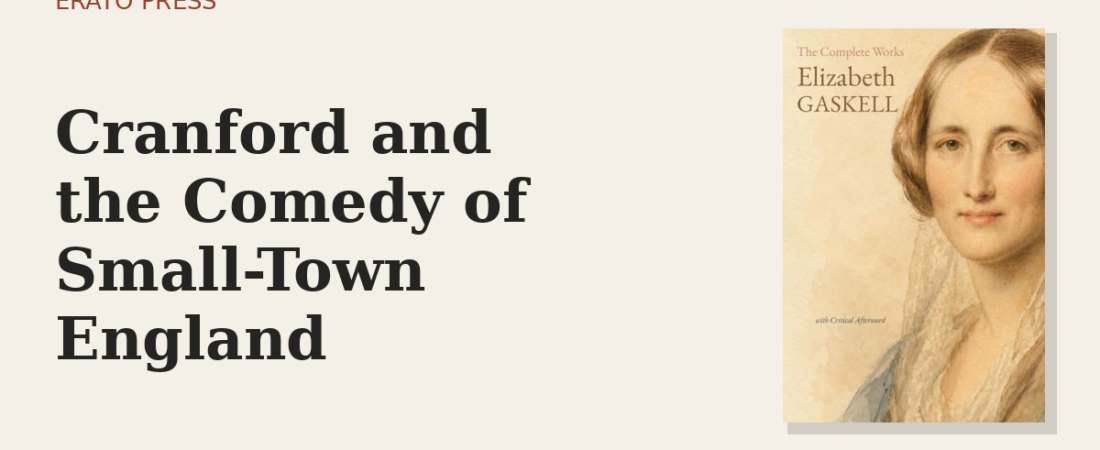
The Erato Press edition restores Cranford to its proper standing, not as a quaint period charm but as one of the most humane comedies in the language, a book that laughs with its characters precisely because it understands exactly what they are bearing. For the reader who has met Miss Matty only by reputation, this edition offers the chance to discover how much weight Gaskell’s lightest novel quietly carries.
Enjoyed this piece?
Get the next one — our essays on the classics and news of each new Erato Press edition — straight to your inbox.