
Nothing happens in a Chekhov story, and everything does. A doctor visits a patient; a woman meets a man at a seaside resort; a family fails to sell an orchard. There are no murders, no twists, no grand resolutions — and yet no writer has ever caught more precisely the texture of an actual human life, its small disappointments and its quiet, unspoken longing.
Anton Chekhov was a physician who wrote on the side, and he brought a doctor’s eye to fiction: unsentimental, exact, endlessly compassionate. He refused to judge his characters or to hand the reader a moral. ‘It is not the writer’s job to solve the problem,’ he said, ‘only to state it correctly.’ His stories simply show people as they are — self-deceiving, hopeful, ordinary — and trust us to feel the ache beneath the surface. In doing so he reinvented the short story, and taught the twentieth century how to write one.
And in the theatre he did the same, replacing melodrama with the mundane: in The Seagull, Uncle Vanya, The Three Sisters, The Cherry Orchard, people talk past each other, dream of a Moscow they will never reach, and let their lives slip away in real time. It is the most influential body of drama since Shakespeare.
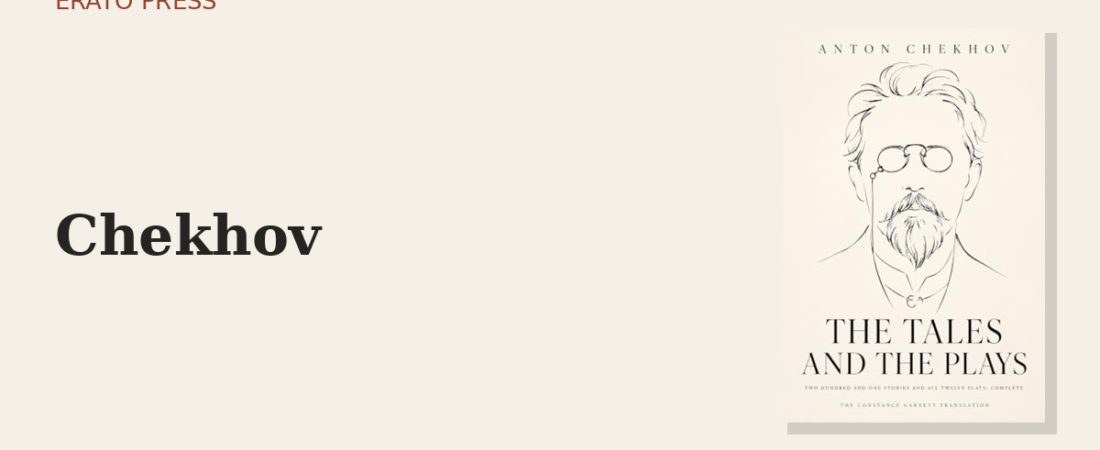
This edition gathers 201 stories and all twelve surviving plays in the complete Constance Garnett translation. Read a story tonight; you will feel it for a week.
Read Anton Chekhov: The Tales and the Plays →
Enjoyed this piece?
Get the next one — our essays on the classics and news of each new Erato Press edition — straight to your inbox.