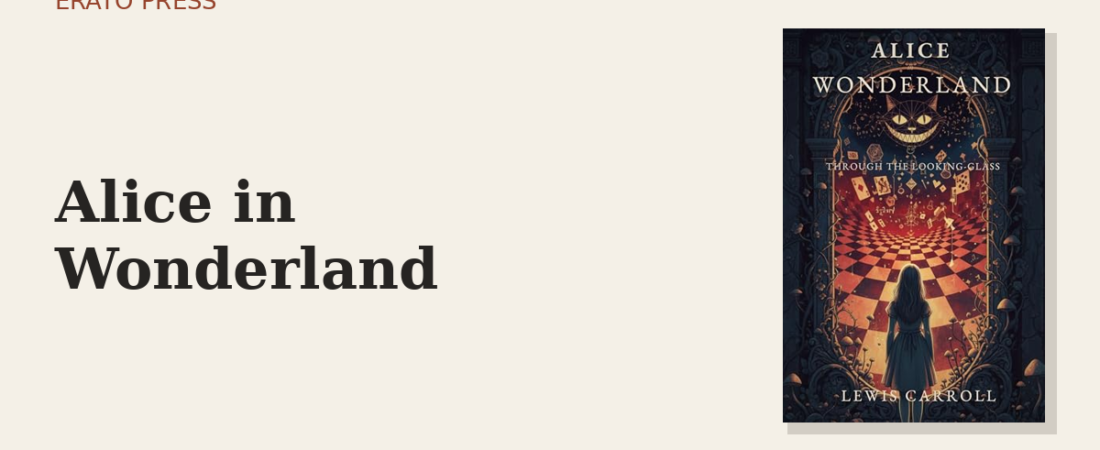

We call it a children’s book, and children love it. But Alice’s Adventures in Wonderland was written by an Oxford mathematician, and its nonsense is the most rigorous in English — nonsense built, paradoxically, out of pure logic pushed past the point of sense.
Lewis Carroll — really the logician Charles Dodgson — plays games with language and rule that are genuinely philosophical. The Cheshire Cat’s grin without a cat, the trial with no crime, the race where everyone wins and all must have prizes: these are not random silliness but logic run off its rails, the machinery of reason turning without its cargo. Alice, the sensible Victorian child, keeps trying to apply the rules she was taught, and Wonderland keeps proving that the rules are arbitrary all the way down.
That is why philosophers and physicists quote Carroll more than almost any novelist. Beneath the whimsy is a vertiginous idea: that the order we take for granted — of size, time, identity, meaning — is a convention that could dissolve at any moment, as it does the instant Alice falls down the hole.
Like Kipling’s Jungle Books, it is a children’s classic that is far stranger, and far deeper, than the nursery remembers.
Read Alice in Wonderland & Through the Looking-Glass →
Enjoyed this piece?
Get the next one — our essays on the classics and news of each new Erato Press edition — straight to your inbox.