Ask a reader to name an Alexandre Dumas novel and you will get one of two answers, sometimes both: The Three Musketeers and The Count of Monte Cristo. This is a little like knowing Bach only by the Toccata in D minor and the Air on the G String — not wrong, exactly, but a strange way to meet a composer who left more than a thousand works. Dumas wrote, by the most generous count, some two hundred and fifty volumes, and the proportion of that output now read for pleasure is vanishingly small. The argument of this essay is simple and, I think, hard to refute: the two famous books are not the summit of Dumas with the rest sloping away beneath them. They are the visible peaks of a mountain range, and the lesser-known novels — the Valois romances, the later d’Artagnan books, the Revolutionary cycle — are not lesser at all. They are where you go once the great public spectacles have taught you how Dumas works, and where the pleasure deepens rather than thins.

The factory and the man
To read Dumas honestly you have to confront the thing his detractors have used against him for a hundred and seventy years: he ran a workshop. The chief collaborator was Auguste Maquet, a competent historian and a dogged researcher who supplied Dumas with plot skeletons, chronologies, and first drafts that Dumas then rewrote — and the rewriting is the whole point. Maquet’s surviving drafts have been compared with the published novels, and the comparison is devastating to anyone who thinks Dumas merely signed someone else’s work. Where Maquet gives a flat line of expository dialogue, Dumas gives a scene that breathes; where Maquet reports that a character is angry, Dumas makes him say something you remember for the rest of your life. The collaboration was real, it was sometimes ugly — Maquet sued for credit and money, and the terms of their partnership remain a small scandal — but the voice on the page is Dumas’s. The factory existed; the magic was not industrial.
This matters because the scale of the output is itself an aesthetic fact. Dumas wrote serially, for newspapers, paid by the line, against deadlines that would have flattened a lesser temperament, and the conditions shaped the art. The cliffhanger, the chapter that ends on a drawn sword, the relentless forward propulsion — these are not flaws of haste but the native grammar of a writer who understood, before anyone had a word for it, that narrative is a machine for keeping a reader from putting the paper down. Once you stop apologizing for the serial conditions and start reading with them, the whole vast corpus opens up.
The Valois romances: history as nightmare
If you have read only the Musketeers, the first thing to understand is that Dumas wrote a second great cycle, set two generations earlier, in the blood-soaked France of the Wars of Religion, and it is darker, stranger, and in some ways finer than the d’Artagnan books. It opens with La Reine Margot (1845), built around the Saint Bartholomew’s Day Massacre of 1572 — the night Catholic Paris turned on its Protestant guests and killed thousands in the streets. Dumas does not soften this. The novel’s central romance, between the Catholic princess Marguerite de Valois and the Protestant La Mole, plays out against a real atrocity, and the poisons, the severed heads, the cynical statecraft of Catherine de’ Medici give the book a Jacobean intensity that the sunnier Musketeers never reach. Its sequels — La Dame de Monsoreau and The Forty-Five Guardsmen — carry the same court through the reign of the last Valois kings, with the magnificent, doomed Bussy d’Amboise and the melancholy jester Chicot, one of Dumas’s great inventions, a fool who is the only sane man at a murderous court.
What the Valois cycle reveals is a Dumas most readers never meet: a writer genuinely interested in the machinery of historical catastrophe, in how religious hatred is manufactured and used, in the difference between the public face of power and its private appetites. The romance is still there, and the swordplay, but the moral weather is heavier. This is Dumas with the lights turned down.
Beyond d’Artagnan’s first ride
Even within the famous cycle, most readers stop too soon. The Three Musketeers is only the overture. It is followed by Twenty Years After (1845) and then by the enormous Vicomte de Bragelonne (1847–50), which contains, in its final third, the section published separately as The Man in the Iron Mask. To read these in sequence — and a sane reading order is exactly what the d’Artagnan books reward, as we lay out in The Three Musketeers and the d’Artagnan Romances: A Reading Order — is to watch the four friends age, scatter, and grow estranged, and to feel time do to them what it does to all of us. The young men who shouted “all for one” become middle-aged men on opposite sides of a civil war. Athos becomes a grieving father; Aramis becomes a Jesuit intriguer; Porthos goes to a death of operatic grandeur in a collapsing cave. The cycle that began as a romp ends as something close to tragedy, and the famous early book reads completely differently once you know where it is going.
Then there is the Revolutionary cycle — Joseph Balsamo, The Queen’s Necklace, Ange Pitou, The Countess de Charny — Dumas’s vast, sprawling attempt to dramatize the fall of the French monarchy from the inside, with the mesmerist Cagliostro as a kind of presiding genius of history. It is uneven, sometimes exhausting, and shot through with passages no other writer of the period could have produced.
Why the lesser-known novels reward you
The case for going beyond the famous two is not antiquarian completism. It is that Dumas got better, or at least stranger and richer, the further he went from the obvious crowd-pleasers. The minor novels contain his most interesting experiments: Georges (1843), set on Mauritius, with a mixed-race hero and a frank treatment of colonial racism unusual for its moment and personally charged for an author who was himself the grandson of an enslaved Haitian woman; The Black Tulip, a jewel-like short novel about horticultural obsession and political terror in seventeenth-century Holland; the genuinely funny The Wolf-Leader, a werewolf tale drawn from the folklore of his childhood. Read whole, Dumas stops being the author of two reliable entertainments and becomes what he actually was: one of the great improvisers of European fiction, a man who could write anything, at any length, and almost never bored himself or you.
There is also the simple matter of company. To live for a few weeks inside the complete Dumas is to keep the best possible company — a writer of inexhaustible good humor, generosity, and appetite, who liked his characters and liked his readers and never once condescended to either. The snobbish dismissal of him as a mere entertainer has cost generations the pleasure of his range.
Frequently asked questions
Did Dumas really write all these books, or was it Maquet?
Both, in different measures. Maquet was a genuine collaborator on the major historical novels — he supplied research, structure, and rough drafts — but the comparison of his surviving manuscripts with the published texts shows that the prose, the dialogue, the wit, and the characterization that make the novels live are Dumas’s. Many of the minor works had no Maquet at all. The “factory” charge is a half-truth used to diminish a writer who was, by any standard, prodigiously productive in his own right.
Where should a newcomer start after the famous two?
La Reine Margot is the natural next step: short enough to be manageable, vivid enough to hook you, and a direct gateway to the whole Valois cycle. If you would rather stay with the Musketeers, continue straight on to Twenty Years After and let the friends age.
Are the lesser novels actually good, or just curiosities?
The best of them — The Black Tulip, Georges, the Valois romances, the later d’Artagnan books — are first-rate and would secure a lesser writer’s reputation on their own. Dumas’s misfortune is to have written two books so famous that they eclipse a body of work most novelists would envy.
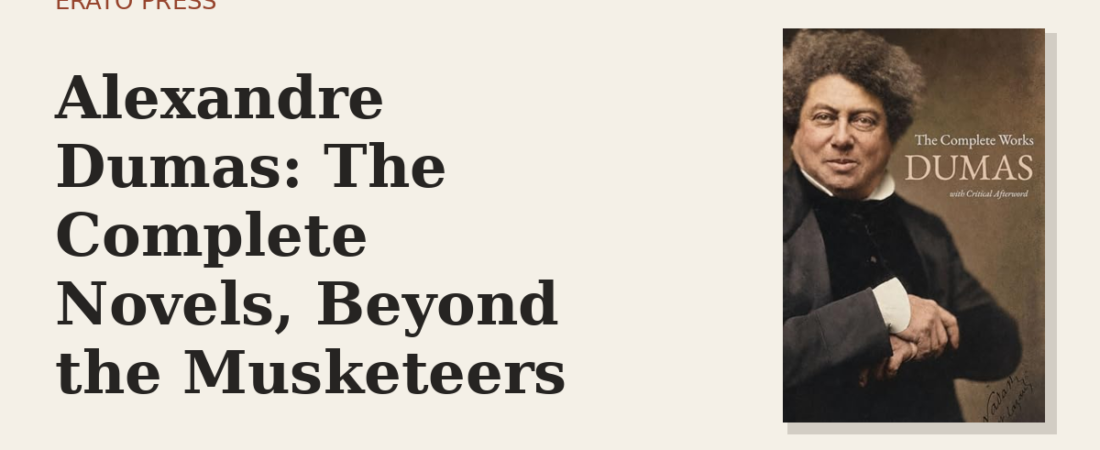
This is why a complete edition is not a vanity but a necessity: Dumas is a writer you cannot take the measure of in two volumes, because his greatness is partly a greatness of abundance. The Erato Press edition gathers the novels so that the range becomes visible — so that you can move from the Valois court to the Revolution, from the werewolf to the iron mask, and watch one of the most generous imaginations in literary history work at full stretch. Read the Erato Press edition and discover the Dumas who has been waiting, all this time, just past the two books everyone already knows.
Read the Erato Press edition →
Enjoyed this piece?
Get the next one — our essays on the classics and news of each new Erato Press edition — straight to your inbox.