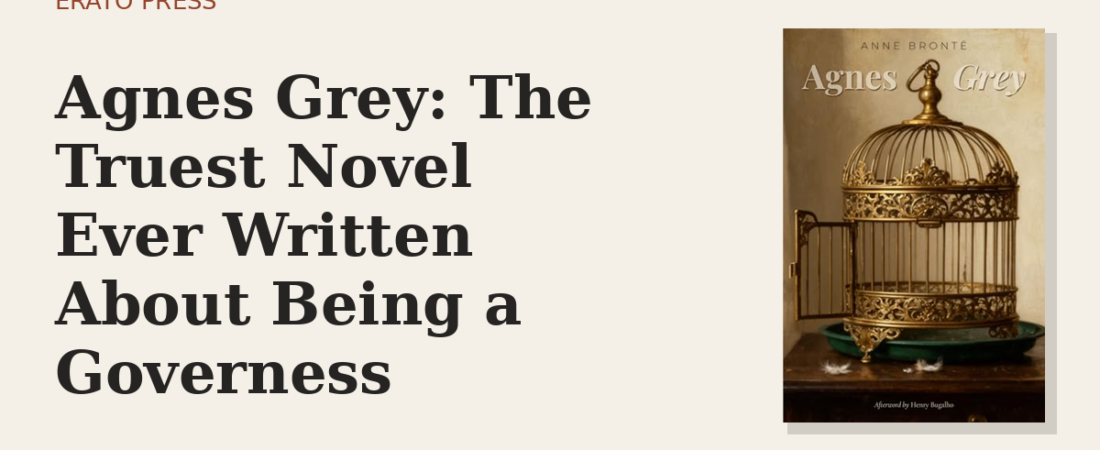
Anne Brontë is the forgotten sister — overshadowed by Charlotte’s fame and Emily’s genius — and Agnes Grey (1847) is her quiet, clear-eyed first novel, the most honest account in English of a life that thousands of educated but penniless Victorian women were forced to lead: that of the governess. Drawn directly from Anne’s own bitter experience, it has none of the gothic drama of her sisters’ books and all the more truth for it — a plain, unsparing, deeply moral record of loneliness, humiliation, and the quiet endurance of a good woman with no power and no place. It is the truest novel ever written about being a governess, and a small masterpiece of understated integrity.

The governess’s invisible misery
Agnes, a clergyman’s daughter fallen into poverty, takes work as a governess to support her family — and discovers the peculiar cruelty of the position: neither servant nor family, respected by no one, responsible for children she cannot discipline, at the mercy of employers who treat her as furniture. Anne Brontë, who had endured exactly this, refuses to romanticize it. She shows the spoiled, cruel children who torment their governess and the parents who blame her for their own failures; the crushing isolation of a woman with no equal to talk to; the daily small humiliations that wear down the soul. Where Charlotte’s Jane Eyre escapes into gothic romance, Agnes simply endures, and the unglamorous truth of her endurance is the book’s quiet power. It is one of the most accurate social documents the Victorian novel produced.
Anne Brontë’s clear moral vision
What lifts Agnes Grey above mere complaint is Anne’s steady moral clarity. She was the most straightforwardly religious and ethical of the sisters, and her novel is grounded in an unshowy conviction: that goodness, patience, and integrity matter even when they go unrewarded, that a life of quiet virtue in a hard place is not a failure. Agnes is not a dazzling heroine; she is a good one, and Anne makes goodness — usually so hard to render interesting — genuinely moving, precisely because it is tested by so much petty cruelty and never breaks. The reward, when it comes (a modest love, a modest happiness), is earned by character, not plot, and feels all the truer for its smallness.
The overlooked Brontë
Charlotte, after Anne’s early death, actually suppressed her sister’s fiercer second novel and did her reputation no favors; Anne has been undervalued ever since. But readers who come to her find a distinct and valuable voice — plainer than Charlotte’s, calmer than Emily’s, more honest than either about the ordinary realities of a woman’s working life. Agnes Grey is the perfect introduction to her, and an essential part of the Brontë story that our guide to the sisters tells — the third voice, quiet but true, that completes the most extraordinary family in English literature.
Why read it now
Because it is the honest one — the Brontë novel that tells the plain truth about powerlessness, work, and quiet endurance, without gothic consolation — and because Anne Brontë’s clear moral vision and unsparing realism deserve to be rediscovered. Short, truthful, and moving, it is the ideal way to meet the sister the world forgot.
Frequently asked questions
Is Agnes Grey autobiographical?
Closely. Anne Brontë drew directly on her own miserable experience as a governess to spoiled, cruel families, which gives the novel its unusual accuracy and quiet anger. It is the most honest fictional account of the governess’s life.
How does Anne compare to her sisters?
She is the plainest and most morally direct — less gothic than Charlotte, less wild than Emily, and more realistic than either. Long undervalued, she is now increasingly recognized as a distinct and important voice.
Is it a good place to start with Anne Brontë?
Yes — it is her shorter, gentler first novel and an ideal introduction, after which her bolder second novel rewards further reading. It is the perfect entry to the overlooked sister.
Read the Erato Press edition →
and meet the Brontë who told the plain truth.
Enjoyed this piece?
Get the next one — our essays on the classics and news of each new Erato Press edition — straight to your inbox.