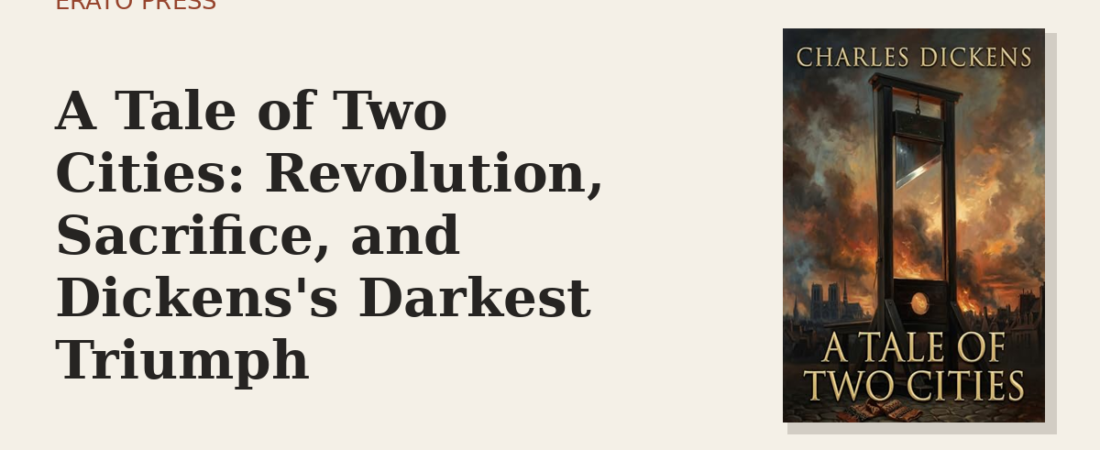
“It was the best of times, it was the worst of times.” Everyone knows the opening, and almost no one finishes the sentence, which runs on for another two hundred words, piling antithesis on antithesis until the age it describes collapses into the age we are reading in: “the period was so far like the present period.” That is the secret architecture of A Tale of Two Cities hiding in plain sight. Dickens is not writing a costume drama about a foreign revolution sixty years gone. He is writing about recurrence — about how the machinery of injustice and the machinery of vengeance are built from the same parts, and how a single human being might step into that machinery and stop it, at the cost of his own life.

It is the strangest of his major novels, and the one most unlike the others. There is almost no comedy, which for Dickens is like a river running without water. The cast is small, the plot is wound tight as a watch spring, and the famous Dickensian abundance — the crowd of eccentrics, the digressions, the comic set pieces — has been deliberately starved away. What remains is concentrated, and the concentration is the point. This belongs to the late phase of his career, the period of Great Expectations and Our Mutual Friend, when Dickens stripped down his method toward a spare, searching engagement with the darkest things he knew. A Tale of Two Cities is the purest experiment in that mode: Dickens working almost entirely in plot, refusing his own greatest gift in order to find out what else he could do.
A revolution that is a crime and a verdict at once
Dickens read Carlyle’s The French Revolution obsessively — he claimed to have read it five hundred times — and the novel breathes its fevered atmosphere. But Dickens is doing something more careful than borrowing thunder. He refuses to let the reader settle into either of the easy positions on the Revolution. The aristocracy he depicts is genuinely monstrous: the Marquis St. Evrémonde runs down a peasant child with his carriage and tosses a coin from the window as compensation, annoyed chiefly at the inconvenience. The Evrémonde brothers have raped and killed and walled up the evidence with the cold confidence of men who will never be called to account. When Dr. Manette’s buried testimony surfaces, the case against the old order is overwhelming.
And then Dickens turns the lens. The Revolution that answers these crimes becomes a crime of its own, a thing with its own appetite. Madame Defarge, knitting the names of the doomed into her register, is the great figure here: a woman with a real and unanswerable grievance — she is the surviving sister of the family the Evrémondes destroyed — who has let that grievance harden into something inhuman. By the end she wants to guillotine not only Charles Darnay but his wife and his child, to extinguish the bloodline entirely. The wrong done to her was monstrous; what she has become is also monstrous. Dickens will not let us choose. The grindstone in the courtyard, turned by men whetting their weapons until the stone runs red, is his image for a justice that has become indistinguishable from the thing it set out to punish.
The tightest plot Dickens ever built
Dickens was the supreme improviser of the Victorian novel, composing in monthly numbers, letting his serial sprawl breathe and double back. A Tale of Two Cities is the great exception. Here nothing is wasted, and almost nothing is what it first appears. The shoemaker’s bench in the garret of Saint Antoine, the patch of road where the mender works, the wine-cask that breaks and stains the street red before a single drop of blood is spilled, the knitting that seems an idle woman’s pastime — every one of these is a charge laid early and detonated late. The plot is a single mechanism in which a buried letter written in a Bastille cell condemns, two decades later, the very man who married into the family that the letter’s author loved.
The novel’s defining structural device is the double, announced in the title and worked out through every layer. Two cities, London and Paris, bound by the Channel and by a traffic in lives. Two prisoners restored to the world: Dr. Manette, “recalled to life” from the living death of the Bastille. And above all two men with the same face — Charles Darnay, the renouncing aristocrat, and Sydney Carton, the wasted English lawyer — whose physical resemblance is the hinge on which the entire ending turns. Dickens has been criticized for relying on coincidence, and the criticism is not wrong. But here the coincidence is not lazy; it is thematic. In a novel about how the sins of one generation are visited on another, about how nobody escapes the chain of consequence, the doubling is the argument. Identity itself is shown to be exchangeable, and that exchangeability is what makes redemption possible.
Sydney Carton and the redemption Dickens needed
Carton is the reason the book endures, and he is one of the most quietly devastating characters Dickens ever drew. He is introduced as a ruin: brilliant, idle, drunk, contemptuous of himself, “a man who had given up the race of life and let it run him down.” He does the legal work for which a handsomer man takes the credit. He loves Lucie Manette and knows he is unworthy of her, and tells her so, asking nothing, promising only that he would “embrace any sacrifice for you and for those dear to you.” The line is planted like everything else in this book, and like everything else it goes off.
When Darnay is condemned by the very testimony of the man whose daughter he married, Carton walks into the prison, drugs his double, exchanges clothes and identity, and goes to the guillotine in his place. The exchange is the literal cashing-in of the doubling that has run through the novel; the ruined man and the worthy man become, for one transaction, the same person, and the ruined one redeems them both. Dickens gives him a final, unspoken meditation on the scaffold, ending in the most famous closing sentence in English fiction: “It is a far, far better thing that I do, than I have ever done; it is a far, far better rest that I go to than I have ever known.” This is Dickens’s deepest conviction in its starkest form — that the response of the heart to another’s suffering is not sentiment but knowledge, and that the truest act of moral life is to extend to another the recognition of a full human worth. Carton, who could never make his own life count, makes his death count absolutely.
Sentiment, and why it is not a flaw here
The charge against Dickens, leveled from F.R. Leavis on down, was always sentimentality — the manipulation of feeling for its own sake. Carton’s sacrifice invites exactly that suspicion, and a cynical reader can roll his eyes at the dying nobility of it all. But notice what Dickens has built around the feeling. The sacrifice is not a sudden burst of virtue; it is prepared by hundreds of pages of self-loathing and small failure, so that when Carton finally acts, the act is recognizable as the one true thing a wasted man manages in a wasted life. The feeling is earned, structurally, by the plot’s relentless logic. Dickens insisted his whole career that sympathy was a cognitive act, that to feel another’s suffering was to know something true about the world. A Tale of Two Cities stakes everything on that proposition, and the bet is what makes the ending land rather than cloy.
Frequently asked questions
Is A Tale of Two Cities a good place to start with Dickens?
It is the most accessible of the major novels because it is the shortest and the most tightly plotted — you will not lose the thread across a thousand pages. But it is also atypical, almost humorless, and a reader who begins here may be surprised by the comic abundance of David Copperfield or Bleak House. Think of it as the lean, intense entry point, with the larger world of Dickens still ahead.
How accurate is the history?
Dickens drew heavily on Carlyle’s The French Revolution and on firsthand accounts, and the broad arc — the storming of the Bastille, the September Massacres, the Terror, the Revolutionary Tribunal — is faithful to the record. The Defarges and the Evrémondes are inventions, but the conditions that produced both the rage of Saint Antoine and the bloodthirst of the Tribunal are rendered with real historical force.
Why does Carton sacrifice himself?
Partly love for Lucie, partly the longing of a self-condemned man to redeem a life he believes worthless. Dickens makes the motive double, like everything else in the book. Carton dies so that the woman he loves can keep her husband and her happiness, and in doing so he finally becomes, for one decisive moment, the man he always had it in him to be.
This is a novel that gains immeasurably from an edition that traces its sources, untangles its clockwork of buried letters and doubled identities, and situates it within the late, concentrated phase of Dickens’s art. The Erato Press text gives you the novel and the apparatus together, so that the antitheses of that famous opening resolve, by the last page, into something whole.
Read the Erato Press edition →
and let Carton’s last walk to the scaffold do its work on you undiminished.Enjoyed this piece?
Get the next one — our essays on the classics and news of each new Erato Press edition — straight to your inbox.