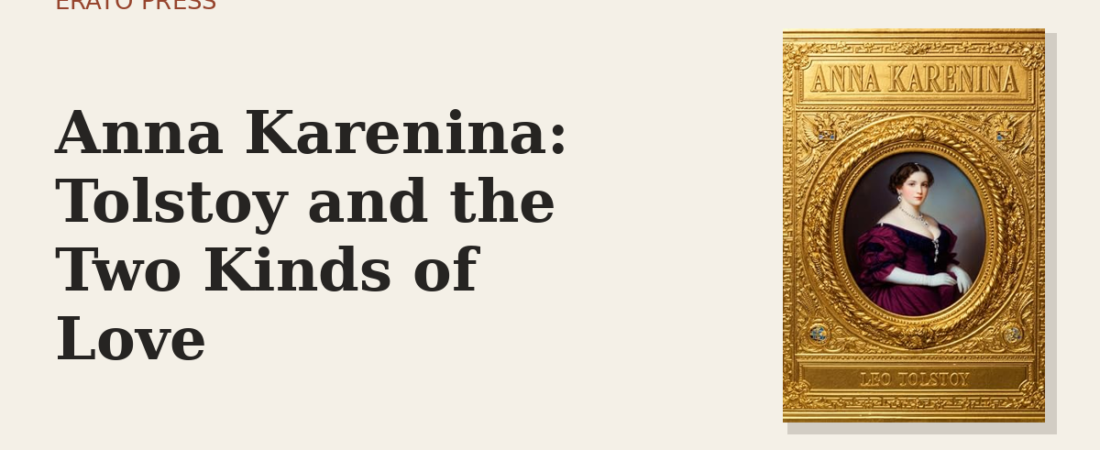
Tolstoy put the verdict at the front of the book, before a word of the story: “Vengeance is mine; I will repay.” It is God speaking, and for a century and a half readers have argued about what Tolstoy meant. A warning that Anna will be punished for her adultery? A rebuke to the society that punishes her? A caution that judgment belongs to God alone? The greatness of Anna Karenina (1877) is that it refuses to decide, and spends nine hundred pages making sure we cannot decide either. It is the most balanced of tragic novels because its author, who set out to write a cautionary tale about a fallen woman, fell in love with her instead, and could not bring himself to close the case.

Two novels in one binding
Anna Karenina is not one novel but two, braided together. There is Anna’s story — the married Petersburg beauty who leaves husband and son for the officer Vronsky and is destroyed by the collision of her passion with the society that will tolerate the affair only while it stays hidden. And there is Levin’s story — the awkward landowner who farms, marries, has a child, and wrestles endlessly with how a thinking person can bear to live at all. The two plots barely touch; Anna and Levin meet once. But Tolstoy built the book so they would comment on each other on every page: Anna seeks happiness in passion and finds annihilation; Levin seeks it in work and faith and finds something like peace. It is a vast controlled experiment in two ways of being alive, and it feels less like a story than like life observed from a height no other novelist reached. For newcomers to the Russians, our guide to where to begin places this double vision at the heart of what makes the Russian novel unique.
The most alive woman in fiction
Anna is often called the most fully realized woman in the European novel, and the claim survives the book. Tolstoy renders her not through abstract psychology but through the physical — the light step, the black curls that will not stay pinned, the almost frightening vitality that draws every eye at the ball where she takes Vronsky from Kitty without meaning to. He gives her every fault and withholds every excuse — she abandons her son, she is destroyed as much by her own jealous imagination as by any social machine — and still we cannot look away, still we grieve. That is the moral education the novel performs: it makes condemnation impossible not by arguing against it but by making Anna too human to condemn.
Levin, and the question the novel cannot stop asking
If Anna is the book’s heart, Levin is its restless conscience — and transparently Tolstoy himself, down to proposing to Kitty by chalking the first letters of words, exactly as Tolstoy proposed to his wife. Levin is happy and cannot understand why happiness does not answer the question that torments him: if we all die and the universe is indifferent, what is the point? He contemplates suicide at the height of his contentment, and the novel’s final movement is his unstable arrival at an answer — not a doctrine but a way of living. It is the honesty that puts Tolstoy beside his own War and Peace and against his great rival Dostoevsky: the refusal of a tidy answer to the only question that matters.
Why read it now
Because no other novel gives you so much of life at once, and gives it so evenly — the ballrooms and the mowing fields, the marriages and the deathbeds, the whole society and the single soul. It rewards slow reading and a good text; the classic Constance Garnett translation, lightly modernized, carries Tolstoy’s plainness into English better than the flashier versions. Read it for Anna, stay for Levin, and notice on the last page that you can no longer say which of them the book was about.
Frequently asked questions
Is Anna Karenina hard to read?
Less than its size suggests. Tolstoy’s prose is famously clear, and the story moves. The one real demand is the Russian names; a good edition with a character list solves that in an afternoon, after which it reads as swiftly as any nineteenth-century novel.
Which should I read first, this or War and Peace?
Anna Karenina is the more focused and accessible entry; War and Peace is the larger world. Either is a magnificent beginning to Tolstoy.
Is Anna a villain or a victim?
Neither, and that is the point. Tolstoy gives her real faults and real sympathy, and refuses to let the reader settle into judgment. The epigraph about vengeance hangs over the whole book precisely to unsettle our verdict.
Read the Erato Press edition →
and decide for yourself who deserves the vengeance, and who the mercy.
Enjoyed this piece?
Get the next one — our essays on the classics and news of each new Erato Press edition — straight to your inbox.