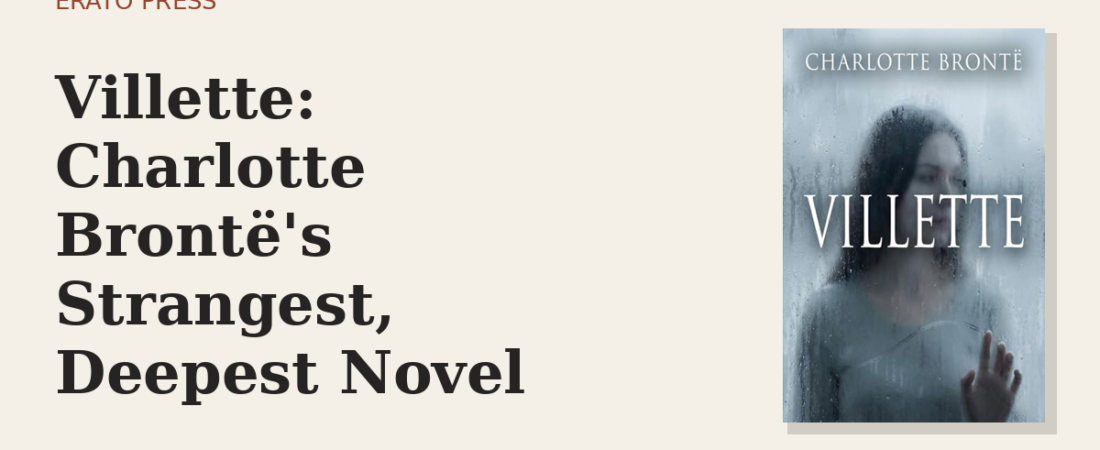
Charlotte Brontë’s last and, many now believe, greatest novel is also her strangest. Villette (1853) is narrated by Lucy Snowe, a poor, plain, friendless Englishwoman who takes a teaching post at a girls’ school in a foreign city — and who tells us her story while systematically hiding from us the very things she feels most. She withholds crucial facts, conceals her own heart even from the reader, narrates her deepest crises in the third person or not at all. It is a bold, disorienting, deeply modern performance — a novel about loneliness so profound that its narrator cannot fully speak it — and beneath the reticence it contains some of the most intense writing about isolation, longing, and mental suffering in the language.

The unreliable heart
Lucy Snowe is one of the most original narrators in Victorian fiction precisely because she does not want to be known. She watches everyone, records everything, and reveals herself almost never; she is cold on the surface (“snowe”) and volcanic underneath, and the gap between the two is the novel’s real drama. She will describe a shattering event and then refuse to tell us how she felt; she keeps a secret from the reader for hundreds of pages about a character we should have recognized at once. Brontë, drawing on her own lonely months as a teacher in Brussels and her unrequited love for a married schoolmaster there, created in Lucy a study of the self-protective reticence that extreme loneliness breeds — the way a person too often disappointed learns to hide her hopes even from herself. It anticipates the psychological complexity of the modern novel by half a century.
The long dark night
At the novel’s center is one of the most powerful accounts of mental anguish in nineteenth-century literature: the long vacation when the school empties and Lucy is left utterly alone, her isolation deepening into something like breakdown, until in her desperation she — a Protestant — enters a Catholic church and confesses to a priest, simply to speak to another human being. The passage is harrowing and unforgettable, and it comes from the deepest place in Brontë’s own experience of solitude and depression. She was writing after the deaths of all her siblings, alone with her aging father, and the loneliness of Villette is not a literary device but a wound. It gives the book an emotional authority that her more famous Jane Eyre — for all its power — does not quite reach.
The refusal of the happy ending
And Brontë ends the novel with a final act of daring. Lucy at last finds love — with the irascible, tender professor Paul Emanuel — and Brontë, who knew what her readers wanted, refuses to give it to them cleanly. The famous last pages leave the lovers’ fate deliberately, tormentingly ambiguous, the storm at sea suspended over the ending so that hope and grief are held forever in balance. Brontë’s father begged her for a happy ending; she compromised only by making the ambiguity possible to read either way, and left the reader to choose between consolation and truth. It is one of the boldest closes in Victorian fiction, and it seals Villette as the work of a writer who had stopped trying to please and was writing, at last, exactly what she knew.
Why read it now
Because it is the deepest study of loneliness in Victorian fiction and a startlingly modern experiment in the unreliable, self-concealing narrator — a book that trusts the reader to feel what its heroine cannot say. Harder and stranger than Jane Eyre, it is the Brontë novel that most rewards a mature reader, and the one its author poured most of her own suffering soul into.
Frequently asked questions
Is Villette harder than Jane Eyre?
Yes — its narrator deliberately conceals her feelings and even withholds facts from the reader, and its structure is less straightforward. But that difficulty is its greatness; many critics now consider it Brontë’s finest and most psychologically profound work.
How autobiographical is it?
Deeply. Brontë drew on her own isolating experience as a teacher in Brussels and her unreciprocated love for a married professor there. The novel’s loneliness comes straight from her life, written after the deaths of all her siblings.
What happens at the end?
Brontë leaves the lovers’ fate deliberately ambiguous — a storm at sea suspended over the final pages — refusing her readers a clean happy ending and letting them choose between hope and grief. It is one of the boldest endings in Victorian fiction.
Read the Erato Press edition →
and meet the narrator who tells you everything except what she feels.
Enjoyed this piece?
Get the next one — our essays on the classics and news of each new Erato Press edition — straight to your inbox.