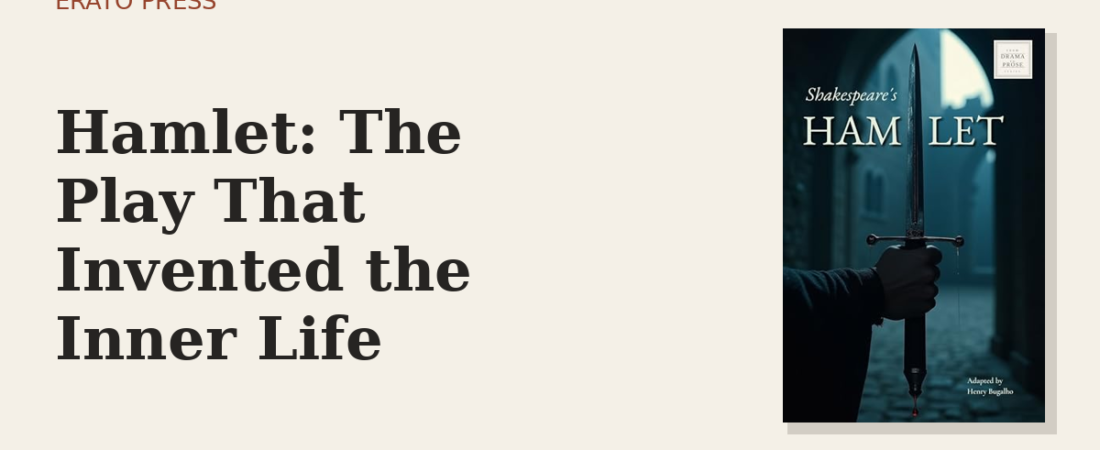
The plot is a simple revenge story: a prince learns from his father’s ghost that his uncle murdered the king and married the queen, and is charged to avenge it. In any other Elizabethan play the prince kills the villain in five acts and the blood is mopped up. Shakespeare’s Hamlet (c. 1600) does something no play had done: it makes the hero not act — makes him think, doubt, delay, turn his mind over and over upon itself for four acts — and in that delay it opens up the interior of a human being to a depth that had never been shown on a stage, or perhaps anywhere. It is the most discussed work in the language, and the reason is simple: in Hamlet, Western literature learned to represent the full, contradictory, self-aware inner life. Some scholars go further and say that the modern self, the deeply interior consciousness we take for granted, was in part invented here.

The mystery of the delay
Why does Hamlet not act? The question has generated more commentary than any other in literature, and the play refuses to settle it — which is the point. Is he too thoughtful, paralyzed by a philosophical mind that sees every side? Too moral, unwilling to become a murderer even for justice? Too melancholy, sick with grief and disgust at a world he calls “an unweeded garden”? Is he mad, or feigning madness, or both? Shakespeare gives evidence for every reading and confirms none, because Hamlet is not a puzzle with a solution but a person with the full opacity of a person — and the delay is the space in which his consciousness unfolds. We know Hamlet’s mind more intimately than we know almost anyone’s, our own included, and still we cannot fully explain him. That is Shakespeare’s revolution: a character with genuine inner depth, irreducible to a motive.
The soliloquies
The instrument of that revolution is the soliloquy, and Hamlet’s are the greatest ever written. “To be, or not to be” is only the most famous of a series of speeches in which a mind thinks aloud — argues with itself, catches itself, doubts its own doubts, contemplates suicide and action and the unknown country of death. In these speeches the audience is admitted not to a character’s plans but to the very movement of his consciousness, the thought forming and dissolving in real time. Nothing like this interiority existed in drama before; it is the foundation of every later attempt, in the novel and the theatre, to render a mind from within, the distant ancestor of the stream of consciousness our essays on the modernists take up three centuries later.
A world out of joint
Around Hamlet’s inwardness turns a whole dark world: the rotten court of Elsinore, the spying and corruption, the grief that curdles into disgust with life and with women, the great questions of death that the graveyard scene, skull in hand, makes unbearably concrete. “The time is out of joint,” Hamlet says; “O cursed spite, that ever I was born to set it right.” It is the cry of the modern individual burdened with a task too large, in a world whose corruption he sees too clearly to act cleanly within it. The tragedy is not that he fails to kill his uncle — he does, at last — but that thought and action, conscience and deed, cannot be reconciled, and the reconciliation costs nearly every life on the stage.
Why read it now
Because it is the deepest portrait of a thinking, doubting, self-divided human being in our literature, and because Hamlet’s condition — seeing too much to act, burdened with a world he did not break and cannot mend — is the permanent condition of the reflective mind. Read it slowly, aloud where you can; it is the summit of what language has done with the inner life.
Frequently asked questions
Is Hamlet hard to read?
The Elizabethan English takes adjustment, but a good annotated edition glosses the difficulties, and the play’s psychological drama is immediate once the language opens up. Reading it aloud, or alongside a performance, helps enormously.
Why does Hamlet delay?
Shakespeare deliberately leaves it unresolved — too thoughtful, too moral, too grief-sick, too uncertain of the ghost. The unanswerable question is the play’s genius: Hamlet has the irreducible depth of a real person, not the transparency of a plot device.
Is it the greatest work in English?
Many would say so. It is certainly the most influential and most analyzed, credited with deepening the very idea of dramatic character and, some argue, with helping to shape the modern sense of an interior self.
Read the Erato Press edition →
and enter the most fully imagined mind in literature.
Enjoyed this piece?
Get the next one — our essays on the classics and news of each new Erato Press edition — straight to your inbox.