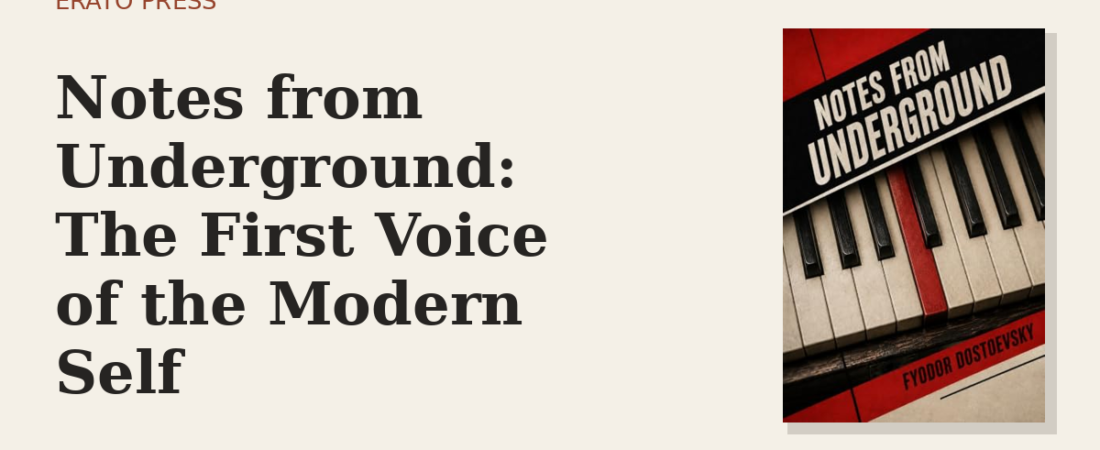
“I am a sick man.… I am a spiteful man. I am an unattractive man.” With those opening lines, published in 1864, Dostoevsky gave literature a voice it had never heard before — the voice of the modern anti-hero, spiteful, self-lacerating, brilliant, and paralyzed — and launched a hundred years of fiction about the divided, alienated self. Notes from Underground is short, savage, and foundational: a monologue by a nameless retired civil servant who has withdrawn from life into a “mouse-hole” of resentment and endless self-analysis, and who dismantles, from below, the comfortable nineteenth-century faith that reason and progress would make human beings happy and good. It is the seed from which existentialism, and much of modern literature, grew.

The revolt against reason
The Underground Man’s first target is the confident rationalism of his age — the belief, then fashionable, that once people understood their true interests they would naturally act well, and society could be engineered into a utopia (Dostoevsky had in mind the socialist rationalists of his day, and their “Crystal Palace” of perfect order). Nonsense, says the Underground Man. Human beings do not want what is good for them; they want, above all, to be free — free even to act against their own interest, to choose suffering, to smash the rational utopia out of sheer spite, simply to prove they are men and not piano keys played by the laws of nature. “Twice two makes four is an excellent thing,” he sneers, “but twice two makes five is sometimes a very charming thing too.” It is one of the most influential arguments in modern thought: that the human craving for freedom is deeper, and darker, than reason — and cannot be organized away.
The sickness of consciousness
But the Underground Man is no hero of freedom; he is its casualty. His hyper-developed consciousness, his endless awareness of his own motives and their baseness, has made him incapable of action, of love, of life. In the second half of the book he tells a story from his past — an encounter with a young prostitute, Liza, who offers him the one chance of real human connection, which he cruelly, compulsively destroys, because he cannot bear to be loved, because his self-contempt needs to poison everything. Dostoevsky’s terrifying insight is that too much self-awareness can be a disease, that the modern man who sees through everything, including himself, may see his way straight into paralysis and cruelty. The Underground Man is the first fully modern character: the alienated intellectual at war with himself.
The book that starts the modern age
Everything that would define twentieth-century literature — alienation, the unreliable narrator, the anti-hero, the interior monologue of a mind at war with itself — begins here. Nietzsche admired it; the existentialists claimed it; Kafka and the modern novel of consciousness descend from it. It is the compact, ferocious overture to the great novels our guide to Dostoevsky maps — the place where he first sounded the themes of freedom, suffering, and the perverse depths of the human will that The Brothers Karamazov would raise to their full tragic height.
Why read it now
Because it is the founding document of the modern self — the first and still the most piercing portrait of the alienated, over-conscious, self-sabotaging person that a century of literature, and a great deal of contemporary life, would come to recognize in the mirror. At barely a hundred pages, it is the fastest way into the mind of the writer who understood the modern condition before it had a name.
Frequently asked questions
Is Notes from Underground a novel?
It is a short novel or long novella in two parts — a philosophical monologue followed by a narrated episode. The unusual form is deliberate: the abstract rant of the first half is tested against the human failure of the second.
Is it a good first Dostoevsky?
It is the shortest way in, and it introduces all his great themes, but its narrator is deliberately repellent and its argument dense. Many readers start with Crime and Punishment and come to Notes once they trust him. Read as an overture, it is electrifying.
Why is it called the first existentialist work?
Because it insists that human freedom and the search for meaning run deeper than reason, that people will choose suffering over a rational happiness imposed on them — themes the twentieth-century existentialists would make central. Sartre and Camus stand in its shadow.
Read the Erato Press edition →
and hear the first voice of the modern self.
Enjoyed this piece?
Get the next one — our essays on the classics and news of each new Erato Press edition — straight to your inbox.