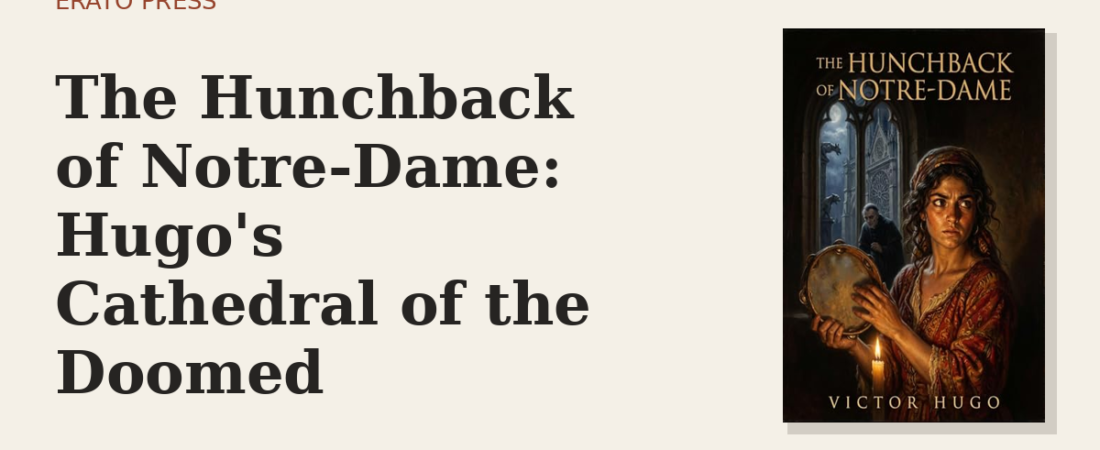
Forget the cheerful cartoon. Victor Hugo’s The Hunchback of Notre-Dame (1831) — its French title, Notre-Dame de Paris, names its true protagonist — is a dark, sprawling, magnificent tragedy set in the teeming medieval Paris of 1482, in which desire destroys nearly everyone and the great cathedral broods over the wreckage like fate itself. It made Hugo famous, saved the actual cathedral from demolition by reawakening France to its Gothic heritage, and remains one of the most powerful of Romantic novels: a story of the beautiful gypsy Esmeralda, the deformed bell-ringer Quasimodo who loves her, the tormented priest Frollo who lusts for her, and the vast indifferent city and church that grind them all to dust.

Beauty, deformity, and the cruelty of desire
Hugo builds his tragedy on a brutal geometry of desire. Everyone loves Esmeralda, and each love destroys. Frollo, the archdeacon, is consumed by a lust his vows forbid, and his self-hatred curdles into a determination to possess or destroy her — one of literature’s great studies of repression turned murderous. Quasimodo, the hunchback whose monstrous body hides a tender soul, loves her with pure devotion and can only watch her doom. The handsome, worthless soldier Phoebus, whom she loves, cares nothing for her. And Esmeralda herself, kind and innocent, is crushed between them, condemned by a society that sees only her beauty and her outsider blood. Hugo’s Romantic conviction — that the beautiful and the grotesque are intertwined, that the monster may be nobler than the priest — drives the whole tragic machine.
The cathedral as hero
The novel’s true center is not a person but a building. Hugo devotes long, rhapsodic chapters to Notre-Dame itself and to the medieval Paris around it, because his deepest subject is the Gothic — the vanishing world of stone and craft that the modern age was letting rot. Quasimodo is bound to the cathedral as to a mother; the building shelters, imprisons, and finally cannot save the doomed. Hugo’s passionate defense of Gothic architecture, embedded in the melodrama, had a real historical effect: the novel’s success shamed France into restoring Notre-Dame, so that Hugo’s book quite literally saved the cathedral that would still be standing, and burning, and rebuilding, two centuries later. The romance of Les Misérables would come thirty years later, but the vast social vision and the fusion of melodrama with moral grandeur are already here.
Romantic tragedy at full volume
This is Romanticism at its most uncompromising: huge emotions, grotesque contrasts, a plot that spirals toward almost universal destruction, and a refusal of the consoling ending. The famous final image — Quasimodo’s skeleton found years later in the charnel house, embracing Esmeralda’s, crumbling to dust when touched — is as bleak and as beautiful as anything in nineteenth-century fiction. Hugo is not interested in the small realism of the drawing room; he wants the cathedral, the mob, the plague of desire, the sweep of history, all at maximum intensity. Given wholly to its spirit, the novel overwhelms.
Why read it now
Because it is Romantic tragedy at its grandest, a story of desire and doom staged against one of the great buildings of the world — and because, since the 2019 fire, Hugo’s passionate love-letter to Notre-Dame reads with fresh urgency. Sprawling, digressive, and unforgettable, it gives the reader the whole teeming medieval world and a tragedy that does not flinch.
Frequently asked questions
How different is it from the Disney film?
Almost entirely. The novel is a dark tragedy in which most of the principals die, Frollo is a far more disturbing figure, and there is no happy ending. The cartoon keeps the setting and a few names and little else.
Why is the cathedral so important?
Hugo made Notre-Dame the true subject of the book, and his rhapsodic defense of Gothic architecture helped spark the real-life restoration of the then-decaying cathedral. The building is character, symbol, and cause at once.
Is it hard to read?
The long digressions on architecture and history can slow the first-time reader; the central story is vivid and gripping. Skim the essays if you wish on a first pass — the tragedy needs no help holding you.
Read the Erato Press edition →
and enter the cathedral that broods over them all.
Enjoyed this piece?
Get the next one — our essays on the classics and news of each new Erato Press edition — straight to your inbox.