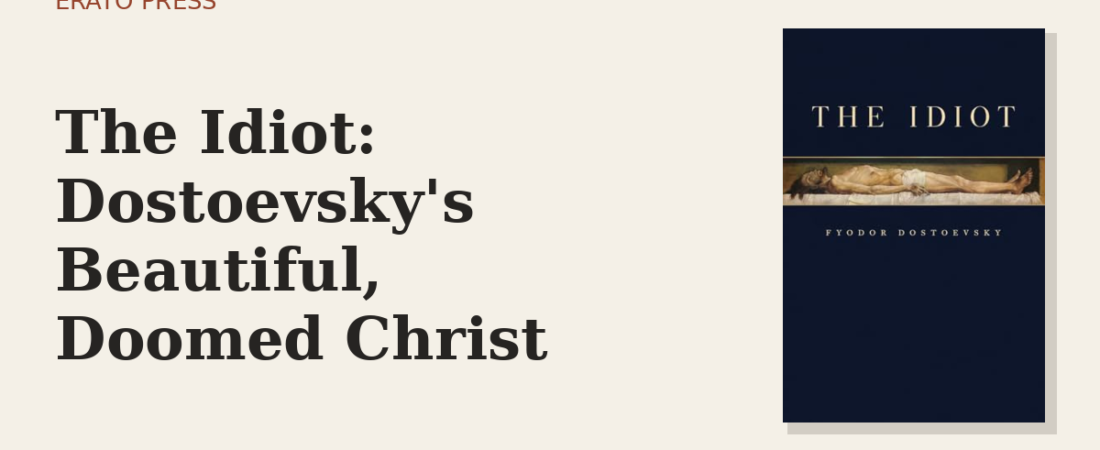
Dostoevsky set himself, in The Idiot, the most dangerous task a novelist can attempt: to portray “a positively beautiful human being” — a person of complete goodness — and to do it without making him ridiculous or dull. He knew the difficulty. “There is only one positively beautiful figure in the world,” he wrote, “Christ,” and to attempt another was almost blasphemy. The result is one of the strangest and most moving of his novels: the story of Prince Myshkin, an epileptic of childlike purity who returns to the poisonous society of Petersburg and is destroyed by the very innocence that makes him holy. It is a book that asks a question our world still cannot answer: what actually happens to genuine goodness when it is set loose among us?

The holy fool among the wolves
Myshkin is Dostoevsky’s “idiot” — a word that in the Russia of the time carried the older sense of the holy fool, the simpleton whose foolishness is a kind of sanctity. He is honest when honesty is catastrophic, forgiving when forgiveness is taken for weakness, incapable of the calculation and vanity that the people around him breathe like air. And precisely because he cannot lie or scheme, he becomes a mirror in which everyone else sees themselves exposed — and they cannot bear it. The society of the novel, with its money-lust and wounded pride and cruelty dressed as wit, does not know what to do with a man who is simply good, and its confusion curdles into destruction. Dostoevsky’s terrible suggestion is that the world is not merely indifferent to goodness but actively unable to tolerate it.
Two women and the impossibility of love
At the heart of the novel are two women who love Myshkin and whom he cannot save: Nastasya Filippovna, a “fallen” woman of shattering beauty and self-lacerating pride, ruined by an early betrayal and bent on her own destruction; and Aglaya, the proud young girl who offers him an ordinary happiness he cannot quite take. Myshkin loves them both — one with pity, one with hope — and his very inability to choose, his boundless compassion that cannot narrow into a single human commitment, becomes the engine of tragedy. Dostoevsky is asking whether Christ-like love, which excludes no one, can survive in a world built on the exclusive bonds of romance and possession. The answer, arriving in one of the most harrowing final scenes he ever wrote, is no.
The novel that argues with itself
The Idiot is less controlled than The Brothers Karamazov, more feverish, built out of scandalous scenes that erupt and collapse — and its very unruliness is part of its power. Dostoevsky wrote it in exile, in debt, in grief, gambling away his advances, and the book has the intensity of a man writing to save his soul. It contains his most direct meditation on the death of Christ (before a copy of Holbein’s brutal painting of the dead Christ, a character says the picture could make a man lose his faith) and his deepest doubt about whether goodness can redeem a fallen world. To read it beside his other novels — the ground our guide to where to begin with Dostoevsky maps — is to watch the greatest of the religious novelists stake everything on a wager he suspects he will lose.
Why read it now
Because it is the most searching portrait in literature of what our world does to the genuinely good, and because Myshkin — trusting, transparent, incapable of self-protection — is a figure our age of cynicism needs to be disturbed by. It is not Dostoevsky’s most perfect novel, but it may be his most tender and his most haunting, and its final image is one no reader forgets.
Frequently asked questions
Why is the prince called “the idiot”?
The title plays on the double meaning: Myshkin is thought simple and naïve by a worldly society, but the word also evokes the Russian tradition of the holy fool, whose apparent foolishness is spiritual clarity. The “idiot” is the only sane man in the book.
Is it a good first Dostoevsky?
Crime and Punishment is the more accessible entry, and The Brothers Karamazov the summit. The Idiot rewards readers who already love him; its feverish structure and religious depth land hardest once you know his world.
What is the Holbein painting about?
Hans Holbein’s The Body of the Dead Christ in the Tomb, which Dostoevsky saw and was shaken by, depicts Christ’s corpse with unsparing realism, with no hint of coming resurrection. In the novel it becomes the emblem of the doubt the whole book wrestles with: whether death and evil have the last word.
Read the Erato Press edition →
and meet the good man the world could not survive.
Enjoyed this piece?
Get the next one — our essays on the classics and news of each new Erato Press edition — straight to your inbox.