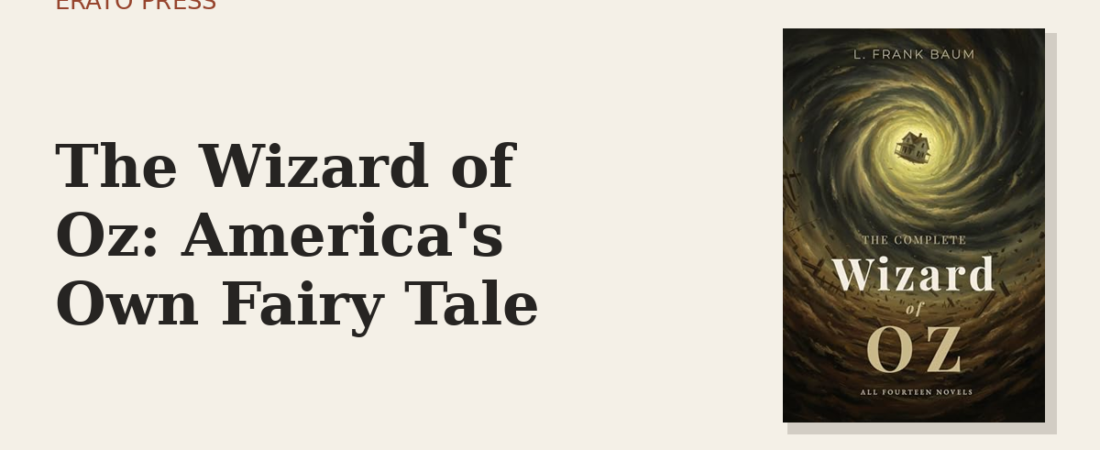
In the introduction to The Wonderful Wizard of Oz, written in 1900, L. Frank Baum made a quiet declaration of independence. The old fairy tales, he wrote, with their “fearsome moral” and their genies and dwarfs and witches, had done their work and could now be classed as “historical.” What America wanted was “a series of newer ‘wonder tales’” that kept the wonder but threw out the heartaches and nightmares. He was, in effect, proposing to invent a national fairy tale from scratch — one without the inherited European machinery of curses and severed heels and children roasted in ovens. That ambition is the most interesting thing about the book, more interesting than any allegory readers have since strapped to it, and it is worth taking Baum at his word before taking him apart.

Whether he fully succeeded is another matter — there is a beheaded wildcat and a witch who melts, and the body count is higher than the movie ever let on — but the intention shaped everything. Oz is a fairy-tale country with no kings worth the name, a place where authority turns out to be a humbug behind a curtain and where the real power belongs to a barefoot farm girl from the flattest, grayest part of the American interior. That is not how European fairy tales work. It is how an American one might.
A fairy tale grown in Kansas dirt
Look at the first chapter, which almost no adaptation honors. Baum describes the Kansas prairie in prose drained of every color: the sun has baked the plowed land into “a gray mass,” the grass is gray, the house is gray, and Aunt Em, who came as a young wife, has been turned by sun and wind into a woman who is “gray” too, who “never smiled now.” Six times in a few paragraphs the word “gray” tolls. Then the cyclone lifts Dorothy out of all that grayness and drops her into a land so saturated with color that the contrast is the entire emotional engine of the book. Oz is not an escape from a wicked stepmother or a haunted forest. It is an escape from the economic gray of the post-frontier Plains, from drought and mortgage and the slow erasure of a young woman into an old one. The fairy tale is rooted, deliberately, in a recognizable American hardship.
And then comes the famous reversal: Dorothy wants nothing more than to leave the technicolor paradise and go home to the gray. “There is no place like home,” she insists, baffling the friends who cannot imagine why anyone would prefer a bleak prairie to Oz. This is Baum’s deepest and most American move — the refusal of enchantment in favor of the ordinary, the insistence that the dusty real place where your people are beats any wonderland. The European tale usually ends in a palace. This one ends in a farmhouse, and means it.
The Populist reading, handled with care
You cannot discuss this book for long without meeting the famous allegory. In 1964 a high-school teacher named Henry Littlefield published an essay arguing that Oz is a coded parable of the 1890s debate over monetary policy — the Populist fight over whether to back the dollar with silver as well as gold. In this reading the Yellow Brick Road is the gold standard, the silver slippers (silver, not the film’s ruby) are the free-silver remedy, the Scarecrow is the undervalued farmer, the Tin Woodman the dehumanized industrial laborer, the Cowardly Lion the politician William Jennings Bryan, and “Oz” itself the abbreviation for the ounce in which gold and silver are weighed. It is ingenious, and it has been taught as fact in classrooms for two generations.
It should be treated with real skepticism. Littlefield offered the reading as a teaching device, not as a claim about Baum’s intentions, and there is no evidence — not a letter, not a diary entry, not a contemporary remark — that Baum meant any of it. Baum was a sometime newspaperman with shifting politics, and the monetary symbolism that looks so tidy in retrospect was assembled long after his death by readers hungry for hidden meaning. The honest position is that the allegory is a fascinating artifact of how we read, not a key Baum cut. A children’s book can absorb the anxieties of its moment — the agrarian distress, the wizardly confidence men, the longing for a benevolent power that turns out to be a fraud — without being a cryptogram. The grayness of Kansas is real social observation; the Yellow Brick Road is probably just a road that is yellow.
What Baum actually invented
Strip away the allegory and the genuine innovations stand out more clearly. Baum gave America a fairy-tale heroine who is neither a princess nor a passive prize but a practical, kind, slightly bossy child who solves problems — she organizes her companions, she keeps her nerve, she dispatches the Wicked Witch almost by accident while trying to put out a fire. He gave it companions defined by a sly joke: the Scarecrow who fears he has no brains is the one who keeps thinking of plans, the Tin Woodman who longs for a heart is the most tender of them all, the Lion who believes himself a coward keeps charging into danger. Each already possesses the very thing he quests for; the Wizard merely gives them a diploma, a silk heart, a dose of courage-from-a-bottle, and the gifts work because belief, not magic, was always the operative force. That is a remarkably modern, even psychological, fable, smuggled inside a story for children.
It helps to see what Baum was reacting against. The fairy tales he wanted to retire were the ones we now know in their unsoftened forms, and a reader who comes to Oz after the Grimm’s Fairy Tales: The Dark Originals can feel exactly what Baum was sanding down — the mutilations, the vengeance, the casual cruelty meted out as moral instruction. Baum kept the structural bones of the wonder tale, the quest and the helpers and the threshold-crossing, and replaced the inherited grimness with a sunnier, more democratic spirit. The result was less a rejection of the tradition than a transplant of it into new soil, where it grew differently.
The book and the film are not the same thing
One last thing worth insisting on: the 1939 MGM film, beloved as it is, has half-erased the book in the popular mind, and the book is the stranger, richer object. In Baum’s text the slippers are silver. Oz is a real place that Dorothy visits, not a concussion dream — she returns to it again and again across thirteen sequels. There are whole episodes the film could not use: the deadly poppy field, the Queen of the Field Mice, the delicate China Country where the inhabitants shatter, the Hammer-Heads who fling their own skulls. Baum’s Oz is more populous, more peculiar, and more matter-of-fact about violence than the Hollywood version. To read the original is to recover a book that has been hiding behind its own most famous adaptation for nearly a century.
Frequently asked questions
Is The Wizard of Oz really an allegory about money and politics?
Almost certainly not in any way Baum intended. The Populist-monetary reading was constructed by a teacher in 1964 as a classroom exercise and has no support in Baum’s own statements. The book does absorb the mood of 1890s America — agrarian hardship, distrust of hollow authority — but reading it as a deliberate coded tract about the gold standard goes well beyond the evidence.
How is the book different from the famous movie?
Substantially. The slippers are silver, not ruby; Oz is a genuine magical land rather than a dream; and the novel includes many episodes the film dropped, along with a higher and franker degree of peril. Baum also wrote thirteen sequels, building Oz into a whole imagined country with its own geography and recurring characters.
Why does Dorothy want to leave Oz?
This is Baum’s central, and very American, irony. Oz is everything Kansas is not — colorful, magical, kind to her — and Dorothy spends the whole book trying to get back to the gray prairie because it is home and her family is there. The refusal of enchantment in favor of the ordinary is the book’s emotional core and its quiet moral.
The original Wonderful Wizard of Oz deserves to be read as the deliberate, ambitious, slightly subversive piece of literary invention it was, not as a vague memory of a film or a decoder ring for forgotten politics. The Erato Press edition restores the full text and frames it with the history of Baum’s project, the Populist debate handled honestly, and the European tradition he set out to replace.
Read the Erato Press edition →
and meet the Kansas farm girl who built America its own fairy tale.Enjoyed this piece?
Get the next one — our essays on the classics and news of each new Erato Press edition — straight to your inbox.