There is a moment in Tess of the d’Urbervilles when the whole machinery of Thomas Hardy’s universe shows itself in a single misplaced object. Tess, unable to confess her past to Angel Clare aloud, writes it all down, seals it, and slips the letter under his door in the dark. For days she watches him for a change that never comes, and concludes he has read and forgiven. Then she lifts the edge of the carpet and finds her confession still sealed, thrust by accident not only beneath the door but beneath the carpet too, where his eye never fell. A scrap of paper, a fold of rug, and a marriage is doomed. No villain arranged it. That is the cruelty Hardy spent his career anatomizing: not malice, but an indifferent universe in which the smallest accident is enough to break a life, and no one is watching to set it right.

Wessex: a real country that never existed
Hardy gave his fiction a kingdom. Wessex — the old Saxon name for the southwest of England, revived by Hardy and stretched across Dorset, Wiltshire, and their neighbors — is a half-invented region with real soil under it: real chalk downs, real dairies, real market towns lightly renamed. Casterbridge is Dorchester; Marlott and Talbothays and Egdon Heath are imagined places rooted in fields Hardy could have walked to. The effect is to give his tragedies the weight of geography. These are not stories that could happen anywhere; they happen here, on land that has carried the same labor for centuries, where a milkmaid’s calendar is set by calving-time and the banns are read in a church that has stood since before her family’s name decayed.
That rootedness matters because Hardy is writing at the exact moment when this world is dying. The railways are reaching the dairies; the old folk-fatalism of the field-folk is colliding with a new mobility that scatters communities and strands individuals. Tess is destroyed partly because she can be moved — sent to claim kin, sent to a strange farm, carried hundreds of miles by a husband who imagines distance will outrun the past. Wessex is the stage on which Hardy watches an ancient way of life break apart, and watches the people inside it pay for the breakage.
Chance, coincidence, and the indifferent sky
Critics have always complained that Hardy leans too hard on coincidence, and they are not wrong about the frequency; they are wrong about the meaning. The letter under the carpet, the chance encounter at the inn where a stranger half-recognizes Tess, the postponed confession that is always deferred by one more interruption — these are not lazy plotting. They are Hardy’s argument made structural. In a Hardy novel the world is governed by accident and not by justice, and the accumulation of unlucky chances is precisely how he forces the reader to feel the absence of a guiding hand.
His characters sense it themselves. Tess, on the eve of her too-smooth wedding, mutters that all her good fortune will be “scourged out of me afterwards by a lot of ill — that’s how Heaven mostly does.” She has absorbed the fatalism of people who live closer to natural phenomena than to other human beings, and the novel proves her right in the bleakest way. The famous closing line of Tess — that the President of the Immortals had ended his sport with her — is often read as Hardy blaming the gods. It is darker than that. The gods, if they exist, are merely amusing themselves; more likely there are no gods at all, only a cosmos that does not notice. Cruelty would at least imply attention. Hardy’s universe withholds even that.
The novels that earned him his exile from fiction
It is worth knowing Hardy across three books, because each turns the screw differently. The Mayor of Casterbridge opens with a man selling his wife and child at a country fair while drunk, then traces the slow, dignified, doomed effort of that man to rebuild a self around the buried act — a study in how a single deed metastasizes through a life. Tess of the d’Urbervilles takes a woman who is, in Hardy’s pointed subtitle, “a pure woman,” and watches society punish her for a wrong done to her. Jude the Obscure follows a working man who longs for learning and is shut out of the university, and a marriage outside the rules that the world will not permit to stand.
These last two cost Hardy his career as a novelist. Tess outraged readers who could not accept his insistence on her innocence; Jude, with its frank treatment of marriage, desire, and one of the most harrowing scenes in English fiction, was reviewed with such venom — one bishop reportedly burned it — that Hardy abandoned the novel form altogether. He had said what the age could not hear about marriage, faith, and the cruelty of the social order, and he had said it too plainly. For the last three decades of his long life he wrote only poetry. The man who built Wessex walked out of it, driven by scandal, and what drove him was telling the truth about how little the universe cares.
Why the cruelty is not cynicism
It would be easy to mistake all this for despair, and miss the tenderness that makes Hardy bearable to read. He is merciless to his characters and tender toward them at once. Tess is rendered with a closeness of attention — her speech, her fears, the ballad her mother sang her about the robe that betrays an unfaithful wife — that amounts to a kind of love. Hardy refuses the consolations of his age: no providence redeems the suffering, no last-act forgiveness arrives. But he insists, against his own bleak cosmology, that the people crushed by chance were worth everything, that their inner lives were vast and real. That double vision — the indifferent sky above, the precious and particular human below — is the source of his strange power. It is also why a reader who comes to him for the plot stays for something harder to name.
Set Hardy beside his great contemporary and the contrast sharpens. George Eliot and Middlemarch: The Greatest English Novel? shows a novelist who also denies easy providence but who finds, in the slow growth of sympathy and the web of ordinary consequence, a moral order of sorts. Hardy offers no such order. Where Eliot’s universe rewards patient goodness with a diminished but real dignity, Hardy’s lets a folded carpet undo a life.
Frequently asked questions
Which Hardy novel should I read first?
Tess of the d’Urbervilles is the natural entry point: it is his most famous, his most emotionally direct, and it contains the clearest statement of everything he believed about chance and injustice. If you want something less harrowing, Far from the Madding Crowd shows his Wessex with more light in it. Save Jude the Obscure for when you trust him, because it is the darkest of all.
Why did Hardy stop writing novels?
The hostile reception of Tess and especially Jude the Obscure in the 1890s — attacks on their treatment of sex, marriage, and religion — exhausted his patience with the censoriousness of the reading public. He turned to poetry, which he had always considered his truer vocation, and produced major verse for the rest of his life.
Is Wessex a real place?
It is a literary region Hardy adapted from the medieval Saxon kingdom and mapped onto the real southwest of England. The landscapes and many of the towns correspond to actual places — Casterbridge is Dorchester — lightly renamed and unified into a coherent fictional country that recurs across his novels.
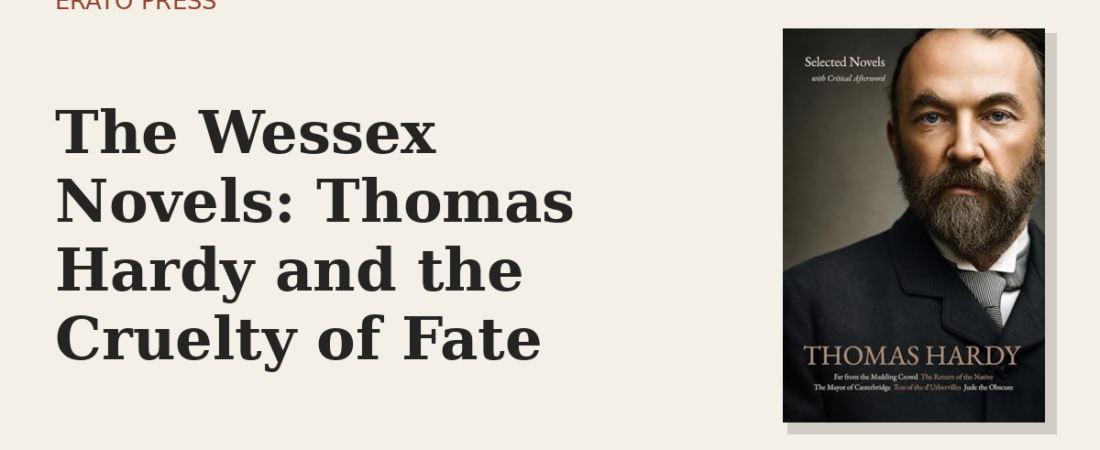
To read Hardy whole is to watch a great writer refuse every comfort his century offered and remain, somehow, on the side of the people his stories destroy. The Erato Press edition presents the Wessex fiction with the context to see what he was building and what it cost him — the geography, the fatalism, and the scandals that turned a novelist into a poet.
Read the Erato Press edition →
Enjoyed this piece?
Get the next one — our essays on the classics and news of each new Erato Press edition — straight to your inbox.