Before the novel was respectable, it was a vagabond. The form we now teach in universities and bind in cloth began its life in the gutter, in the company of thieves, beggars, runaway servants, defrocked friars, and starving students, all of them moving down a dusty road with nothing in their pockets and everything to lose. The European novel was born picaresque, born comic, born on the move, and it is worth remembering that the most ambitious narratives our civilization produced started as low entertainment about people trying not to go hungry. The road is the oldest plot in the world, and the comic road, where a clever survivor lurches from one master to the next and skewers each in turn, is the engine room of fiction itself.

The argument here is simple and, I think, under-appreciated: the comic road novel was not a primitive stage the novel grew out of but the form in which the novel learned its deepest trick, the ability to hold a whole society up to ridicule by walking a single fool or rogue straight through the middle of it. From the anonymous Spanish picaresque to Cervantes and Rabelais, the episodic journey is a satirical X-ray. The traveler is the contrast medium; everything he passes lights up and shows its rot.
What the picaresque actually is
The word comes from the Spanish picaro, the rogue, and the genre takes its shape from Lazarillo de Tormes (1554), the slim, savage, anonymous little book that set the template. A boy of no family attaches himself to a series of masters, a blind beggar, a miserly priest, a starving nobleman too proud to admit he has nothing to eat, and serves each one long enough to expose his particular hypocrisy before moving on. The structure is deliberately loose, a string of episodes rather than a plotted arc, because the point is not where the boy ends up but what he sees along the way. He is low-born, he is hungry, he is amoral by necessity, and that very lowness gives him a clear, cold eye. He cannot afford illusions. The picaro sees society from below, which turns out to be the angle from which its lies are most visible.
This is a profound discovery, and it explains why the form spread across Europe and never really died, surviving into Fielding, into Dickens, into Huckleberry Finn, into the road movie. Put a sharp, dispossessed observer on a journey and you have a machine for satire that runs on its own fuel. Each new episode is a new target. The episodic looseness that earlier critics dismissed as artless is in fact the whole instrument: it lets the writer cover the entire body of society, organ by organ, without the constraints of a single tidy story.
Rabelais and the comedy of excess
If the Spanish picaresque is lean and hungry, the French answer is its opposite: monstrously, gloriously overfed. Francois Rabelais wrote of giants, Gargantua and his son Pantagruel, and the comedy is one of grotesque abundance, of bodies that eat whole herds and drink whole cellars, of language that piles up in catalogues until the list itself becomes a kind of drunken music. Where Lazarillo’s world is defined by scarcity, Rabelais’s is defined by surplus, and yet the satirical purpose is the same. Beneath the slapstick and the obscenity is a learned, ferociously anticlerical mind taking aim at scholastic philosophy, monastic hypocrisy, pedantic education, and every institution that mistook solemnity for wisdom.
Rabelais understood something the comic tradition has never let go of: that laughter is a solvent. The body, with its eating and drinking and excreting, its sheer biological insistence, is the great deflator of pretension. You cannot be pompous and a digestive system at the same time, and Rabelais never lets his targets forget that they have bowels. The reader who treats Gargantua and Pantagruel: Rabelais and the Comedy of Excess as mere bawdy misses the seriousness underneath; the excess is an argument that life, in its full appetite, is on the side of freedom and against the gray authorities who would shrink it. The famous motto of his ideal abbey, the Abbey of Theleme, is “Do what thou wilt,” and the whole vast comic apparatus exists to earn that line.
Don Quixote and the road that turns inward
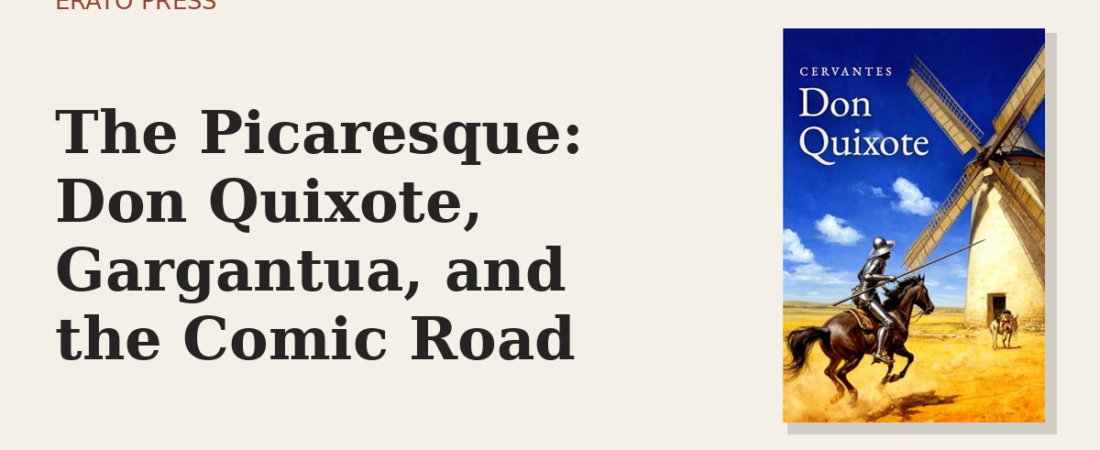
Then comes Cervantes, and the comic road changes forever. Don Quixote (1605, 1615) takes the picaresque structure, the episodic journey, the road, the string of encounters, and does something no one had done before: it makes the traveler not a hungry survivor but a deluded idealist, a country gentleman who has read too many chivalric romances and rides out to revive a world of knights that never existed. The genius of the book is that it keeps the picaresque’s satirical machinery while inverting its hero. The picaro sees society too clearly; Don Quixote does not see it at all. He looks at an inn and sees a castle, at windmills and sees giants, at a peasant girl and sees a princess.
And here the comedy deepens into something almost unbearable. We laugh at the old man’s delusions, and then, slowly, we begin to suspect that his madness is more honorable than the sane world’s cynicism, that a man who insists on chivalry in a debased age is both ridiculous and the only noble thing on the road. Cervantes gives him Sancho Panza, the earthbound peasant whose proverbs and appetites are pure picaresque, and the friction between the dreamer and the realist becomes the first great double act in fiction, the original of every mismatched pair from Holmes and Watson to Vladimir and Estragon. This is why we call it, in our companion essay, Don Quixote: The First Modern Novel: because Cervantes discovered that the road could go inward, that the journey through Spain could become a journey through the gap between how we wish the world were and how it is, and that this gap is where the modern self lives.
Why the comic road outlasts the tragic plot
There is a snobbery, old and persistent, that ranks comedy below tragedy, that treats the laughing book as lighter, less serious, less true. The history of the road novel is the standing refutation of that prejudice. Tragedy tends to narrow toward a single doomed protagonist; comedy, especially the comedy of the road, opens outward to take in a whole society, every class and trade and folly of an age. Don Quixote contains more of human nature than almost any tragedy because the road brings the knight into contact with dukes and innkeepers, galley slaves and goatherds, scholars and barbers, and each encounter is a small anatomy of a type. The episodic form, dismissed as loose, turns out to be capacious.
And the comic road never lets its hero off the hook of the body, the purse, the indignity of being a creature who must eat and sleep and be laughed at. That is its honesty. Tragic heroes die nobly; comic travelers get thrown in a blanket, robbed, beaten, and made fools of, and survive to be made fools of again tomorrow. There is a deep democratic truth in this, the recognition that most lives are not arcs toward catastrophe but long, undignified, resilient journeys through a world that does not take us at our own estimation. The picaresque is the novel form most honest about what it is actually like to be alive: episodic, repetitive, comic, and somehow, against the odds, ongoing.
The road we are still on
Every buddy comedy, every quest where the real subject is the bickering between the travelers, every satire that sends a naif through a corrupt world to expose it, descends from this lineage. When Mark Twain put a boy and a runaway slave on a raft, when Kerouac put two restless men in a car, when a thousand films send a mismatched pair down a highway, they are working the vein that Lazarillo opened and Cervantes made inexhaustible. The comic road is not a museum form. It is the deep structure of how we tell stories about a self moving through a society it can neither fully escape nor fully accept.
To read these founding books is to watch the novel discover its own powers in real time, the power to satirize, to digress, to hold the high and low of life in the same frame and find both of them funny and both of them serious.
Frequently asked questions
Is Don Quixote really a picaresque novel?
Not strictly, and that is the interesting part. It uses the picaresque’s episodic road structure and its satirical sweep, but its hero is the inverse of the classic picaro: an idealist rather than a survivor, deluded rather than clear-eyed. Cervantes was working within the tradition and transforming it at once, which is exactly what made his book the foundation of the modern novel rather than just another rogue’s tale.
Do I need to read these in a particular order?
No, though there is pleasure in chronology. Lazarillo de Tormes is short and shows the bare template; Rabelais and Cervantes both build on that ground in opposite directions, Rabelais toward grotesque abundance and Cervantes toward inward depth. If you read only one, read Don Quixote, but read it knowing the comic road it grew from.
Are these books still funny, or only historically important?
Genuinely funny, in a good edition. Rabelais’s excess still lands, and the central duo of Quixote and Sancho is one of the most enduringly comic pairings ever written. Humor dates faster than tragedy, so some topical jokes need a footnote, but the deep comedy, of delusion meeting reality, of the body deflating the soul’s pretensions, is permanent.
The Erato Press edition of Don Quixote gives you Cervantes’s full two-part masterpiece with a critical apparatus that traces its roots in the Spanish picaresque and shows how the comic road became the highway of the modern novel. It is the ideal way to meet the book that began it all, knight, squire, windmills, and the long dusty road of human folly.
Read the Erato Press edition →
Enjoyed this piece?
Get the next one — our essays on the classics and news of each new Erato Press edition — straight to your inbox.