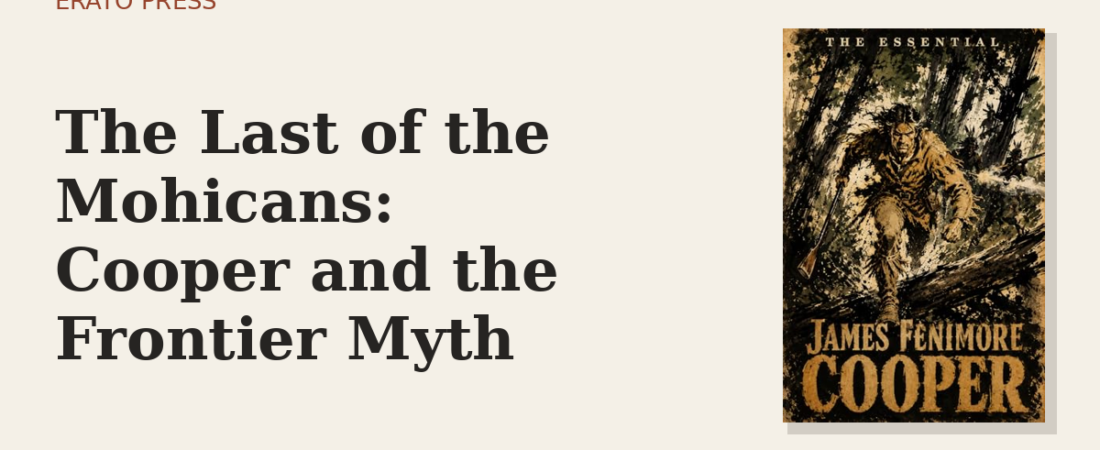
James Fenimore Cooper subtitled The Last of the Mohicans “A Narrative of 1757,” and the date is the first thing worth pausing on. He published the book in 1826, half a century after the Revolution, in a young republic that had already pushed the frontier far west of the forests where his story unfolds. Cooper was not reporting on a living wilderness; he was building a myth about a vanished one, at the precise moment the nation needed such a myth to explain itself. The novel is thrilling, it is foundational to American fiction, and it is also one of the great manufacturing plants of a falsehood the culture told itself for two hundred years: that the disappearance of Native peoples was a kind of natural tragedy, sad and inevitable, with no human author. To read it well today is to be gripped and unconvinced at the same time.

The plot, and the man who walks between worlds
The frame is the French and Indian War, the British and French empires fighting for North America with Native nations drawn in on both sides. Two daughters of a British colonel, Cora and Alice Munro, are being escorted through hostile country to their father at Fort William Henry. Their guide betrays them: Magua, a Huron with his own grievances and his own designs, leads them toward capture. Against him stand a trio that has become permanent furniture in the American imagination — Hawkeye, the white scout raised among Indians; Chingachgook, the Mohican chief; and Uncas, his son, the “last” Mohican of the title. What follows is pursuit, ambush, massacre, and sacrifice across a landscape Cooper renders with real grandeur.
At the center is Hawkeye — Natty Bumppo, the hero Cooper returned to across five novels known as the Leatherstocking Tales. He is the original of a figure American storytelling cannot stop reproducing: the white man who has learned the wilderness from its native inhabitants, who moves between civilization and the frontier and belongs fully to neither, who is more authentically “of the land” than the Native characters are permitted to be. From Hawkeye descends a long line — the frontier scout, the cowboy who knows Indian ways, the white outsider who out-Indians the Indians. The type is seductive, and it is worth seeing clearly, because it quietly performs a substitution: the white hero inherits the wilderness even as the book mourns the people it is taking from.
The “vanishing Indian” and the work the myth does
Cooper’s title announces his central device. To call Uncas the “last” of his people is to file the Mohicans, in the reader’s mind, under already gone — to treat extinction as accomplished and grieve it as one grieves a sunset, beautifully and without responsibility. This is the “vanishing Indian,” one of the most consequential fictions in American culture. It converts a political and military process — dispossession, broken treaties, removal, killing, all carried out by people making choices — into a melancholy law of nature, as if Native nations were simply fading like the forest before the plow, no one to blame.
The Mohicans, of course, did not vanish. Their descendants live today; the Mohican nation persists. Cooper wrote them into the past tense while they were demonstrably present, because the myth of their disappearance was useful: it let a nation built on their land feel sorrow instead of guilt. And Cooper sorts his Native characters into a scheme that exposes the machinery — the noble, doomed, conveniently dying Chingachgook and Uncas on one side, the treacherous, vengeful Magua on the other. Good Indian and bad Indian, both finally serving a story whose real subject is the white inheritance of the continent.
Reading Cooper critically without throwing him out
None of this is reason to stop reading him — it is reason to read him with both eyes open. The Last of the Mohicans is genuinely powerful: the wilderness set-pieces, the relentless pace of the chase, the massacre at Fort William Henry rendered with a horror that still lands. Cooper more or less invented the American adventure novel, and writers from the dime-novelists to the makers of Westerns have been drawing on his template ever since. Mark Twain famously mocked his prose and his improbabilities, and the mockery is funny and partly fair; Cooper’s sentences can be stiff and his coincidences absurd. But the imaginative architecture survived the jokes, because it gave the country a usable past.
The honest way to read it now is as a double document: a rousing romance and a primary source for how nineteenth-century America narrated its own conquest to itself. When you notice Hawkeye repeatedly insisting on his identity as “a man without a cross” — a white man of unmixed blood, even as he claims the wilderness as his birthright — you are watching the myth define its own anxieties. When Cora, the daughter of mixed ancestry, is denied the future the novel grants its purely white characters, you are watching the period’s racial logic written into the plot’s machinery. The book does not hide these things. It simply assumes you will not question them. Two centuries later, the questioning is the most interesting thing a reader can bring.
Why it still belongs on the shelf
A myth this powerful is not dismantled by ignoring it; it is dismantled by understanding it. The Last of the Mohicans is where so much of the American frontier imagination was forged — the lone scout, the noble doomed native, the wilderness as a stage for white self-discovery — and you cannot read later American literature, or watch a Western, without meeting Cooper’s ghost. He stands at the head of a tradition that runs straight through the genre: The Classic Western Novels Worth Reading traces how the frontier romance he founded mutated into the Western and what those later books did with the inheritance. Read Cooper for the thrill, and then read him for the argument he is making without admitting he is making it. Both readings are part of taking the book seriously.
The landscape as the real protagonist
One thing Cooper does better than almost anyone who followed him is make the forest itself a presence. The chases unfold through a wilderness rendered with such density of detail — the trails read like maps, the rivers and falls and rock shelters become tactical facts on which lives turn — that the land acquires a character of its own. It is grand, dangerous, and supremely indifferent to the human dramas crossing it, and that indifference is part of what gives the book its scale. Cooper’s contemporaries had never read American adventure described with this kind of topographical seriousness; he taught the national literature to take its own continent as a worthy subject, vast enough to dwarf the people on it. The irony, of course, is that this magnificent wilderness is presented as empty, awaiting white inheritance, even as the novel parades the Native peoples whose home it is — another quiet operation of the myth, hiding in the scenery.
Frequently asked questions
Is The Last of the Mohicans historically accurate?
It is set against real events — the French and Indian War and the 1757 siege and massacre at Fort William Henry — but it is a romance, not a history. Cooper bends fact for drama and, more importantly, frames the Native nations through the “vanishing Indian” myth, which distorts the actual history of dispossession into a tale of natural, blameless decline.
Where does it fit among Cooper’s novels?
It is the most famous of the five Leatherstocking Tales, the series following the scout Natty Bumppo (Hawkeye) across his life. The Last of the Mohicans can be read entirely on its own; many readers start here and then move outward to the others if Cooper’s frontier world grabs them.
Should I be uncomfortable reading it?
A little discomfort is the right response, and the productive one. The novel is a landmark and a pleasure, but its racial framework is the framework of 1826. Reading it as both an achievement and an argument — admiring the storytelling while seeing through the myth — is more rewarding than either celebrating it uncritically or refusing it outright.
Cooper’s frontier remains one of the founding dreams of American literature, and the only way to inherit it responsibly is to see what it conceals. The Erato Press edition presents the novel with the context to read it on both levels at once — as the adventure that shaped a genre and as the myth that shaped a nation’s memory of itself.
Read the Erato Press edition →
Enjoyed this piece?
Get the next one — our essays on the classics and news of each new Erato Press edition — straight to your inbox.