Read these words aloud: “And God said, Let there be light: and there was light.” Eleven words, ten of them of one syllable, the eleventh borrowed for an instant of grandeur and then released. There is no ornament, no subordinate clause, no Latinate abstraction—only the bare verbs of command and consequence, separated by a colon that functions like a held breath. The sentence enacts what it describes: a void, a word, and then, with the swiftness of the thing itself, the world. No English writer has improved on it, and a committee of forty-seven men produced it in 1611. This is the central paradox of the King James Bible: the supreme monument of English prose was written by no one in particular, on commission, as a work of careful institutional compromise—and it became, in spite of every reason it should not have, the book that taught the English language how to sound.

To read the King James Version as literature is not to read it irreligiously. It is to attend to the thing believers and unbelievers can agree on: that whatever else it is, it is a masterpiece of English, the deep substratum beneath four centuries of writers, and that its cadences are so woven into the language that millions who have never opened it quote it daily without knowing the source.
The work of the committee, and the man behind it
The Authorized Version was a political document before it was a literary one. James I, newly arrived from Scotland in 1604 and presiding over a church torn between bishops and Puritans, authorized a new translation partly to produce a Bible that pleased no faction enough to keep quarreling—a text shorn of the partisan marginal notes that made the popular Geneva Bible a Calvinist weapon. He convened six companies of translators at Oxford, Cambridge, and Westminster, divided the books among them, and set rules: they were to revise rather than reinvent, to keep ecclesiastical words like “church,” to compare their drafts against the work of the companies before them. It was scholarship by committee, the least promising arrangement imaginable for the production of beauty.
That it produced beauty is owed to two things the committees themselves would have been the first to acknowledge. The first is that they were not starting from scratch: their charge was to perfect an existing English tradition, not to originate one. The second, and decisive, fact is the ghost in the machine—William Tyndale. A generation before, in the 1520s and 30s, working alone, in exile, and in mortal danger, Tyndale had translated the New Testament and much of the Old directly from the Greek and Hebrew into an English of astonishing plainness and force. He was strangled and burned for it in 1536. But scholars estimate that something like four-fifths of the King James New Testament is Tyndale’s, often word for word. “Let there be light” is Tyndale’s. “Am I my brother’s keeper,” “the powers that be,” “the salt of the earth,” “fight the good fight,” “the signs of the times”—Tyndale. The 1611 translators were, to a remarkable degree, editors of a dead heretic’s genius, and the literary glory we assign to King James belongs in large part to the man the same church had executed for writing it. The committee’s contribution was real but conservative: they smoothed, they weighed rhythms, they chose among existing options with an ear of extraordinary delicacy. They were the finest revisers in the history of the language because they revised the finest material.
What the prose actually does
The literary character of the King James Bible is best understood by what it refuses. English in 1611 was tilting toward the elaborate Latinate manner that would soon swell into the great baroque sentences of Milton and Browne. The translators went the other way. Bound by the Hebrew original and by Tyndale’s example, they built their effects out of the oldest and shortest words in the language—the Anglo-Saxon core—and out of a syntax of parallel clauses strung together with “and.”
This is the genius of Hebrew poetry, which the translators preserved rather than disguised: the parallelism of the Psalms, where the second line answers the first—”The Lord is my shepherd; I shall not want. He maketh me to lie down in green pastures: he leadeth me beside the still waters.” The structure is additive, not subordinating; clauses lie alongside one another like courses of stone, and the rhythm is the rhythm of speech raised to ceremony. Listen to the cadence of Ecclesiastes—”To every thing there is a season, and a time to every purpose under the heaven: a time to be born, and a time to die”—and you hear a music that depends entirely on monosyllables and repetition, on the slow tolling of “a time, a time, a time.” Or the terrifying compression of Job, or the sustained sublimity of Isaiah: “they shall mount up with wings as eagles; they shall run, and not be weary; and they shall walk, and not faint.” No abstraction, no decoration, only concrete verbs and the gathering force of the parallel. The translators trusted plainness to carry weight, and it does.
The river that fed everything downstream
The influence is past calculating, and it operates at two depths. The shallow one is the vast inventory of phrases the book gave the language: “a thorn in the flesh,” “the apple of his eye,” “a law unto themselves,” “the root of the matter,” “feet of clay,” “a drop in the bucket,” “how are the mighty fallen.” These are now simply English, used by people with no idea they are quoting scripture. But the deeper influence is on the very ear of English prose—on what writers heard as eloquent.
You cannot read Bunyan without it, or the prose of the metaphysical preachers, or—reaching forward—the speeches of Lincoln, whose Gettysburg cadences (“brought forth,” “shall not perish from the earth”) are King James cadences, or the rolling anaphora of Martin Luther King, who preached in a tradition the Bible had tuned. Melville’s Moby-Dick is unimaginable without the prophetic thunder of the Authorized Version; Hemingway’s stripped, declarative plainness is, paradoxically, the same Anglo-Saxon austerity arrived at from the opposite direction. The single greatest English poem of the next half-century took its very subject from these pages: John Milton’s retelling of Genesis owes its scriptural gravity to the translation his contemporaries had just completed, and our essay on Paradise Lost: Milton’s Satan and the Problem of Evil traces how he raised the bare narrative of the Fall into epic—building on a foundation the King James translators had laid only a generation before him.
What makes the King James Version literature rather than merely a source of literature is that it has held its readers as readers, across the collapse of the faith it was made to serve. People who believe none of it still read it for the prose, the way they read Homer without sacrificing to Zeus. That durability is the final argument. A translation made to settle a seventeenth-century church quarrel has outlived the quarrel, the church politics, and very nearly the language it was written in, and it survives because at some hundreds of points it found the most beautiful possible arrangement of English words—and, having found it, fixed it forever.
Frequently asked questions
Why read the King James Version when modern translations are more accurate?
Because accuracy and literary power are different virtues, and the King James possesses the second in a degree no modern version approaches. Contemporary translations, made with better manuscripts and a clearer eye on the original languages, are the right tools for study and for worship in living English. But if you are reading to hear the prose that shaped four centuries of English literature—the rhythms Lincoln and Melville and the hymn-writers heard—then the 1611 text is not one option among several. It is the text.
Did Shakespeare have a hand in it?
No—this is a charming legend with no evidence behind it. The much-repeated puzzle about the word “shake” and “spear” appearing near the forty-sixth point of Psalm 46 is a coincidence and a parlor trick. The translators were scholars and divines, not playwrights. The resemblance between the Bible’s eloquence and Shakespeare’s is real, but it is the resemblance of two supreme achievements in the same language at the same moment, not collaboration.
Is the language too archaic to follow?
Less than you expect. The vocabulary is overwhelmingly the plain monosyllabic core of English, which has changed little; the difficulty is mostly the older grammar—”thee” and “thou,” verb forms like “maketh”—which a reader absorbs within a few pages. Good annotation handles the genuinely obscure words and the cultural background. The archaism that remains is part of the dignity, and the ear adjusts to it as quickly as it adjusts to Shakespeare.
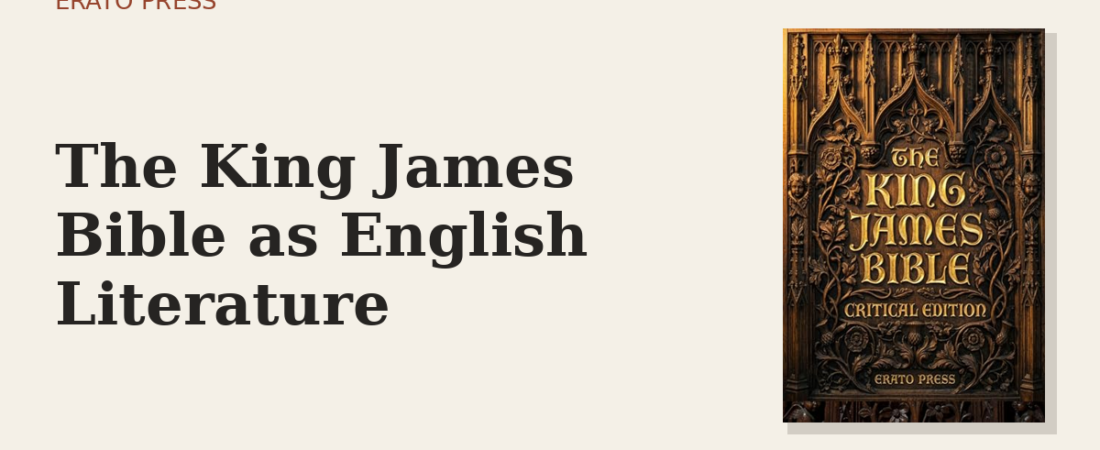
The Erato Press edition presents the King James text with an introduction on its making—the companies, the rules, the long shadow of Tyndale—and annotation that opens its language and its literary art to the modern reader without flattening the prose that is the whole point. We have made an edition for the reader who comes to the most influential book in the English language to hear it as literature: closely, aloud, and whole.
Read the Erato Press edition →
Enjoyed this piece?
Get the next one — our essays on the classics and news of each new Erato Press edition — straight to your inbox.