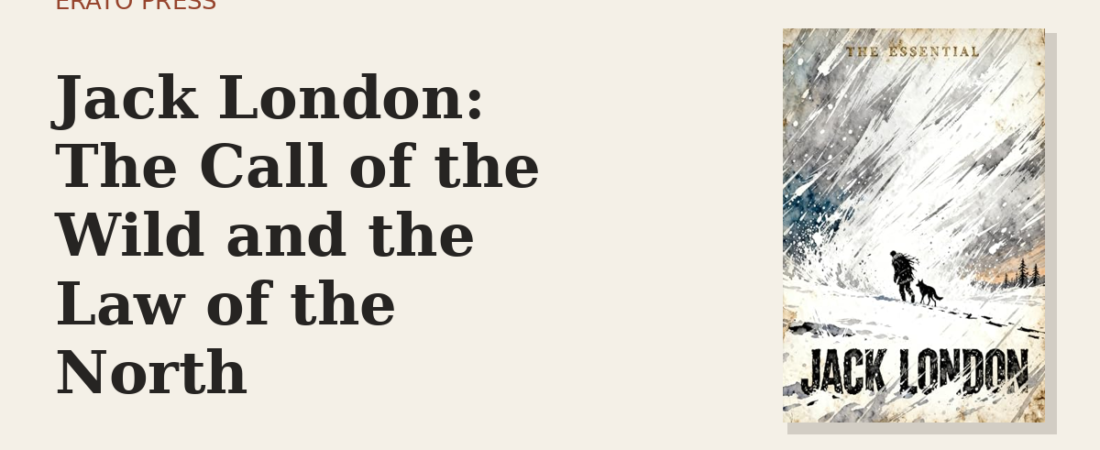
Buck does not understand the snow. That is the first thing London tells us about the dog at the center of The Call of the Wild, and it is the whole novel in a single observation. Buck has spent four soft years on a judge’s estate in the Santa Clara Valley, a king among the household dogs, and he has no preparation whatsoever for what is about to happen to him. Stolen, beaten, shipped north, harnessed to a sled, he learns the new world one brutal lesson at a time — the law of club and fang, the necessity of stealing food to survive, the way the team kills a dog that falls. London’s great subject is exactly this: the thin, recent veneer of domestication, and how quickly the cold strips it away to reveal something older underneath. The novel is the record of a descent that London insists is also an ascent — a return to a truer, wilder self that civilization had only ever buried, never erased.

London knew the country he was writing about. In 1897 he joined the Klondike Gold Rush, spent a punishing winter in the Yukon, came home with scurvy and no gold, and converted the experience into the most commercially successful serious fiction of his era. He was a self-taught socialist, a sailor, an oyster pirate, a tramp, and by thirty the highest-paid writer in America. The North gave him his great theme, and the theme was forged from real cold: men and animals tested against an environment that is not hostile, exactly, because hostility implies attention, and the Yukon does not notice you at all. It simply kills you if you make a mistake.
Darwin in the snow
London read Darwin, Spencer, and Nietzsche, and his fiction is saturated with the late-Victorian conviction that life is struggle and that the strong, the adaptable, the fit, prevail. The Call of the Wild is the cleanest expression of it. Buck succeeds not because he is good but because he learns — faster than his rivals, more completely — and his triumph over Spitz, the lead dog he must destroy to take command, is presented without sentiment as the proper working of nature. The “law of the North” that runs through London’s Klondike fiction is a Darwinian law: adapt or die, dominate or be dominated, and do not expect the universe to grade on kindness.
What keeps this from being mere ideology is London’s refusal to make it comfortable. The fittest survive, but the cost is appalling, and London does not look away from the cost. Dogs are worked to death and shot when they can no longer pull. The gentler creatures — the ones who cannot learn the new law fast enough — are eliminated early and without mercy. And in White Fang, the companion novel that runs the same machinery in reverse, London complicates the picture further: there a wild wolf-dog is gradually drawn out of the wilderness and into trust and love, civilization shown not as a corruption but as a rescue. Read together, the two books refuse to settle on a single verdict. Nature can call you home; it can also be the thing you are lucky to escape.
The atavistic dream
The strangest and most powerful current in London is atavism — the idea that the deep past lives on inside us, that beneath the modern self lies an ancestral one waiting to be summoned. As Buck masters the wild, he begins to dream. He sees, around a different fire, a hairy primitive man crouched in fear of the dark, and he feels memories that are not his own but his species’, stretching back to the first wolves. London means this literally as a kind of racial or evolutionary memory, a then-fashionable notion, and whatever one makes of the science, the imaginative power is undeniable. Buck is not just learning to survive; he is remembering something. The “call” of the title is the howl of the wild ancestor in the blood, and by the end Buck answers it, running with the wolf pack, having shed the last of the dog that loved a man.
This is the romantic core that complicates London’s hard Darwinism. The descent into savagery is rendered as liberation, even as ecstasy — the passages where Buck runs down a moose or leads the pack are written with a lyric intensity London reserves for almost nothing else. There is a longing in it, a sense that the modern, indoor, domesticated human being has lost contact with some vital older self and would be more fully alive if he could recover it. It is a dangerous idea, and London knew it was seductive, and he wrote it with his whole heart anyway. That contradiction — the cold-eyed naturalist who is also a romantic of the wild — is what gives the work its strange heat.
“To Build a Fire” and the indifference of the cold
If you want London distilled to his essence, read the short story “To Build a Fire,” which strips away even the dog’s-eye sentiment of the novels and leaves only a man, a cold, and a fatal lack of imagination. An unnamed newcomer to the Yukon sets out alone at seventy-five degrees below zero, against the advice of an old-timer who warned him never to travel solo in such cold. He is not stupid, exactly. He is something worse for the North: literal-minded, unable to imagine consequences he has not personally experienced. He breaks through ice, wets his feet, and must build a fire or die — and the story becomes an almost unbearable procedural account of frozen fingers fumbling with matches while the temperature does its patient, impersonal work.
The genius of the story is its refusal of drama. The cold is not a villain; it has no malice, no interest in the man at all, and that indifference is more terrifying than any antagonist could be. The dog beside him survives because it has the instinct the man lacks — it knows, without reasoning, not to travel in such cold — and when the man dies, the dog simply trots off toward the camp and the other food-and-fire providers. London leaves us with no consolation and no lesson beyond the brute one: nature does not care, and the creature that lives by instinct outlasts the creature that lives by miscalculating reason. It is one of the most perfectly constructed short stories in American literature, and one of the bleakest.
The writer behind the myth
London made himself into a legend — the rugged adventurer hammering out a thousand words a day — and the legend has obscured the craftsman. He was a deliberate, disciplined stylist who understood pace and compression as few of his contemporaries did. He was also a man of contradictions worth knowing: a committed socialist who wrote of individual supermen, a believer in human brotherhood whose work carries the racial assumptions of his moment, a celebrant of vitality who drank and worked himself to an early death at forty. To read him well is to hold the power and the trouble together rather than smoothing either away.
Those who fall for London tend to want to read him whole, the way readers of any major writer eventually do — and the impulse to map a whole career, to find the right door into a body of work, is the same one that animates a guide like Where to Start With James Joyce. London could hardly be more different from Joyce in surface and ambition, but the reader’s task is kindred: to start with the book that opens the door — here, The Call of the Wild — and let it lead outward to the larger, stranger country beyond.
Frequently asked questions
Is The Call of the Wild a children’s book?
It is often handed to children because its protagonist is a dog, but it was written for adults and it earns that audience. The violence is real and unsoftened, the philosophy is Darwinian and unsentimental, and the vision of nature is genuinely harsh. Children can read it; they are reading a more brutal book than the packaging suggests.
How are The Call of the Wild and White Fang related?
They are mirror images. The Call of the Wild follows a domesticated dog who reverts to the wild; White Fang follows a wild wolf-dog who is gradually civilized and learns to love a man. London wrote the second partly in answer to the first, and reading them as a pair reveals how carefully he balanced his belief in the call of the wild against his belief in the redemptive pull of human bonds.
Why is “To Build a Fire” considered his masterpiece?
Because it achieves perfect economy. With one man, one dog, and one falling temperature, London dramatizes his entire worldview — nature’s indifference, the fatal gap between instinct and reason, the price of imagination’s failure — without a wasted word. It is the most concentrated thing he ever wrote and a model of the naturalist short story.
London rewards an edition that takes his ideas seriously — that sets the Klondike fiction against the real Gold Rush, traces the Darwinian and Nietzschean currents running beneath the adventure, and reads The Call of the Wild, White Fang, and “To Build a Fire” as a single sustained argument about nature, instinct, and the thin ice of the civilized self. The Erato Press edition gathers the essential North and frames it with that apparatus.
Read the Erato Press edition →
and follow Buck out past the last campfire, to where the wild is calling.Enjoyed this piece?
Get the next one — our essays on the classics and news of each new Erato Press edition — straight to your inbox.