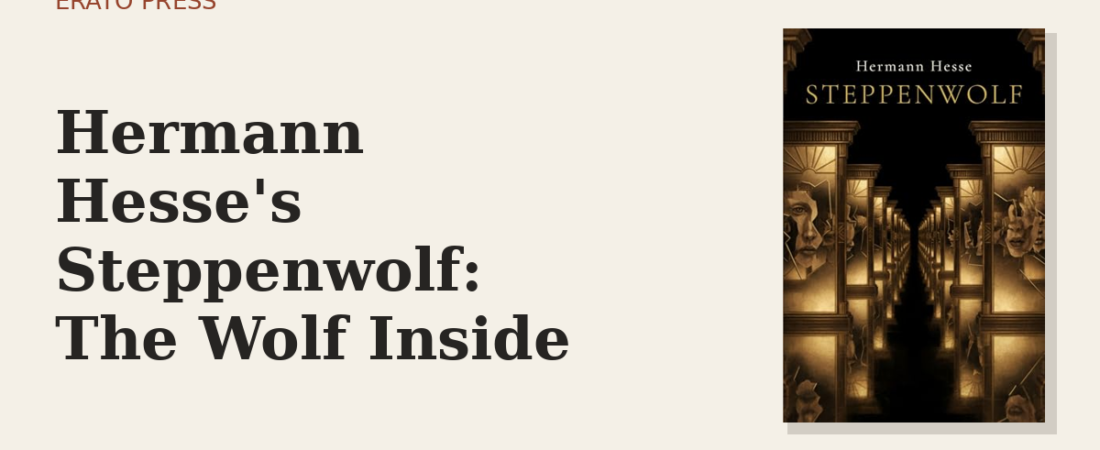
“For the mad only.” The placard over the door of Hesse’s Magic Theater is the truest line in Der Steppenwolf, because the book it belongs to is a deliberate provocation aimed at exactly the reader who thinks himself too sane to need it. Harry Haller—the middle-aged intellectual who has rented an attic room, who loves Mozart and Goethe and despises the modern world, who carries a razor for the night he finally decides to use it—believes he is two beings trapped in one skin: a cultivated man and a wild wolf, the bourgeois and the beast. The argument of this essay, and ultimately of the novel itself, is that Harry is wrong about himself in the most instructive way possible, and that Hesse built the entire strange architecture of the book—preface, manuscript, treatise, theater—to prove it. The wolf inside is not the truth about Harry. It is a lie he tells to keep from facing how many selves he really contains.

The book Hesse built out of his own crisis
Hesse did not invent Harry Haller from cool distance. He wrote Steppenwolf, published by S. Fischer in Berlin in the autumn of 1927, out of the deepest crisis of his own middle life—a personal, spiritual, and historical breakdown all at once. His marriage had collapsed; he had submitted himself to psychoanalysis; the old certainties of the cultivated German bourgeoisie into which he had been born were dissolving around him. The man who wrote the book was almost fifty, the same age as his hero, and shared the hero’s initials. Born in 1877 in the small Black Forest town of Calw, the son of a Pietist missionary, Hesse had spent his whole life suffering from external forms that seemed to throttle his inner nature—he had fled a famous seminary at thirteen after only seven months, and that flight became the leitmotif of his existence. The longing to break out, the inability to fit the given pattern, runs through every book he wrote, from Peter Camenzind to Unterm Rad, each of them circling men who fail because the world is not made for them, or they are not made for the world.
What rescues Steppenwolf from being merely the confession of a depressed man is that Hesse turned the crisis into a method. The book does not describe disintegration from the outside; it enacts it on the page. Its broken, multi-layered form is the literary expression of a broken self, and that is why it remains a great novel rather than a great symptom.
Weimar in 1927: jazz on the edge of the abyss
To read the novel without its moment is to miss half its meaning. 1927 fell squarely inside what historians would later call the “Golden Twenties” of the Weimar Republic—a glittering, feverish interval bounded on one side by the currency stabilization that followed the catastrophic hyperinflation of 1923, and on the other by the stock-market crash of 1929 that would end it. Germany seemed, briefly, to have found its feet. Berlin had become the cultural capital of Europe, a rival to Paris: the Bauhaus, Brecht and Piscator’s experimental stage, a golden age of cinema, cabarets and theaters along the Kurfürstendamm. But the brilliance rested on a cracked foundation. The republic was a permanent balancing act between irreconcilable forces; the extremes of left and right were gaining ground; the streets of Berlin were already the scene of recurring clashes that promised worse to come. Beneath the productivity ran a current of dread—an unspoken knowledge among the intellectuals that none of it could last.
Into this came jazz, arriving from America like a cultural tsunami—through the radio that began broadcasting in 1923, through the gramophone that democratized the new dance music into every café and parlor. Josephine Baker reached Berlin in 1926 and became the icon of a new and frankly sexual modernity; the Charleston turned the stiff, correct body of the educated bourgeois into something loose and ecstatic; a whole nocturnal subculture grew up in which workers, artists, homosexuals, and the middle classes mixed in a way unthinkable by daylight. To conservatives and the rising Nazis, this was the symptom of decay, “Negermusik,” the un-Germaning of Germany. To the young it was liberation. And Hesse stood, like Harry, on both sides of the question at once. In the novel jazz returns again and again—in the dance halls, in the saxophonist Pablo, in the dancing lessons Hermine forces on Harry—not as mere music but as a charged emblem of the modern: attractive and repellent, freeing and shallow. Harry despises jazz as the proof of cultural coarsening, and is helplessly drawn to it. Hesse dramatizes, through that contradiction, the secret hunger of the cultivated European for the very modern fruits he claims to scorn.
The bourgeois and the wolf—and why the split is a lie
The novel hands Harry a diagnosis of himself and then dismantles it. He believes he is half man, half wolf—the respectable burgher who pays his rent and admires the classics, locked in mortal struggle with the savage animal of his instincts. It is a seductive image, and Hesse plants a long anonymous pamphlet in the middle of the book, the “Treatise on the Steppenwolf,” precisely to take it apart. The two-soul model is too simple, the treatise insists. A human being is not a duality but a manifold, an onion of a hundred selves, a chaos of forms. Harry has reduced his whole teeming inner population to a tidy pair—cultured man, wild beast—because the binary is easier to suffer than the truth. To call yourself half wolf is romantic. To admit you are a thousand contradictory things is to lose the comfort of a story about yourself.
This is Hesse’s real subject: the 1920s crisis of the self, the dawning modern suspicion that the unified, sovereign individual of the nineteenth century was a fiction. The cultivated bourgeois who loved Goethe and Mozart had no place in a world of jazz and street violence and dissolving values, and his anguish was Hesse’s own. But the cure the novel proposes is not to choose the man over the wolf or the wolf over the man. It is to stop pretending the self is so small. Harry must learn to live as the plurality he is—to multiply rather than to halve.
The Magic Theater and the lesson Harry flunks
All of this comes to its head in the Magic Theater, the hallucinatory finale where Pablo invites Harry to step out of his single self and into a corridor of doors, each opening on another life, another version of who he might be. It is here that the novel’s formal daring pays off, because the theater is the dramatization of the treatise’s argument: the self as a stage on which countless figures can be assembled and dissolved at will. Harry is offered exactly what he needs—the chance to learn humor, lightness, the art of treating his own seriousness as a game. And he fails. Confronted with Hermine in the arms of Pablo, the old jealous, deadly-earnest Harry seizes a knife. He cannot yet laugh; he murders, where he was meant to play.
The failure is the point. Hesse does not let his hero graduate. Mozart, appearing in the theater as a figure of pure laughter, mocks Harry for taking the whole magnificent game too gravely—and tells him he will have to try again, that he must learn the laughter of the immortals. The book ends not with cure but with the promise of repetition: Harry will live, will return to the theater, will one day learn to play. This is Hesse’s most important legacy in the novel—not a doctrine you can memorize but a new way of asking the question, an insight into the productive power of being torn. The fragmentation is not the disease. The refusal to accept it is.
That refusal of single, settled meaning is what places Steppenwolf among the central experiments of its era. Its nested narrators—the editor’s preface, Harry’s manuscript, the anonymous treatise, the chorus of voices from Goethe to Mozart to Pablo—make it a book that questions its own authority, that asks “who is speaking here?” and refuses to answer. Readers who want to see how this technique fits the larger revolution in the European novel should turn to Modernism Explained: A Reader’s Guide, which sets Hesse’s broken form beside the experiments of his contemporaries.
Frequently asked questions
Is Steppenwolf autobiographical?
Profoundly, though not literally. Hesse shared Harry Haller’s initials, his age, his cultural tastes, and the crisis—a failed marriage, a course of psychoanalysis, a sense that the bourgeois world he came from was collapsing—out of which the book was written. But Hesse turned the private breakdown into a deliberate artistic structure. The confession became a method, which is why the novel reads as art rather than diary.
What does the “wolf of the steppes” actually represent?
Harry uses the image to name what he thinks is his animal, antisocial half, the part of him that cannot belong to respectable society. The novel’s argument is that this self-image is a comforting oversimplification. The “Treatise on the Steppenwolf” explicitly corrects it: a human being is not two souls but hundreds, and Harry’s tragedy is that he has reduced his own complexity to a manageable pair so he doesn’t have to face the real chaos within.
Is the ending hopeful or despairing?
Neither, exactly, and that ambiguity is intentional. Harry fails his test in the Magic Theater—he cannot yet laugh at himself—but he is told he will live and try again. Hesse offers no cure and no final defeat, only the promise that the work of becoming many-sided continues. The hope, such as it is, lies in learning the laughter of the immortals, which Harry has only begun to glimpse.
The Erato Press edition presents Hesse’s novel with the care its strange construction demands—a faithful text and critical apparatus that take seriously both the Weimar world that produced it and the formal experiment that makes it endure. If you have ever suspected that the story you tell about yourself is too simple, this is the book that knew it first.
Read the Erato Press edition →
and step, at last, through the door marked “for the mad only.”Enjoyed this piece?
Get the next one — our essays on the classics and news of each new Erato Press edition — straight to your inbox.