In the space of five years — between 1895 and 1898 — a young, sickly, lower-middle-class Englishman who had trained as a science teacher published four short novels that between them invented most of what we now call science fiction. Time travel as a machine you could build. Alien invasion from a hostile planet. The terror of bodily transformation. Invisibility and the moral collapse it permits. H. G. Wells did not merely write about the future; he supplied the future with its basic vocabulary, the images and anxieties that every subsequent writer of the form has had to use or argue with. We are still living, in a real sense, inside the scenarios he sketched before the twentieth century had properly begun.

The phrase “invented the future” sounds like blurb, so let us be precise about the claim. Wells’s originality was not prophecy — he got plenty of details wrong — but method. He worked out how to make the impossible feel inevitable: take one fantastic premise, grant it with a single deft pseudo-scientific gesture, and then reason coldly about its human consequences. He called these books “scientific romances,” and the key word is the adjective. Earlier fantastic voyages asked you to believe in magic; Wells asked you to believe in a logical extension of physics, biology, and class. Out of that discipline came both the genre and something larger: a body of work that uses the future as an instrument for diagnosing the present.
The Time Machine: deep time as social prophecy
The Time Machine (1895) is the founding document, and its real subject is not the gadget but what the gadget reveals. The Time Traveller pedals forward to the year 802,701 and finds humanity split into two species: the delicate, idle, childlike Eloi who play in a garden world above ground, and the pale, subterranean Morlocks who tend the machines below — and, it slowly and horribly emerges, feed on the Eloi they serve. This is not idle fantasy. It is Victorian class society projected across hundreds of millennia and turned into biology: the leisured rich bred down into helpless prey, the laboring poor bred down into predatory machinery. Wells, a committed socialist who had risen from a draper’s shop, was using the far future to show his own age its trajectory.
And then the Traveller goes further still, to a beach beneath a swollen, dying sun, where the only life is a black, tentacled thing flopping on a bloody sea. This image — cosmic, post-human, indifferent — is where Wells’s scientific training shows. He had absorbed Darwin and the new geology of deep time, and he grasped, as few of his contemporaries did, that humanity was a brief episode and the universe owed it nothing. Science fiction’s capacity to make us feel small against cosmic scales begins here. That nerve runs back to the founding text of the whole tradition; our essay on Frankenstein, Mary Shelley, and the birth of science fiction shows how Shelley first married scientific ambition to dread, and Wells is her most consequential heir — the man who industrialized what she invented.
The War of the Worlds: the empire as victim
The War of the Worlds (1898) is the alien invasion that all later alien invasions imitate, and its genius lies in a reversal of perspective that was, in 1898, genuinely subversive. Wells set the Martian landings not in some exotic elsewhere but in the comfortable suburbs of Surrey — Woking, Weybridge, the ordinary Home Counties his readers commuted through. The tripods stalk across the most domesticated landscape in the world, and the British Empire, then at the height of its power, is reduced in days to refugees, helpless against a technologically superior force that regards them as vermin.
The point is stated openly in the novel’s opening pages: the Martians do to England exactly what England’s settlers had done to the Tasmanians, whom European invaders “entirely swept out of existence.” Wells, who had watched the imperial century reach its zenith, turned the invasion story into a mirror held up to empire — what does conquest feel like from the receiving end? The Martians are finally killed not by human courage but by bacteria, “the humblest things that God in his wisdom has put upon this earth,” to which they have no immunity. Even the resolution is a biological argument: in the Darwinian universe, the smallest organisms hold the balance of power, and human triumphalism is a delusion. This is the template — superior invader, futile resistance, ironic deliverance — that fed a century of films and radio panics, most famously Orson Welles’s 1938 broadcast.
The Invisible Man and the laboratory of the self
If the first two novels point the telescope outward, The Invisible Man (1897) turns it inward, onto the scientist himself. Griffin, a brilliant and embittered researcher, discovers how to make living tissue invisible and tries it on his own body — and the experiment, instead of liberating him, destroys him. Invisibility turns out to be a trap: he cannot eat without his half-digested food showing, cannot venture out in rain or fog without being outlined, cannot sleep safely, and slides rapidly from inconvenience into theft, terror, and a “Reign of Terror” of murder. Wells understood that the interesting question about a power is not what it lets you do but what it does to you.
Griffin is the prototype of the modern figure we have learned to fear: the gifted technician with no ethical ballast, certain that genius licenses cruelty. Wells, a man of science who believed in science, was clear-eyed about its dangers in a way that makes him feel contemporary. The same writer who imagined wonders also imagined, with chilling accuracy, the aerial bombardment of cities and, in a 1914 novel, the “atomic bomb” — he coined the phrase decades before the physics existed. He was a prophet not because he predicted gadgets but because he understood that every new capacity arrives with a new capacity for harm.
The other Wells: prophet of society
It distorts Wells to leave him in the scientific romances, and Erato Press’s edition resists that distortion. After 1900 he became one of the most widely read public intellectuals on earth — a Fabian socialist, a campaigner for a unified world state, a tireless writer of “novels of ideas” about marriage, work, money, and the constraints of class. Books like Marriage turn their attention to the unglamorous machinery of an ordinary life: the household budget, the wife’s economic dependence on the husband, the question of whether a couple can live by their own austere rule rather than by social pressure. The same restless intelligence that imagined Martians on Horsell Common worried, in his realist fiction, about whether two people could be honest with each other across the inequalities marriage imposed on them.
This is the unity beneath the variety: Wells used fiction as a tool for thinking about how human beings should live. The scientific romances ask it on the scale of the species and the cosmos; the social novels ask it on the scale of a marriage and a wage. He believed, with an almost religious intensity, that humanity could either reason its way toward a better order or blunder into catastrophe, and he spent fifty years dramatizing both outcomes. The future he invented was never merely a setting. It was an argument about what we might become and what we had better avoid.
Frequently asked questions
Where should a new reader start?
Start with The War of the Worlds if you want the pure thrill of the form, or The Time Machine if you want the richest ideas in the smallest space — it is barely a hundred pages and contains a whole philosophy of history. Both are short, fast, and astonishingly undated. Save the social novels for once Wells has earned your trust; they reward it.
Has the science aged badly?
Some of it, inevitably — there are no canals on Mars, and the time machine is hand-waved into existence. But Wells’s method has aged beautifully, because he never depended on the science being right. He depended on the human consequences being true, and those — the cruelty of empire, the indifference of deep time, the danger of unchecked power — have only grown more legible.
Was Wells really the first, or was Verne?
They invented different things. Jules Verne wrote thrilling extrapolations of existing technology — submarines, balloons, rockets. Wells went further, granting frankly impossible premises and reasoning about their meaning, which made him the ancestor of the idea-driven, socially critical science fiction that dominates the form today. Verne engineered the vehicles; Wells imagined the futures.
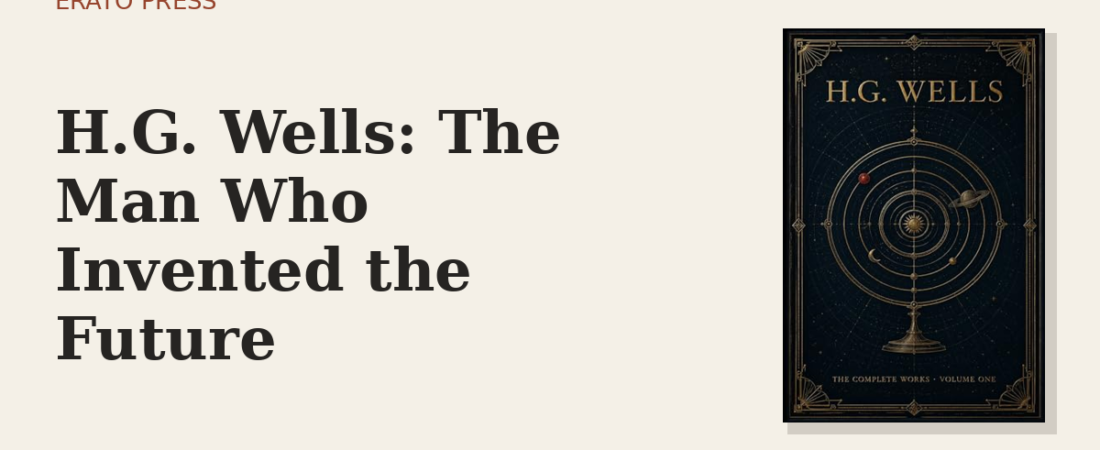
The Erato Press edition gathers the great scientific romances alongside the social fiction so the whole writer comes into view — the inventor of the genre and the prophet of society as one continuous mind, with apparatus that traces how a science teacher from Bromley turned Darwin, class anxiety, and imperial guilt into the future itself. and meet the man who taught the twentieth century how to imagine what was coming.
Enjoyed this piece?
Get the next one — our essays on the classics and news of each new Erato Press edition — straight to your inbox.