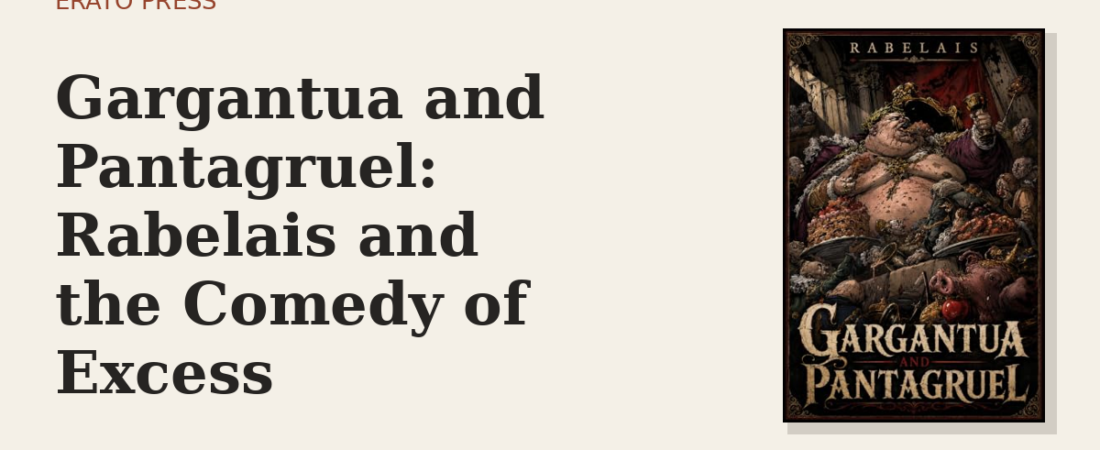
The word survives even where the books do not. We call a joke, a feast, a belly laugh “Rabelaisian,” and most people who use the adjective have never read a page of the man who earned it. That is a strange afterlife for François Rabelais, a sixteenth-century monk, physician, and Greek scholar whose enormous, sprawling, filthy, learned books about two giants gave the language a word for a whole mode of being: appetite without apology, the body unashamed, laughter that swallows the world. Gargantua and Pantagruel is one of the founding comic works of European literature, and it is funny in a way that no longer feels safe, because its excess is not decoration. It is an argument.

Here is the claim worth carrying into these books. Rabelais’s comedy of excess, the giants who drink rivers and eat pilgrims in their salad, the catalogues that run for pages, the obscenity piled on erudition, is not childishness and not mere transgression. It is a philosophy delivered in the only register capacious enough to hold it: that the body, the belly, eating, drinking, sex, and laughter are not the enemies of learning and the spirit but their ground, and that a civilization which forgets this becomes cruel and dead. The excess is the meaning.
The giants are a method, not a gimmick
Begin with the obvious oddity: the heroes are giants, Gargantua and his son Pantagruel, of variable and frankly impossible size. Rabelais uses their hugeness the way a satirist uses any distortion, to make the ordinary visible by blowing it up. When Gargantua’s mare swats away an army with her tail, when the infant Pantagruel requires the milk of thousands of cows, when a whole civilization of tiny people is discovered living in the giant’s mouth, the scale is doing intellectual work. The grotesque body, enormous, leaking, consuming, is set against the official world of fasting monks, hair-splitting theologians, and pedantic schoolmen, and it wins, because it is alive and they are not.
The famous early episode of Gargantua’s education makes the point directly. First he is taught by the old scholastic method, made to memorize useless texts backward and forward for decades until he grows stupid and filthy. Then he is given a humanist education, one that joins the mind to the body, study to exercise, Latin to swimming and music and good digestion. The contrast is Rabelais’s whole program: knowledge that has cut itself off from the living body is a kind of death, and the giant’s huge appetite for everything, food, drink, languages, mathematics, jokes, is the image of a mind properly at home in the world.
The obscenity is welded to the erudition
What disorients first-time readers, and what makes Rabelais genuinely strange, is that the filth and the learning are not in separate compartments. The same sentence that gives you a catalogue of how the young Gargantua tested various objects to wipe himself will also be quoting Galen and Plutarch and parodying the structure of a scholastic disputation. Rabelais was one of the most learned men of his age, a physician who edited Greek medical texts and a master of several languages, and he poured all of it into books full of drunkenness and excrement. This is deliberate, and it is the source of the comedy’s peculiar force. By refusing to keep the high and the low apart, Rabelais mocks the pretension that the spirit can be quarantined from the body. The joke is always at the expense of those who think themselves above the flesh: the gluttonous monks who fast in theory, the lawyers who bury justice in jargon, the theologians of the Sorbonne who condemned Rabelais’s own books.
It helps to know that he wrote in an age of religious war and censorship, when men were burned for the wrong opinions, and that several of his volumes were condemned by the theological faculty of Paris. The laughter is not innocent of all this. It is the weapon of a humanist who has watched dogma kill, and who answers it with the one thing dogma cannot tolerate: the irreverent, bodily, generous laughter that levels everyone, pope and peasant alike, at the dinner table and the privy.
Carnival, and Bakhtin’s great reading
The twentieth-century critic Mikhail Bakhtin, writing under Stalin, found in Rabelais the key to something he called the carnivalesque, and his reading remains the most illuminating way into these books. Bakhtin saw that medieval and Renaissance Europe lived alongside an official culture of hierarchy, solemnity, and fear, and a second culture of the marketplace and the carnival, where for a season the hierarchy was inverted, the fool was crowned king, the sacred was parodied, and the body in all its functions was celebrated rather than hidden. Carnival laughter, in Bakhtin’s account, is festive and communal rather than satirical and superior; it does not laugh down at a target but laughs at everything, including the laugher, in a great democratic leveling.
Rabelais, for Bakhtin, is the supreme literary monument to that folk culture. The grotesque body that eats and drinks and defecates and gives birth is not disgusting but regenerative: it is the body of the species, never finished, always consuming the world and being consumed back into it, always dying and being reborn. Writing in a state that had crushed every form of unsanctioned laughter, Bakhtin understood Rabelais as a liberation, proof that there exists a kind of comedy no authority can fully suppress, because it is rooted in the indestructible facts of appetite and renewal. You do not have to accept every detail of his theory to feel that he has named something real about why these books, for all their grossness, leave a reader feeling enlarged rather than soiled.
Why the form is harder than it looks
It would be a mistake to treat Rabelais as a chaotic heap, an author who simply piled up jokes and obscenities at random. The catalogues that exhaust the reader, hundreds of games, dozens of insults, endless lists of books in an imaginary library, are doing something a single image could not: they enact abundance, they make the reader feel the world’s inexhaustible plenty as a physical pressure. The structure is loose because life is loose, and the famous oracle at the book’s end, the Holy Bottle whose entire message is the single word “Drink,” is a punchline decades of plot have been building toward. “Drink” means take in the world, the wine of knowledge and the wine of the grape both, swallow experience without fear. To write a comedy this large and have it mean something requires a control that hides itself behind apparent abandon, which is precisely why so few have managed the form since.
Frequently asked questions
Do I need to read all of Gargantua and Pantagruel?
The books are long, episodic, and unfinished, and few readers consume them straight through like a modern novel. They reward grazing as much as marching: the education of Gargantua, the birth and youth of Pantagruel, the riotous figure of Panurge, and the voyage to the Holy Bottle are the high points. But the digressions and catalogues are not filler; they are the substance, the felt abundance that is the whole point. Read for the texture, not the plot.
What does “Rabelaisian” actually mean?
It has come to mean coarsely and exuberantly humorous, full of bawdy bodily comedy. That is accurate as far as it goes, but it misses the learning and the seriousness underneath. In Rabelais the bawdy is inseparable from a humanist vision of the whole human being, body and mind together, and a fierce hostility to every authority that would shame the flesh or imprison the laugh. The word should carry that argument, not just the belch.
Why is Rabelais grouped with the origins of the novel?
Because he, along with Cervantes, pioneered the long prose fiction that could hold everything, comedy and philosophy, the high and the low, parody and tenderness, in a single capacious form. The European comic novel of excess descends from him directly. Reading him beside the other great founding comedy of the period makes the lineage visible.
To see how far this comic energy traveled, set Rabelais beside the other book that turned laughter into a way of thinking about the whole human condition: Don Quixote: The First Modern Novel is the giant’s quieter cousin, where excess takes the form of a deluded knight rather than a hungry titan, but the inheritance is the same. The Erato Press edition of Rabelais keeps the obscenity and the erudition welded together as he wrote them, with an apparatus that opens the dense allusions and restores the carnival logic that makes the laughter mean something. It is the rare comedy that gets larger, not smaller, the closer you read it.
Read the Erato Press edition →
Enjoyed this piece?
Get the next one — our essays on the classics and news of each new Erato Press edition — straight to your inbox.