In the summer of 1855, a Brooklyn printer set type for a thin quarto of twelve untitled poems and put his own name nowhere on the title page. There was, instead, a steel engraving of a bearded man in a workman’s shirt, hat cocked, hand on hip, looking out at the reader with frank insolence. The book was Leaves of Grass, and the man was Walt Whitman, who had decided that American poetry did not yet exist and that he would have to write it himself. The astonishing thing is that he was more or less right.

Before Whitman, American verse was a provincial echo of London. Longfellow chimed in borrowed European meters; the Fireside Poets versified the hearth. What Whitman grasped, with a clarity that still feels reckless, was that a democracy could not be sung in the inherited iambics of a monarchy. A new political experiment demanded a new prosody. The thesis of Leaves of Grass, never stated but everywhere enacted, is that the form of a poem is itself an argument about how human beings should live together. Free verse, in his hands, is not the absence of discipline. It is a political philosophy with line breaks.
The line that refused to march
Open to the poem that would eventually be called “Song of Myself” and the first thing you notice is the breath. Whitman’s line does not scan; it expands and contracts according to the lung rather than the metronome. “I celebrate myself, and sing myself, / And what I assume you shall assume, / For every atom belonging to me as good belongs to you.” The cadence is biblical — he had absorbed the parallelism of the King James Psalms — but the content is heretically secular. Where the Psalmist abases himself before God, Whitman levels himself with the reader. The “I” of the poem is not an ego but a clearinghouse, a self deliberately left porous so that the bricklayer, the prostitute, the runaway slave, the President can all pass through it.
This is why the famous catalogues matter, the long unspooling lists of trades and bodies and places that exasperate impatient readers. They are not padding. The catalogue is the democratic sentence made visible: every item granted the same grammatical weight, no clause subordinate to another, the syntax of equality. When Whitman writes “The pure contralto sings in the organ loft” and then, in the next breath, “The carpenter dresses his plank,” he is refusing the hierarchy that would rank the artist above the laborer. The list flattens, and in flattening, it dignifies. A reader who wants to understand how literature began to imagine the United States as a coherent subject should set Whitman beside the novelists in The Great American Novel: A Reader’s Map — but it was Whitman, in verse, who got there first.
The body as the nation’s draft
No poet before Whitman had written the body the way he did — not as the soul’s prison or its temptation, but as its equal and twin. “I am the poet of the Body and I am the poet of the Soul,” he announces, and then declines to rank them. The 1855 edition is frankly, programmatically physical: sweat, armpits, the “love-root,” the “milky stream pale strippings of my life.” Contemporary reviewers were scandalized, and one cannot blame them; Whitman had imported the erotic into the civic and made the two indistinguishable. To touch another person, in his cosmology, is a small enactment of the union the country claims to be. The body is the place where the abstraction “all men are created equal” becomes a thing you can feel.
This is also where his contradictions live, and Whitman, who “contain’d multitudes,” would not want them airbrushed. The poet of universal embrace was a man of his moment on race; his attitudes shift, evade, and occasionally collapse into the prejudices of antebellum America. But the radical instinct of the poetry runs ahead of the man. The slave at auction, in “I Sing the Body Electric,” is appraised with a butcher’s coldness precisely so that Whitman can detonate the catalogue against itself: “Within there runs blood, / The same old blood! the same red-running blood!” The technique that elsewhere celebrates becomes, here, an instrument of moral accusation. The form turns out to have a conscience.
The poem that kept rewriting itself
Here is the fact that separates Leaves of Grass from almost every other book in the language: it is not one book. Whitman revised it for the rest of his life, issuing edition after edition — 1856, 1860, the Civil War-scarred 1867, on through the so-called “deathbed edition” of 1891–92, by which point the slim 1855 quarto had swollen into a vast, sectioned cathedral of nearly four hundred poems. The first Leaves is volcanic, raw, anonymous, dangerous. The last is monumental, organized, canonical, the work of a man who had become “the Good Gray Poet” and knew it.
Readers and scholars have argued ever since about which Whitman is the real one. The 1855 partisans prize the first edition’s wildness, its untamed line, the sense of a form being invented in real time. The defenders of the final text point out that Whitman himself wanted to be read in the architecture he spent forty years building. The honest answer is that the revision is the work — a poem that grows, contradicts itself, absorbs a war and the death of Lincoln (the magnificent elegy “When Lilacs Last in the Dooryard Bloom’d”), and ages, is enacting in its own bibliography the same principle of organic, unfinished democracy that the verse describes. The book about a nation perpetually making itself is, fittingly, a book that never stopped being made.
The inheritance
Everything that sounds distinctly American in poetry afterward owes Whitman a debt, usually an anxious one. Pound called him “a pig-headed father” and admitted “It was you that broke the new wood.” Hopkins, an English Jesuit who disapproved of nearly everything Whitman stood for, confessed that the man’s rhythm was closer to his own than any other writer’s — a confession he found humiliating. Ginsberg’s Howl is unthinkable without “Song of Myself”; so is the long breath of Hart Crane, the demotic sweep of Carl Sandburg, the cosmic ambition of Neruda, who claimed Whitman as the continent’s poet. Even poets who reject him reject him in his own loose-limbed line. He set the terms of the argument.
What endures is not a doctrine but a permission. Whitman licensed the American poem to be vulgar, encyclopedic, ecstatic, and self-contradicting — to “sound my barbaric yawp over the roofs of the world” and mean it. He proved that a poem could be as large, as miscellaneous, and as unfinished as the country it tried to hold.
Frequently asked questions
Should I read the 1855 edition or the complete Leaves of Grass?
Read both, but in order. The 1855 edition is short, incandescent, and the purest dose of the revolution; it is the book to start with if you want to feel why readers were stunned. Then move to the fuller text to see how Whitman built a life’s architecture around that first eruption, folding in the Civil War poems and the Lincoln elegies. The two together tell the real story.
Is “Song of Myself” difficult?
Less than it looks. There is no allusive code to crack, no hidden mythology — the difficulty is one of scale and patience. Whitman asks you to surrender to accumulation rather than argument. Read it aloud, let the catalogues wash over you, and stop trying to extract a thesis from every line. The poem is meant to be inhabited, not solved.
Was Whitman really the first American poet?
Not literally — Bradstreet, Wheatley, Bryant, and Poe all came before. But Whitman was the first to invent a form that could only have come from America and could not be mistaken for anything European. In that sense he didn’t write the first American poems; he wrote the first poems that taught the country what its own voice might sound like.
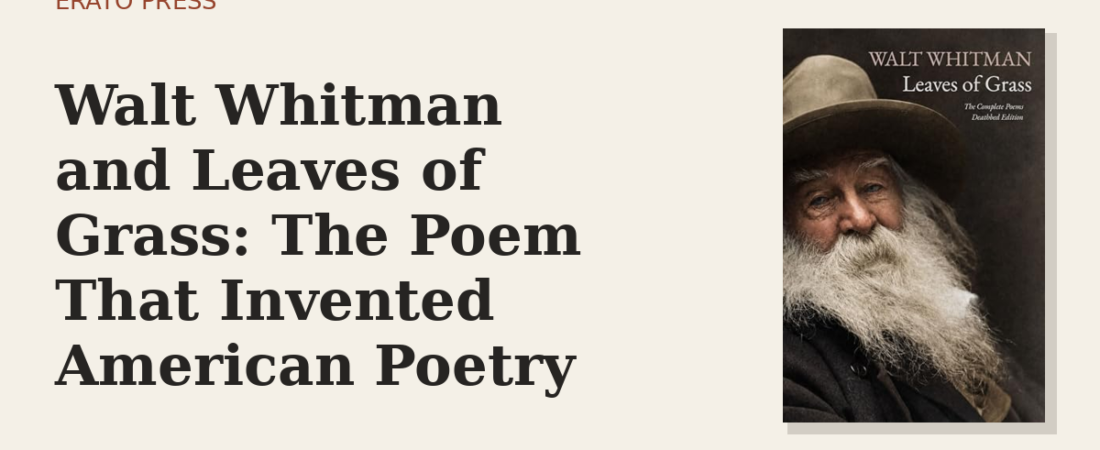
The Erato Press edition gathers Whitman’s great book with the editorial apparatus a poem this layered deserves — the textual history, the buried Civil War context, the lines that changed from edition to edition — so that you can hear both the 1855 firebrand and the deathbed master in a single volume.
Read the Erato Press edition →
Enjoyed this piece?
Get the next one — our essays on the classics and news of each new Erato Press edition — straight to your inbox.