On October 9, 1849, two days after Edgar Allan Poe died in a Baltimore hospital under circumstances no one has ever fully explained, the New-York Daily Tribune ran an obituary that began: “Edgar Allan Poe is dead. He died in Baltimore the day before yesterday. This announcement will startle many, but few will be grieved by it.” It was signed “Ludwig.” The author was Rufus Wilmot Griswold, an editor and anthologist who had quarreled with Poe for years, and that single venomous sentence — few will be grieved — launched one of the most successful and durable acts of character assassination in literary history. The popular image of Poe as a drunken, drug-addled, half-mad degenerate who scribbled his terrors out of a diseased brain is not a fact about Poe. It is a fiction about Poe, and we can name its author.

The strange thing is how completely it worked, and how completely it has been overturned by the documentary record. For a century and a half, biographers, scholars, and editors have reconstructed Poe’s actual life from his letters, his contracts, his prodigious editorial labor, and the testimony of people who knew him, and the man who emerges bears almost no resemblance to Griswold’s gargoyle. The real story is not the degradation of a genius but the slander of one — and the even stranger story of how the slander made him immortal.
The man who hated him got to write the obituary
Begin with the breathtaking conflict of interest. Griswold did not merely write the hostile obituary; he then secured the position of Poe’s literary executor — a role Poe’s relations apparently granted in confusion and haste — and used it to produce, in 1850, a “Memoir” prefixed to the collected works that would shape Poe’s reputation for generations. Griswold had unique access to Poe’s papers, and he abused it. He forged and altered letters to make Poe appear arrogant, ungrateful, and dishonest. He invented incidents. He portrayed Poe as a man without friends, without principles, perpetually drunk, sponging off everyone, expelled from the University of Virginia for dissipation and drummed out of West Point in disgrace.
The poison was effective because Griswold was not inventing from nothing — he was distorting real difficulties. Poe did drink, and drank badly; the modern view is that he had a low and ruinous tolerance, that a single glass could derange him for days, and that he was very likely an alcoholic in the clinical sense rather than a debauchee in the moral one. He was poor, often desperately, because American copyright law in the 1840s allowed publishers to pirate British authors for free and pay Americans next to nothing. He was orphaned young, estranged from his wealthy foster father John Allan, and widowed when his young wife Virginia died of tuberculosis in 1847. Griswold took a life of real hardship and grief and recast it as a life of self-inflicted vice. He took the symptoms of poverty, illness, and bereavement and relabeled them as the marks of a degenerate soul.
What the record actually shows
Set Griswold’s portrait beside the documents and it collapses. The man who supposedly could not function was one of the most disciplined and productive editors of his era. At the Southern Literary Messenger, at Graham’s Magazine, at the Broadway Journal, Poe raised circulation, wrote a torrent of reviews, and effectively invented modern American literary criticism — demanding rigor, attacking the cozy log-rolling of the New York literary cliques, and articulating a theory of the short story (the “single effect,” the calculated unity of every detail toward one emotional outcome) that working writers still use. This is not the output of a ruined sot. It is the output of a professional under relentless economic pressure who, between the bouts that genuinely did damage him, worked with formidable concentration.
And the writing itself refutes the myth of the wild, untutored madman. Poe was the most deliberate of craftsmen. In “The Philosophy of Composition” he claimed — with some provocation, perhaps half in jest — to have constructed “The Raven” backward and by calculation, choosing the refrain, the meter, even the most “melancholy” of subjects (the death of a beautiful woman) as a kind of engineering problem. Whether or not we take the essay literally, it tells us something true: this was a writer obsessed with control, structure, and effect, who invented the detective story as a pure exercise in ratiocination — in logic. The mind that built Auguste Dupin, the analytical detective of “The Murders in the Rue Morgue,” is the opposite of the addled brain Griswold described. Poe’s horror is the horror of a supremely rational man mapping the precise mechanics of terror, guilt, and obsession from the outside.
Why the lie outran the truth
So why did Griswold win, at least for a while? Partly because he held the executor’s pen and most readers had no way to check him. But partly — and this is the uncomfortable part — because the legend was useful, and not least to Poe’s admirers. The French Symbolists, above all Baudelaire, who translated Poe with devotion and treated him as a martyred saint of art, found the image of the doomed, persecuted genius irresistible; it fit their own myth of the poet at war with a vulgar bourgeois society. The drunken, suffering Poe became a Romantic icon precisely because the icon was more flattering to a certain idea of art than the truth of a hardworking professional ground down by bad copyright law and worse luck. Griswold supplied the gothic biography that seemed to match the gothic tales, and the world preferred the symmetry to the facts.
This is the deep irony of Poe’s afterlife: the slander and the fame are the same event. The “myth of Poe” sold his books, drew the Symbolists, fed a century of lurid biographies and films, and made him one of the most recognizable writers on earth — recognizable as a brand, a brooding face, a raven on a shelf, before he is read as a writer. Defenders fought back early; his friends Sarah Helen Whitman and the editor John Henry Ingram labored for decades to correct the record, and modern scholarship has comprehensively dismantled Griswold’s forgeries. But the gargoyle has proven more durable than the corrections, because the gargoyle is better marketing. We are still, in this sense, reading the Poe that his enemy built.
Reading past the myth
The reward of clearing away Griswold’s smoke is that the actual achievement comes into focus — and it is larger and stranger than the legend. Poe did not just write scary stories. He effectively founded three genres: the detective story, modern psychological horror, and a kind of cosmic speculation that culminates in Eureka, his ambitious prose-poem about the origin and fate of the universe. His tales of guilt and self-destruction — “The Tell-Tale Heart,” “The Black Cat,” “The Imp of the Perverse” — are not the ravings of a sick man but precise studies of how the rational mind betrays itself, written by someone fascinated by the perverse logic of confession and self-ruin. If you are coming to him fresh and want to see the architecture rather than the legend, our guide to where to start with Poe lays out the path through the tales, the poems, and the criticism that shows you the engineer behind the nightmares.
The man deserves to be met without the costume his enemy designed for him. He was difficult, proud, sometimes self-destructive, and frequently unlucky — but he was also brilliant, industrious, theoretically sophisticated, and far more in command of his art than the drunkard of legend. The tragedy of Poe is not that he was a degenerate. It is that a genius, dead at forty under murky circumstances, was handed over for safekeeping to the one man who hated him most.
Frequently asked questions
Did Poe really die a drunk in a gutter?
No one knows how Poe died. He was found delirious in Baltimore on October 3, 1849, wearing clothes that were not his own, and died four days later without ever explaining what had happened. Theories range from alcohol to disease to “cooping” — a brutal election-fraud practice of drugging men and forcing them to vote repeatedly. The gutter-drunk story is Griswold’s gloss, not an established fact.
Who was Rufus Griswold and why did he do it?
Griswold was an anthologist and editor, a professional rival who had clashed with Poe over reviews and reputation and, by some accounts, over a woman both admired. After Poe’s death he wrote the hostile “Ludwig” obituary, became Poe’s literary executor, and published a defamatory memoir built partly on forged and altered letters. His motives appear to have been personal resentment dressed up as moral candor.
Was Poe a drug addict?
There is little credible evidence for the opium-addict legend, which owes more to the dreamy atmospheres of his fiction and to later Romantic mythmaking than to any documented habit. His real and serious problem was alcohol, and even there the modern understanding emphasizes a pathological intolerance and probable alcoholism rather than the dissolute carousing of the myth.
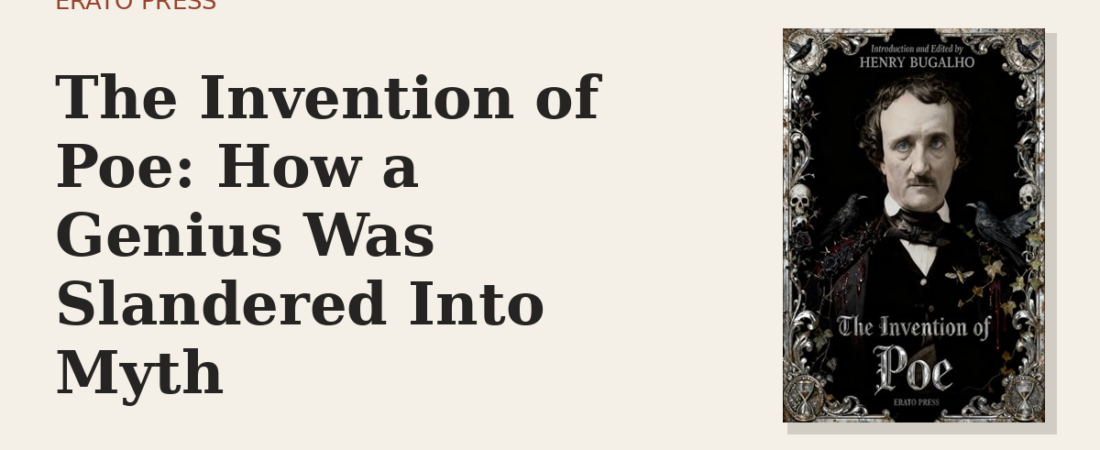
The Erato Press edition gathers Poe’s work with critical material that takes the documentary record seriously — tracing how the legend was manufactured and restoring the deliberate, theory-driven craftsman the legend obscured. It is the edition for readers who want the writer rather than the gargoyle.
Read the Erato Press edition →
and meet the Poe the evidence supports: rational to the point of obsession, and far too good to have been left to the mercy of his enemy.Enjoyed this piece?
Get the next one — our essays on the classics and news of each new Erato Press edition — straight to your inbox.