“I celebrate myself, and sing myself,” the poem begins, and a reader meeting it for the first time can be forgiven for flinching at the apparent vanity. But the next lines turn the boast inside out: “And what I assume you shall assume, / For every atom belonging to me as good belongs to you.” That is the engine of the whole thing. Song of Myself — the untitled, fifty-two-section poem that opens Walt Whitman’s Leaves of Grass in 1855 — is not really about Walt Whitman at all. It is about how one self can dilate until it contains everyone, and how an American poetry might be built out of that radical act of inclusion. The argument worth holding as you read is this: the “I” of the poem is a deliberate device, a self large enough to absorb the whole democratic crowd, and the poem’s famous difficulty — its endless lists, its abrupt leaps — is the formal price of that ambition. Read with that in mind, the poem stops being a sprawl and becomes a structure.

The grass, and the great question
The poem turns on a child’s question in section 6, the hinge of the whole work. “A child said What is the grass? fetching it to me with full hands; / How could I answer the child? I do not know what it is any more than he.” Whitman then answers anyway, and the answers multiply: the grass is the flag of his disposition, the handkerchief of the Lord, a child itself, “the beautiful uncut hair of graves.” That last image opens the poem’s deepest move. The grass grows from the buried dead, “the white heads of old mothers” and “the offspring taken soon out of their mothers’ laps,” and yet it grows — so death is not an end but a transformation, a passing of matter back into life. “The smallest sprout shows there is really no death,” he concludes, and “All goes onward and outward, nothing collapses, / And to die is different from what any one supposed, and luckier.” The grass becomes Whitman’s proof of immortality, a democratic immortality available to everyone equally because everyone, in the end, feeds the same green.
The catalogues: a poetry of everyone
Then come the famous lists — the catalogues that frustrate readers raised on tighter verse and that are, in fact, the most original thing in the book. In section 15 Whitman simply names America at work: the pure contralto singing in the organ loft, the carpenter dressing his plank, the duck-shooter, the deacons ordained at the altar, the lunatic carried at last to the asylum, the prostitute draggling her shawl, the President holding a cabinet council, “the machinist,” “the half-breed,” “the bride,” “the opium-eater.” For pages the poem becomes an inventory of the nation, every trade and condition set side by side without hierarchy. This is the formal embodiment of the democratic claim. Whitman refuses to subordinate one life to another; the long line, expanding to hold whatever it must, and the accumulating list, in which no item ranks above its neighbor, are the verse-shapes of equality itself. “And these tend inward to me, and I tend outward to them,” he writes, “And such as it is to be of these more or less I am, / And of these one and all I weave the song of myself.” The catalogue is not filler. It is the argument made audible, and it is also Whitman’s answer to the question of what an American poetry could be when the country had, as yet, almost no literature of its own to inherit. Where European verse drew on courts and cathedrals and centuries of myth, Whitman had only the raw national present — the ferry, the foundry, the prairie, the auction block — and he made a virtue of it, building his music out of work and weather and the names of ordinary people. The line had to be long because the country was large; the list had to be open because the population kept arriving.
“I contain multitudes”
Near the end, in section 51, Whitman anticipates the obvious objection — that a self this expansive must contradict itself at every turn — and disarms it with the most quoted lines he ever wrote: “Do I contradict myself? / Very well then I contradict myself, / (I am large, I contain multitudes.)” This is the philosophical center of the poem. A self that has taken in the carpenter and the prostitute, the President and the lunatic, the living and the buried dead, cannot be consistent, because consistency would require excluding someone. Whitman chooses capaciousness over coherence on principle. The body is part of this largeness, too, and frankly so: Song of Myself is among the first major poems in English to treat physical desire and the body’s appetites as sacred rather than shameful — “I am the poet of the Body and I am the poet of the Soul” — a candor that scandalized 1855 and that still gives the poem its electric charge.
The barbaric yawp, and the long goodbye
The closing movement is one of the great endings in poetry. In section 52 the poet, having contained everyone, prepares to dissolve back into the world: “The spotted hawk swoops by and accuses me, he complains of my gab and my loitering. / I too am not a bit tamed, I too am untranslatable, / I sound my barbaric yawp over the roofs of the world.” The “barbaric yawp” — that gloriously ungenteel phrase — is Whitman’s declaration of independence from European poetic decorum, a wild American cry that refuses to be polished into respectability. And then he turns, astonishingly, to the reader, and exits into the very ground the poem began with: “I bequeath myself to the dirt to grow from the grass I love, / If you want me again look for me under your boot-soles.” He is in the grass now, the same grass the child asked about, waiting. “I stop somewhere waiting for you.” The poem ends not with a full stop but with an open hand, the dead poet promising to meet the reader on the road. To follow how this single poem grew across Whitman’s lifetime into the vast, revised, ever-expanding book that surrounds it, the Erato edition’s companion essay on The Great American Novel: A Reader’s Map places Leaves of Grass within the wider effort to write the nation’s literature into being.
Frequently asked questions
Which version of the poem should I read — 1855 or later?
Whitman revised Leaves of Grass obsessively across nearly forty years, and Song of Myself changed with it, acquiring its title and section numbers only in later editions. Many readers and critics prefer the raw, untitled 1855 original for its energy and strangeness, the version with the least varnish on it. The later “deathbed” edition of 1891–92 is more polished and more cautious. Start with the 1855 text if you can; it is the poem at its most alive.
Why are the lists so long, and can I skim them?
The catalogues are doing the poem’s central work, not padding it. By naming dozens of Americans of every trade and station without ranking them, Whitman performs the equality he is arguing for. You can read them quickly, letting the names wash over you the way a crowd does, but do not skip them entirely — their accumulating rhythm is the experience, and the sense of a whole nation gathered into a single sentence is the point.
Is Song of Myself difficult?
Less than its reputation suggests, if you let go of the expectation that a poem must build a single tidy argument. It moves by association and expansion rather than logic, and it is meant to be heard as much as parsed. Read it aloud, follow the feeling rather than hunting for hidden meanings, and the leaps that look like chaos begin to feel like breathing.
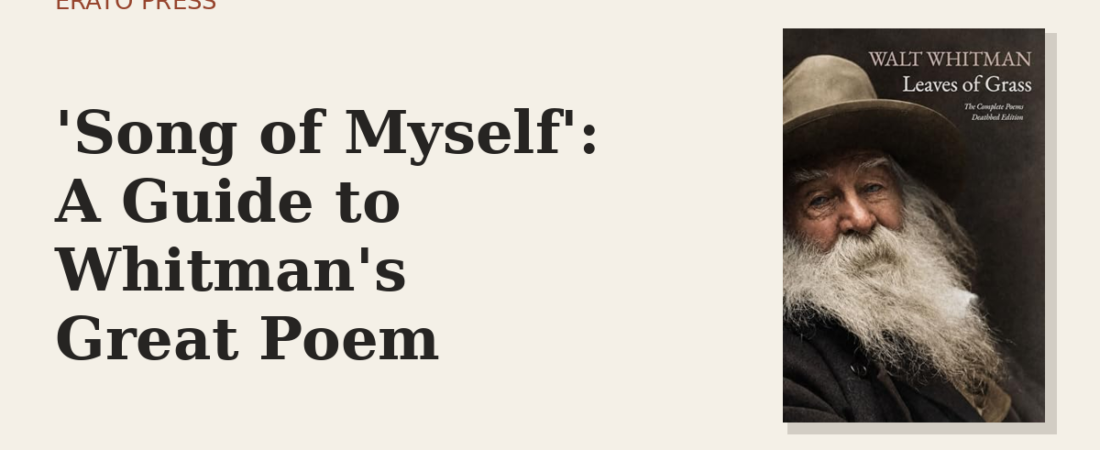
To read Song of Myself as Whitman first loosed it on the world — and to read it within the full, restless book it anchors — the Erato Press Leaves of Grass gives you the text alongside the context to hear the yawp clearly.
Enjoyed this piece?
Get the next one — our essays on the classics and news of each new Erato Press edition — straight to your inbox.