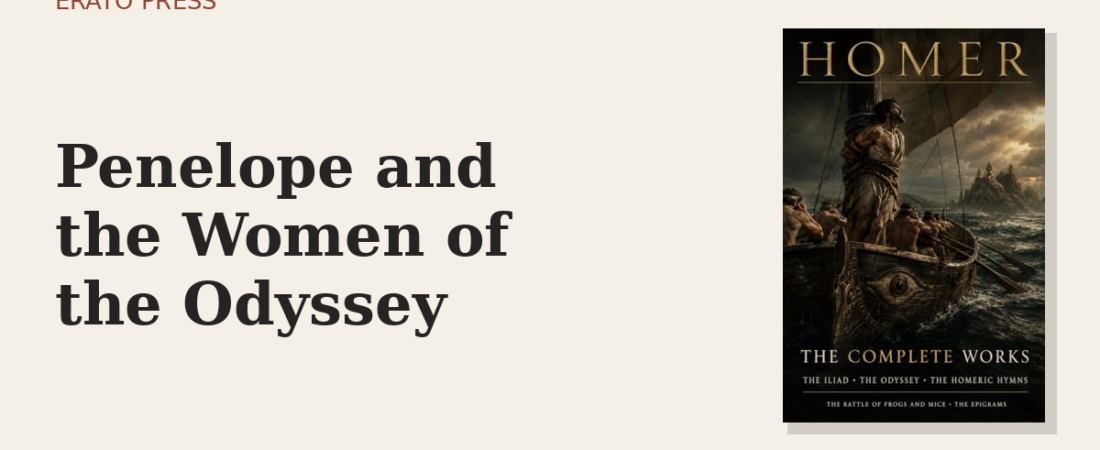
Three thousand years before the novel learned to look inside a woman’s mind, Homer built an epic whose hero spends ten years trying to get home to his wife — and then made the wife as cunning, as patient, and as strategically brilliant as the man rowing toward her. The Odyssey is conventionally read as the story of Odysseus, the man of many turns, the sacker of cities. But read it again with the women in the foreground and a stranger, richer poem emerges: one preoccupied, to an almost unaccountable degree for archaic Greece, with female intelligence, female desire, female grief, and the violence done to women who have none of the protections the poem extends to its hero. The thesis is simple and worth holding onto: the women of The Odyssey are not scenery in a man’s adventure. They are its moral instruments, and Penelope, far from being a passive monument to fidelity, is Odysseus’s true equal — the only other person in the poem who can match him lie for lie.

Penelope’s loom: cunning as the marriage of true minds
Consider the trick that defines her. For three years Penelope holds off the hundred-odd suitors crowding Ithaca’s hall by promising to choose a husband once she has finished weaving a shroud for old Laertes, Odysseus’s father. Each day she weaves; each night, by torchlight, she unpicks the day’s work. The web never grows. It is a perfect emblem — labor that produces nothing, a deferral disguised as diligence — and it is precisely the kind of stratagem her husband would admire, because it is the kind he himself favors. Odysseus survives by deceit: the false name “Nobody” he gives the Cyclops, the beggar’s rags he wears to walk unrecognized through his own house. Penelope survives by a deceit of the same family. Homer gives her the epithet periphron, “circumspect,” “thinking all around a thing” — the feminine answer to her husband’s polymetis, “of many counsels.” The poem is telling us, in its formulaic vocabulary, that these two belong together because their minds work the same way.
Their reunion in Book 23 confirms it. When Odysseus has at last killed the suitors and stands before her, washed and restored, Penelope does not fall into his arms. She tests him. She instructs the servant to move their marriage bed outside the chamber — and Odysseus erupts, because he built that bed himself around the living trunk of an olive tree rooted in the ground; it cannot be moved. Only the two of them know this. The secret of the immovable bed is the password of their marriage, and Penelope has extracted it by laying exactly the kind of trap her husband would have laid. She out-Odysseuses Odysseus. The man who deceived everyone is, for once, deceived — and the poem treats this not as humiliation but as the deepest possible recognition. Their homophrosyne, their “like-mindedness,” is the value the entire Odyssey has been traveling toward.
The other women: temptation, rescue, and the roads not taken
Penelope’s faithfulness gains its weight from the gallery of women Odysseus meets on the way back to her — each of whom offers a version of a life he declines. Calypso, the nymph who holds him seven years on Ogygia, offers him the most extravagant prize in the poem: immortality, eternal youth, and herself, a goddess, forever. He weeps on her shore looking out to sea and chooses mortality and Penelope instead — a choice that quietly defines Homeric heroism as the preference for a finite human life over a deathless but static one. Circe, on Aiaia, turns his men to swine and then, subdued, becomes a year-long lover and a generous guide who tells him he must sail to the land of the dead. Both goddesses are figures of enormous power, and the poem does not punish them for their desire; it treats female appetite as a force to be reckoned with, not a sin to be condemned.
Then there is Nausicaa, the princess of the Phaeacians, who finds the naked, brine-crusted Odysseus washed up on her island and, instead of fleeing, gives him clothing, food, and shrewd instructions for approaching her parents. She is young, marriageable, half in love — another door that might have opened into another life — and Homer renders her with a tenderness and humor (her laundry expedition is really a husband-hunting expedition lightly disguised) that has charmed readers from Samuel Butler to the present. Against these living women stands the dead one: Anticleia, Odysseus’s mother, whom he meets in the underworld of Book 11 and learns died of grief and longing for him. When he tries three times to embrace her, she slips through his arms like a shadow. It is among the most piercing moments in the poem, and it is a moment between a son and a mother — the grief of the women left behind made suddenly, unbearably concrete.
Helen, and the woman who started it all
No survey of these women is complete without Helen, whom Odysseus’s son Telemachus visits in Sparta in Book 4. Here Homer does something audacious: he shows us Helen of Troy at home, reconciled with Menelaus, presiding over a dinner party, dosing the wine with a drug that erases sorrow — and telling stories about the war her own face is said to have caused. Helen is candid, self-aware, faintly dangerous; she remembers helping Odysseus when he infiltrated Troy in disguise, and she remembers, too, almost betraying the Greeks hidden in the wooden horse. She contains the whole ambiguity of the Trojan cause inside one poised, unsettling woman. If you want to follow the thread of how antiquity argued over her for centuries, the Erato edition’s companion essay on The Trojan War: The Complete Story, From the Golden Apple to the Horse traces the larger quarrel from the golden apple to the fall of the city.
The hanged maids: the poem’s hardest page
And then there is the passage no honest reader can pass over. After the slaughter of the suitors, Odysseus orders the twelve servant women who had slept with them to carry out the corpses and clean the blood-fouled hall — and then to be killed. Telemachus, deciding hanging is less “clean” a death than the sword, strings them up by the neck from a ship’s cable; Homer compares their twitching feet to thrushes caught in a snare, and adds, with terrible economy, that their feet kicked for a little while, but not for long. It is one of the most disturbing moments in Western literature, and it has haunted modern readers and writers — Margaret Atwood gave the maids their own voice in The Penelopiad precisely because the original grants them none. The maids force a question the poem itself does not answer: the cunning, the tests, the homecoming so movingly extended to Penelope are extended to no one below her station. The same epic that grants its queen an interior life treats its enslaved women as property to be disposed of. To read The Odyssey well is to hold both of these truths at once — its astonishing attention to women, and the brutal limits of that attention.
Frequently asked questions
Is Penelope really Odysseus’s equal, or just a faithful wife?
Both, and the poem insists the two are the same thing. Her fidelity is not passive waiting but active strategy: the loom-trick that stalls the suitors for years and the bed-trick that tests her returning husband are feats of metis, practical cunning, identical in kind to Odysseus’s own. Homer’s epithet for her, “circumspect,” is the deliberate feminine counterpart to his “of many counsels.” She is the only character who successfully deceives Odysseus, and the poem presents that as the seal of their marriage rather than a defeat.
Why does the poem pay so much attention to women at all?
Scholars have debated this for centuries — Samuel Butler half-seriously argued the Odyssey was composed by a woman. The likelier answer is structural: a poem about homecoming must be a poem about the home, and the home in Homer’s world is the domain of women — Penelope managing the estate, Anticleia dying of grief, the maids and the nurse Eurycleia who recognizes Odysseus by his scar. By making return the central action, Homer makes the lives of women central too, in a way the war-driven Iliad does not.
Do I need to read the Iliad first?
No. The Odyssey stands entirely on its own and is, for most readers, the more inviting of the two epics — its episodes (the Cyclops, the Sirens, Circe) are self-contained marvels, and its emotional core, a marriage tested by twenty years’ absence, needs no prior reading. Knowing the broad outline of the Trojan War deepens certain scenes, but the poem supplies what you need as it goes.
To meet these women as Homer drew them — circumspect Penelope, deathless Calypso, the doomed maids — you want a translation that respects both the poem’s grandeur and its strange intimacy, set in an edition that gives you the cast, the geography, and the critical context to read with your eyes open. Who’s Who in The Odyssey: Odysseus, Penelope, and the Cast of Homer’s Epic is the companion to keep at your elbow as you go.
Enjoyed this piece?
Get the next one — our essays on the classics and news of each new Erato Press edition — straight to your inbox.