The most subversive thing about The Scarlet Letter is that its heroine never repents. Hester Prynne wears the embroidered “A” that her Puritan neighbors have sentenced her to wear, but she wears it as a gold-threaded provocation rather than a brand of shame, and in the seven years the novel covers she does not once concede that she did wrong. Nathaniel Hawthorne, writing in 1850 about a Boston two centuries gone, built the first great American novel around a woman the culture had condemned and quietly arranged matters so that she is the only person in the book with intact dignity. The sinner stands; the saints rot. That inversion is the whole argument.

Hawthorne came to this material by inheritance and by guilt. His great-great-grandfather John Hathorne was one of the judges at the Salem witch trials, a man who never recanted, and the novelist added the “w” to his surname partly to put distance between himself and that ancestor. He grew up steeped in the moral architecture of New England Puritanism and spent his career as its most penetrating critic from the inside — not an Enlightenment scoffer pointing at superstition, but a haunted son who understood exactly how the machinery of sin and judgment worked because it still operated in his own nervous, secretive temperament.
A book that begins by burying itself
Most readers forget that The Scarlet Letter opens not in Puritan Boston but in a nineteenth-century customs house. The long introductory essay, “The Custom-House,” in which Hawthorne describes his tedious patronage job inspecting cargo in Salem and claims to have found the actual scarlet letter and a manuscript account of Hester’s story in the attic, is a deliberate frame that most modern editions are tempted to skip. It should not be skipped. It establishes the novel’s central preoccupation — the dead hand of the past reaching into the present — before the story proper even begins. Hawthorne presents himself as a man flattened by ancestral guilt and deadening routine, and the fiction that follows is his act of escape into imagination. The “A,” he insists, when he pressed it to his own chest, scorched him. The book is a ghost story about the persistence of inherited shame, and it announces itself as one before page one of the plot.
This matters because it tells us how to read what follows. Hawthorne called his books “romances” rather than novels, by which he meant a “neutral territory, somewhere between the real world and fairy-land, where the Actual and the Imaginary may meet.” He is not a realist documenting 1640s Boston; he is a symbolist working in a half-light where a meteor can write a scarlet “A” across the night sky and we are never told whether it really happened or whether Dimmesdale’s guilt-sick mind projected it there. The novel keeps offering us supernatural readings and natural ones and refusing to choose. That ambiguity is not evasion. It is the form Hawthorne invented to dramatize how guilt distorts perception.
The real sin is concealment
Here is the moral hinge of the book, and it is a strange one for a story about adultery: the act of passion is treated as almost venial, while the secret is treated as fatal. Hester sins openly and is punished openly, and the openness is precisely what saves her. She is forced to live her guilt in public, and over seven years she transmutes it — her needlework, her charity, her care of the sick make the townspeople begin to say the “A” stands for “Able.” Arthur Dimmesdale, the brilliant young minister who fathered her child and let her bear the shame alone, sins in secret, and the secrecy destroys him from within. He scourges himself, keeps midnight vigils, presses his hand to his heart where (the novel hints) a corresponding letter has begun to burn into the flesh. His congregation worships him as a saint while his hidden guilt eats him alive, and the gap between his public sanctity and his private rot is the book’s most agonizing irony.
And then there is Roger Chillingworth, Hester’s wronged husband, who arrives in Boston, conceals his identity, attaches himself to the ailing Dimmesdale as physician and confidant, and slowly tortures him under the guise of healing. Chillingworth is the worst sinner in the book precisely because his sin is one of cold premeditation — the deliberate violation of another human soul. “That old man’s revenge has been blacker than my sin,” Dimmesdale finally says, and Hawthorne agrees. The novel’s hierarchy of guilt is exact: passion is human, concealment is corrosive, but the unpardonable sin — the one Hawthorne returns to throughout his work — is the violation of the sanctity of another heart, the manipulation of a person as a means to an end.
Pearl, the letter made flesh
Hester’s daughter Pearl is the novel’s strangest and most brilliant invention — less a child than a living symbol, “the scarlet letter endowed with life.” She is wild, uncanny, beautiful, and relentless, forever pointing at her mother’s badge, demanding to know what it means, refusing every adult evasion. She is what the Puritans most fear, a creature of pure nature outside their moral grid, and she is also, in the novel’s logic, the truth that will not be silenced. Pearl will not let the adults forget or paper over what has happened. When Dimmesdale finally mounts the scaffold and confesses before the whole town, tearing open his ministerial robe, Pearl kisses him — and only then, the narrator tells us, does she become fully human, “a spell broken.” The symbol can dissolve into an ordinary girl only once the concealed truth is spoken aloud. Hawthorne could not have stated his thesis more plainly: confession humanizes; concealment dehumanizes.
The Puritan shadow over the American imagination
What makes The Scarlet Letter the foundational American novel is not just its craft but its subject. Hawthorne identified, in 1850, the thing that would haunt the national literature for two centuries: a society founded by people who came to the New World to build a city on a hill, and who carried with them a ferocious capacity for judgment, surveillance, and the punishment of difference. The scaffold in the town square, where Hester stands exposed to the gaze of the crowd, is the original American image of public shaming, and it has never stopped being relevant. Hawthorne’s Boston is a community organized around the policing of private conduct, and the book’s deepest sympathy is reserved for the individual conscience set against the collective verdict.
This is the seam he opened for everyone who came after — the great American argument between the self and the community, freedom and guilt, the wilderness and the law. You can trace that lineage forward through Melville, who dedicated Moby-Dick to Hawthorne and praised his “great power of blackness,” and onward across the whole shelf charted in our reader’s map of the Great American Novel, where the Puritan inheritance of guilt and grace keeps surfacing in writers who never set foot in a meeting house. Hawthorne gave American fiction its first serious interior, and he located it where the country’s anxieties actually live: in the space between what we show the town and what we hide from it.
Frequently asked questions
Should I read “The Custom-House” introduction or skip it?
Read it. It is tonally different — wry, autobiographical, slow — but it sets up the novel’s entire theme of inherited guilt and the past’s grip on the present, and it frames the story as something Hawthorne discovered rather than invented. Skipping it is like skipping the overture; you can follow the opera, but you miss the key it is written in.
Is the scarlet “A” only for “adulteress”?
Hawthorne never spells out the word in the text, and the meaning deliberately shifts. The townspeople come to read it as “Able”; some see “Angel” when it appears in the sky. The novel’s whole technique is to let one symbol accumulate contradictory meanings, so that the letter ends up signifying less a fixed crime than the impossibility of pinning a human being to a single judgment.
Who is the real villain?
Chillingworth. Dimmesdale is a coward and Hester a transgressor, but both sins spring from human weakness and passion. Chillingworth’s revenge is cold, deliberate, and aimed at corrupting a soul — what Hawthorne considered the one truly unpardonable offense. Dimmesdale says it himself near the end: the old man’s revenge was blacker than their sin.
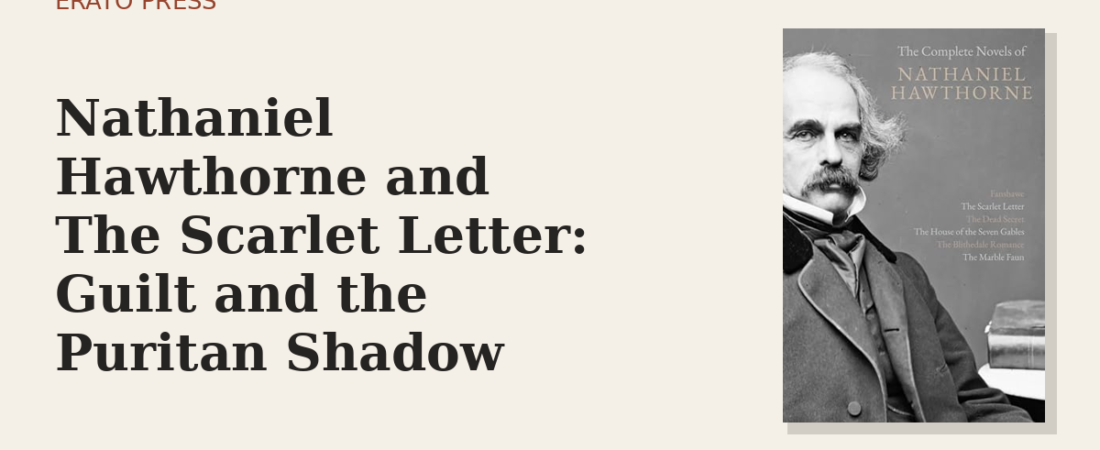
The Erato Press edition presents the full text, “The Custom-House” included, with critical material that opens up Hawthorne’s symbolism, his troubled relation to his Salem ancestry, and his place at the headwaters of American fiction. It is the edition for readers who want to see how much machinery is humming beneath a story that looks, at first, like a simple morality tale.
Read the Erato Press edition →
and meet the woman who refused, for seven years and across two centuries, to say she was sorry.Enjoyed this piece?
Get the next one — our essays on the classics and news of each new Erato Press edition — straight to your inbox.