Trace Odysseus’s voyage home on a map and you get nonsense: a Mediterranean stretched into a fairy-tale ocean where an island of cannibal giants sits a day’s sail from a witch’s palace, and both lie somewhere past the edge of any real coastline. But trace it as a map of fear, and it snaps into a terrible coherence. The monsters Odysseus meets between Troy and Ithaca are not scattered hazards. They are arranged, almost diagrammatically, as a catalogue of the things a human being can be destroyed by, and the poem’s deepest interest is not in whether cunning can defeat them, but in discovering exactly where cunning fails.
That is the claim worth holding onto across the whole sequence. Each monster of the Odyssey is calibrated to a different human dread, and the hero’s celebrated intelligence, his metis, is tested against each in turn. Sometimes it triumphs and sometimes it merely survives, and twice it is shown to be useless, which is the most frightening lesson the poem has to teach. To read the Cyclops, the Sirens, Scylla and Charybdis, Circe, and the Laestrygonians in order is to read a map of what the Greeks feared most, and a sober assessment of what the cleverest man alive could do about it.

The Cyclops: the fear of the lawless guest
Polyphemus is the most famous of the monsters, and the most precisely designed. The Cyclops is not merely a man-eating giant; he is the negation of xenia, the sacred guest-friendship on which the entire moral world of the poem rests. When Odysseus and his men enter the cave expecting the gifts owed to strangers, Polyphemus answers by eating two of them, announcing that he respects no god and keeps no law. The horror here is civilizational. The Cyclops embodies the dread of arriving among people who recognize none of the obligations that make strangers safe, where the visitor is not a guest but meat.
Against this, Odysseus deploys pure intelligence, and it is the poem’s clearest victory for cunning. He does not fight; he plans. The wine, the sharpened stake, and above all the trick of the name, calling himself Nobody so that the blinded giant’s cries for help, “Nobody is killing me,” bring no rescuers, are a triumph of mind over brute force. Yet Homer immediately stages the cost. Odysseus cannot resist shouting his true name as he sails away, and that boast hands Polyphemus the means to curse him: the giant prays to his father Poseidon, and the curse is what stretches the homecoming into ten more years of suffering. The lesson is doubled. Cunning defeats the monster, but pride undoes the cunning. The intelligence that saves the body is sabotaged by the vanity that needs to be known.
The Laestrygonians and Circe: appetite, and the loss of the self
If the Cyclops is a single lawless host, the Laestrygonians are a whole nation of them, and they expose the limit of cunning by giving it nothing to work on. These giants destroy eleven of Odysseus’s twelve ships in a single catastrophe, sinking them with boulders and spearing the men like fish. There is no clever escape, no riddle to solve; only Odysseus’s own ship, moored warily outside the harbor, survives because he alone hung back. The episode is brief and brutal precisely because it is meant to be: against overwhelming numbers and pure predatory appetite, intelligence offers no leverage at all. Caution is the only virtue, and caution merely lets you flee.
Circe poses the opposite danger, the seductive one. Her threat is not violence but dissolution: she turns men into swine, and the metaphor is exact. Her victims keep their human minds inside animal bodies, trapped in appetite, content in the sty. This is the fear of losing the self to pleasure, of being so well-fed and well-housed that one forgets to want to go home. Odysseus survives her not by his own wit but by divine aid, the herb moly given by Hermes, and then by a negotiation that is half-conquest, half-surrender. The deeper danger emerges only after the threat is neutralized: he and his men linger on her island a full year, comfortable, forgetting Ithaca, until his crew has to remind him who he is. Circe shows that the monster need not kill you. It need only make you stop wanting to leave.
The Sirens: the fear of knowing too much
The Sirens are the most refined terror in the catalogue because they threaten not the body or the will but the intellect itself, by offering it exactly what it craves. They do not promise pleasure or food. They promise knowledge, perfect knowledge of all that happened at Troy and all that happens on the earth, and the men who steer toward that promise die wrecked on the rocks, surrounded by the bones of earlier listeners. This is the dread that wisdom can be fatal, that the desire to know everything is itself a lure baited for the clever.
Odysseus’s response is the most psychologically interesting in the poem. He does not avoid the Sirens or block his own ears as he does his crew’s; he chooses to hear the song, but binds himself to the mast and orders his men to ignore his pleading and tighten the ropes. It is a perfect image of intelligence aware of its own limits: he wants the forbidden knowledge, knows he cannot resist it, and so engineers his survival in advance by surrendering his future freedom to his present judgment. Cunning here does not conquer the temptation. It concedes that it cannot, and builds a cage. The hero who outsmarted the Cyclops admits, at the mast, that some desires can only be survived by being physically prevented.
Scylla and Charybdis: where cunning simply fails
And then comes the passage that strips the consolation away entirely. Scylla, the six-headed cliff-monster, and Charybdis, the whirlpool that swallows the sea, sit on either side of a strait so narrow that there is no clean way through. Circe has already told Odysseus the unbearable truth: he cannot defeat Scylla, and he must not try, because any attempt to fight her will cost him the whole ship to Charybdis instead. He must accept the loss of six men, one for each of her heads, as the price of saving the rest. This is the only monster Odysseus is forbidden even to resist.
The episode is the poem’s hard center, the place where the map of fear arrives at the thing no intelligence can route around: the situation that offers only worse and less-worse, never escape. Odysseus, who has tricked giants and outlasted witches, here must steer past Scylla and watch six of his men snatched screaming into the air, calling his name, while he does nothing because doing something would be worse. Homer makes him say it is the most pitiable sight he saw in all his wanderings. The fear mapped here is the deepest of all: that some losses are not failures of cleverness but the structure of the world, and that wisdom sometimes means choosing which of your people to sacrifice rather than how to save them all. Readers who want to follow this Greek confrontation with limit and fate into the tragedians and philosophers will find the path laid out in After The Odyssey: Where to Go Next in the Greek Classics.
Frequently asked questions
Are the monsters of the Odyssey based on real places?
Ancient and modern readers alike have tried to pin Scylla and Charybdis to the Strait of Messina and Circe’s island to various points on the Italian coast, but the geography never fully resolves, and that is the point. The voyage is a map of fear rather than a chart of the sea; its coherence is psychological and moral, not cartographic.
Why does Odysseus’s cunning fail against Scylla and the Laestrygonians?
Because the poem is honest about the limits of intelligence. The Laestrygonians overwhelm by sheer number, and Scylla represents the no-win strait where any clever move makes things worse. Homer deliberately includes monsters that cannot be outwitted, so that the triumph over the Cyclops does not become a fantasy that cleverness conquers everything.
What unites these creatures into a single pattern?
Each is calibrated to a distinct human dread: lawless hospitality (the Cyclops), pure predatory appetite (the Laestrygonians), the dissolution of the self in pleasure (Circe), the fatal lure of total knowledge (the Sirens), and the no-win choice among losses (Scylla and Charybdis). Together they form a catalogue of what can destroy a person, and a measured test of what intelligence can do against each.
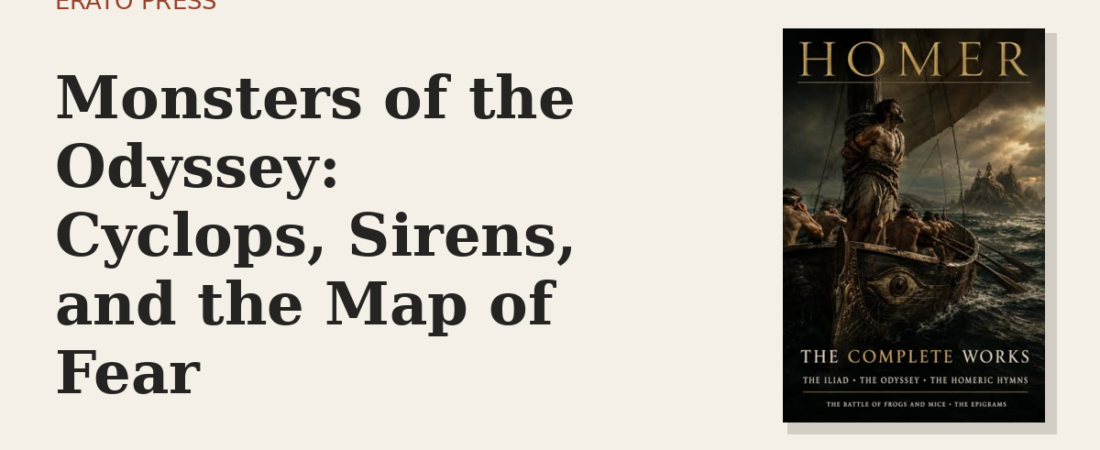
The Erato Press edition presents the Odyssey with the apparatus a reader needs to follow this design, to see the monsters not as a string of marvels but as the deliberate architecture of a poem about the reach and the limits of human cunning. It is an edition built for the reader who wants to understand why these episodes have haunted three thousand years of storytelling.
Enjoyed this piece?
Get the next one — our essays on the classics and news of each new Erato Press edition — straight to your inbox.