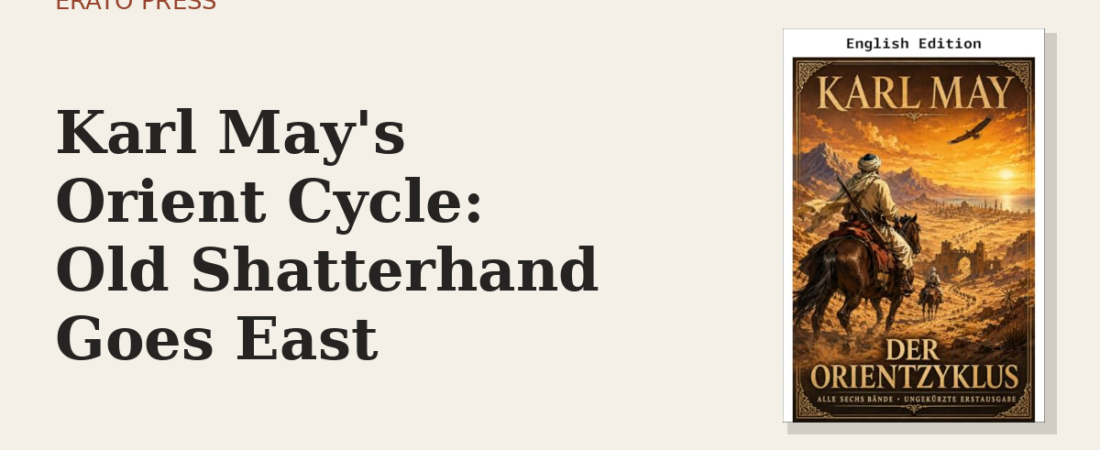
The strangest fact about Karl May, the most widely read German author of the past century and a half, is that he wrote with photographic confidence about deserts, prairies, mosques and war-trails he had never laid eyes on. When his Saxon imagination sent its hero across the Sahara and the Tigris, into Kurdistan and down through the Balkans, May himself was a former schoolteacher with a prison record who had scarcely left the kingdom of Saxony. The Orient Cycle — the six interlocking novels that begin with Durch die Wüste (Through the Desert) and carry the narrator Kara Ben Nemsi from the Maghreb to the mountains of the Near East — is the great monument of armchair travel in European fiction. It is also, and this is the argument worth making, a more deliberate and more morally peculiar artifact than its pulp reputation allows.

Most English-language readers know May, if at all, through his American novels — the Winnetou books, in which the noble Apache chief and the German-born frontiersman Old Shatterhand swear blood-brotherhood on the plains. The Orient Cycle is the Eastern hemisphere of the same imaginative globe, and the same first-person hero walks through it under a different name. Understanding why May built two mirrored worlds, and why generations of Germans loved them past all reason, tells us something about the literature of vicarious adventure that no plot summary can.
One hero, two hemispheres
May’s central invention is a narrator who is always, transparently, an idealized version of Karl May. In the American books he is Old Shatterhand, so called for the single blow that fells any opponent; in the Oriental books he is Kara Ben Nemsi, “Karl, son of the Germans,” riding the famous black stallion Rih with his comic, cowardly, devout servant Hadschi Halef Omar at his side. The two names are masks on the same face. Both heroes are German Christians abroad, both are crack shots and polyglots and amateur ethnographers, both move among foreign peoples as a kind of one-man civilizing mission armed with a repeating rifle and an unshakable conscience. May went so far, in his later years, as to claim that he was Old Shatterhand — receiving visitors in costume, posing for photographs with the rifles he had commissioned to match the ones in the books. The fantasy had consumed the man.
What makes the doubling more than a marketing trick is the way it lets May convert the entire non-European world into a single moral theater. East and West become two stages for the same drama: a virtuous outsider, guided by Christian principle and Saxon common sense, intervening among peoples whom the books present as picturesque, treacherous, hospitable, or savage by turns. The desert sheikhs and the prairie chiefs are drawn from the same box of paints. This is the formula that the harsher critics — and there have been many in Germany — have called colonial wish-fulfillment, and they are not wrong. But it would be a mistake to stop there, because May’s relationship to his material is stranger and more self-aware than the charge implies.
The geography of a man who never travelled
May read. He read obsessively — travel narratives, missionary reports, geographical dictionaries, phrasebooks, the lexicons and atlases of a nineteenth-century library — and he assembled his Orient out of them the way a set-designer builds a city from photographs. The result is a paradox that anyone who opens the books feels at once: the descriptions are dense with proper nouns, tribal names, Arabic and Turkish words, routes and distances and the names of horses’ gaits, and yet the whole edifice floats free of any real place. It is a cartography of the reading lamp. Later, after fame and money had made it possible, May did finally travel to the actual Orient in 1899, and the encounter half-broke him; the real, modern, complicated East bore no resemblance to the moral diorama he had been selling for twenty years, and the journey precipitated a personal and creative crisis from which his late, mystical, allegorical writing never fully recovered.
That biographical wound is the most revealing thing about him. May was not a cynic peddling exotica he privately despised. He believed in his invented geography; he had lived inside it; and confronting its falseness was, for him, a species of grief. The Orient Cycle is therefore not quite escapism in the ordinary sense. It is the record of a man who had built a habitable world out of secondhand words and then mistaken it for the one outside his window — and who wrote it so vividly that millions of readers chose to live there with him.
Why Germany could not put him down
The scale of May’s readership is hard to overstate. His books have sold in the high hundreds of millions of copies in German; he was the formative reading of childhoods across the German-speaking world for the better part of a century, the author boys grew up inside the way English-speaking boys grew up inside Stevenson or Henty. Albert Einstein and Hermann Hesse left fond testimony; so, more uncomfortably, did Adolf Hitler, who admired the Winnetou books and pressed them on his generals — a fact that has hung over May’s reputation ever since and that is worth confronting honestly rather than suppressing, because it points to the genuine ambivalence of the work, its blend of generous cosmopolitan curiosity with an unmistakable fantasy of European mastery.
The reason for the devotion lies, I think, in the moral-adventure formula itself. May offered the unbeatable combination of incident and instruction. His novels gallop — ambushes, captures, daring rescues, desert pursuits — but every chapter is also a small sermon on courage, mercy, loyalty and faith, delivered without the slightest irony. Kara Ben Nemsi is never merely brave; he is brave for a reason, and the reason is always articulated. For a Wilhelmine reading public hungry for the wider world but raised on duty and piety, this was an intoxicating mixture: the freedom of the adventure tale with the reassurance of a clear conscience. You could ride to the edge of the known world and never once leave the company of your own values.
Reading May now
How should a modern reader take him? Not solemnly, and not dismissively. May belongs to the great tradition of the adventure romance — the lineage that runs through Dumas and Verne and Stevenson — and like the best of that tradition he writes with an unembarrassed narrative energy that the literary novel often forgets how to summon. The pleasures are real: the propulsive plotting, the affection between Kara Ben Nemsi and the irrepressible Hadschi Halef Omar, the sheer abundance of invention. He shares the genre’s instinct for the frontier as a place where character is tested, an instinct that connects his Orient to the prairie and to The Classic Western Novels Worth Reading, where the same moral architecture gets built in chaps and spurs rather than burnous and turban.
But the books should be read with eyes open to what they are: the dream of the East as imagined by a man who had only read about it, complete with the period’s prejudices and its will to mastery. Read that way — as both a thrilling story and a document of how the nineteenth century manufactured its idea of the foreign — the Orient Cycle becomes far more interesting than either its defenders or its detractors usually allow.
Frequently asked questions
Do I need to read the Winnetou books first?
No. The Orient Cycle stands on its own, and its hero Kara Ben Nemsi is self-contained. Readers who know the American novels will recognize the same narrating sensibility wearing different clothes, and that recognition adds a layer of pleasure, but it is not a prerequisite. Many German readers met the desert before the prairie.
Did Karl May ever visit the places he wrote about?
Not until long after he had written most of them. The Orient Cycle was composed entirely from reading. May made his one real journey to the Near East in 1899, after decades of fame, and the disillusionment of seeing the actual modern Orient marked a turning point in his life and work.
Is the cycle dated in its treatment of the peoples it depicts?
Yes, unavoidably. The books carry the colonial assumptions of their moment, and the hero’s civilizing confidence reads very differently today. That is part of what makes them worth reading attentively — as adventure and as evidence of how an era pictured the world beyond its borders.
Erato Press has gathered the Orient Cycle in a single annotated volume, with a critical introduction that situates May between the travel literature he plundered and the colonial fantasies he helped shape, and that takes both his artistry and his blind spots seriously. It is the edition for readers who want the gallop and the context at once.
Read the Erato Press edition →
Enjoyed this piece?
Get the next one — our essays on the classics and news of each new Erato Press edition — straight to your inbox.