At the end of his great duel with the English detective, Arsène Lupin loses. The case is decided against him; the master of method has, on points, won. And then Lupin reaches into the great man’s pocket, lifts his watch, and strolls away. The theft changes nothing in the plot. The watch is worth a fraction of the treasures that have already passed through Lupin’s hands. It is, by any reasonable accounting, a pointless flourish — and it is the single thing every reader of Maurice Leblanc remembers, long after the solution to the case has evaporated. That stolen watch is the whole secret of why Lupin has outlived nearly every serious novel published beside him.

Maurice Leblanc invented his gentleman-thief almost by accident in July 1905, when a publisher launching a glossy Paris monthly called Je sais tout asked him for a crime story in the manner of the foreign sensations everyone was reading — Conan Doyle’s Sherlock Holmes, above all. Leblanc, who had spent two decades trying and failing to become a serious literary novelist in the line of Flaubert and Maupassant (both of whom he had met in his native Rouen), needed the money. He dashed off “The Arrest of Arsène Lupin,” and the result detonated. He had wanted to be Flaubert; he would spend the next thirty-five years as the man who made Lupin, never quite forgiving his creation for being so much more loved than the books he was proud of.
The watch and the meaning of the duel
To understand Lupin, stay with that watch a moment longer, because Leblanc has compressed his hero’s entire philosophy into it. The Englishman — whom Leblanc, after Conan Doyle’s lawyers objected, slyly renamed “Herlock Sholmès,” or “Holmlock Shears” in the period English translations — is the man of method, of sequence, of patient reconstruction. He measures time; the watch is the perfect emblem of his genius, order made portable, the world rendered as a mechanism a careful enough mind can read. For Lupin to lift that watch is to steal, symbolically, the one thing the methodical man cannot work without: his grip on time itself.
The thief who lives in the pure present, who improvises, who acts faster than the law can write anything down, reaches into the pocket of the man who lives by the clock and removes the clock. It is a joke and it is a manifesto. Method may solve the case, the gesture says, but improvisation owns time: the patient man reconstructs the past while the audacious man is already gone into the future, carrying the patient man’s watch. The detective is left, in the perfect closing image, with no way to tell the hour — beaten not in the contest he won but in the deeper one he never knew he was fighting. This is the contrast that gives the duel its charge, and it is the same fault line that runs through all of detective fiction, the difference between the reasoner and the intuiter, the kind of opposition we trace when we set Sherlock Holmes against Father Brown, two opposite kinds of detective. The trophy outlasts the verdict. That is the law of Lupin: the gesture is remembered, the outcome forgotten, the name endures.
A hero built out of the twentieth century’s favorite materials
Lupin should, by now, be a charming period fossil. He was born in 1905, his world is one of motor-cars and telegrams and Belle Époque drawing rooms, and that machinery has aged into quaintness. Yet he keeps being reborn in new languages and new media, and the reason is that Leblanc, almost without meaning to, built his hero out of exactly the materials the coming century would prize most highly: celebrity, performance, the manipulation of the press, and the conviction that identity is something you construct and project rather than something you are born into and carry.
Lupin is the first hero of self-invention as a way of life. He has no fixed self, no inherited rank, no loyalty he did not choose. He remakes himself with every adventure, brands himself through the newspapers, converts every theft into reputation, and treats the entire apparatus of modern publicity as his native element. He robs in order to be reported. Strip away the jewels and the bonds and the legendary treasure of the kings — all of which pass through his hands and out again — and what accumulates from book to book is two words: Arsène Lupin. He is, in the precise modern sense, famous for being famous, except that he had to invent the crimes to be famous for. The twenty-first century, which has made self-fashioning a universal occupation and celebrity a universal aspiration, looks at Lupin and recognizes one of its own.
How the stories actually fool you
Leblanc’s plots have a signature shape, and it is worth naming because it explains the particular vertigo of reading him. A Lupin story characteristically withholds not a clue but a frame — not a missing fact inside a stable picture, but the identity of the picture itself. You are given everything: the events, the people, the dialogue, often Lupin’s own actions described in plain sight. What is held back is the single piece of knowledge that reorganizes all of it at once — usually that some person you have been watching, trusting, or dismissing for fifty pages was Lupin all along. The reveal adds no information. It redistributes meaning. Everything you have read is instantly re-read as having meant something other than what you took it to mean.
This is a different and more devious machine than the classic clue-puzzle, in which the detective assembles scattered facts into a solution the reader could in principle have reached. Leblanc rarely plays that fair, and his unfairness is the source of his pleasure. He does not ask you to solve; he asks you to be fooled, and then to enjoy being shown how. The delight is retrospective — the backward rush when the final sentence forces the whole story to mean anew. The form and the hero are the same shape: just as Lupin walks through the plot in a disguise the characters cannot see through, the story walks through your mind in a disguise you cannot see through, until Leblanc removes the mask from the narrative exactly as Lupin removes it from his face. You finish feeling not cheated but delighted to have been so thoroughly had.
The lightness of a doomed world
There is one more layer, and it gives the comedy a depth Leblanc could not have intended. These adventures were written in the last decade before 1914. The France of Lupin is confident, prosperous, theatrical, in love with its own cleverness and its own beautiful objects — a society that believed in progress and the endless refinement of pleasure, and that was, even as Leblanc wrote, sliding toward the catastrophe that would kill a generation of the young men who read him. To a reader who knows what came next, the lightness is almost unbearable. The dancing burglar, the gentleman’s game of crime, the duel conducted as sport — all of it belongs to a world four years, then three, then two, from the Marne.
Lupin is the dream of a civilization that wanted, above everything, to believe that intelligence and charm could win any contest — that the clever man always escapes, that audacity defeats force, that the game is finally safe because the hero cannot really be hurt. The war would refute every term of that dream; force would prove not a plodding adversary to be outwitted but an industrial machine that fed on exactly the bright, brave young men Lupin taught a generation to admire. To read these stories now is to visit, knowingly, a world enjoying its last and most charming fantasy of safety. The lightness is not naive. It is doomed, and the knowledge of the doom, which Leblanc could not have had and we cannot escape, gives the comedy its strange weight.
Frequently asked questions
Did Lupin really fight Sherlock Holmes?
He fought a parody of him. Leblanc summoned Conan Doyle’s detective by name in a 1906 story; Doyle’s representatives objected to the unlicensed use, and Leblanc simply rearranged the letters — Holmes became “Herlock Sholmès,” Watson became Wilson. In the Edwardian English translations the figure appears as “Holmlock Shears.” It was a perfect Lupin maneuver: confronted with the law of literary property, Leblanc disguised his borrowing in plain sight and dared the world to object.
Do I need to read the stories in order?
No. The Lupin books are stronger in their parts than their wholes — the consequence of being composed forward, month by month, for a magazine, each installment needing its own hook and turn. You can begin almost anywhere, though the first collection, Arsène Lupin, Gentleman-Burglar, introduces the hero’s voice and the duel with the English detective that defines him.
Why does Lupin still feel modern when the setting is so dated?
Because the dated part is the surface — the motor-cars and telegrams — while the modern part is the core: a man who treats identity as a performance, fame as the only treasure worth keeping, and the press as a tool. That second kind of modernity has only intensified, which is why a hero from 1905 reads like one of us.
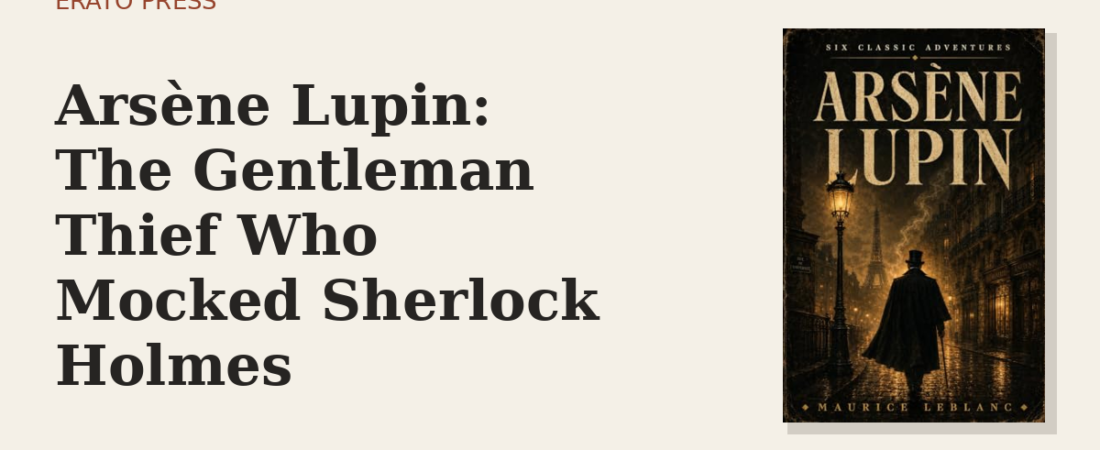
This Erato Press edition gathers the classic adventures with critical material that follows Lupin from the Norman cliffs of Étretat to his strange immortality as the first great fictional celebrity of the media age. It is the edition for readers who want the comedy and the depth beneath it.
Read the Erato Press edition →
and let the man of a thousand faces lift your watch — you will thank him for it.Enjoyed this piece?
Get the next one — our essays on the classics and news of each new Erato Press edition — straight to your inbox.