There is a moment in the twenty-second book of the Iliad, just after Achilles has run Hector down beneath the walls of Troy, when the narrative pauses to remember a spring. Two springs, in fact, where the Trojan women used to wash their bright clothes in the days of peace, before the Greek ships came. Homer names them, lingers over the warm one steaming and the cold one running like hail, and only then lets the two greatest fighters in the world tear past on their last circuit. That spring exists for no plot reason whatsoever. It is there because the poem knows something its warriors are too busy dying to know — that all this killing happens in a real place, where laundry once got done. To read all of Homer is to learn how that double vision works, and why it has never been equaled.

We tend to receive Homer in fragments: the Iliad assigned in one course, the Odyssey in another, the Homeric Hymns left to specialists, the comic Battle of Frogs and Mice mentioned, if at all, as a footnote. The fragmentation is a habit of the syllabus, not a feature of the material. Read together, in one volume, the works that antiquity attached to the name of Homer compose something larger than the sum of two epics — a single imaginative world seen from war and from peace, from the battlefield and from the home, from the heights of Olympus and from the underside of a hexameter joke. The argument for the omnibus is not convenience. It is that you cannot really see any one of these poems until you have seen them in company.
Two poems, one world, opposite ends of it
The Iliad and the Odyssey are not a matched set so much as a deliberate pair of opposites, and their power multiplies when you hold them against each other. The Iliad is a poem of compression: forty-some days in the tenth year of a ten-year siege, a single battlefield, a wrath that begins in the first line and burns through to the funeral of Hector in the last. Its emotional register is grief and rage and the unbearable nearness of death; its great recurring gesture is the simile that swings the camera away from the spear-point to a shepherd on a hillside, a mother brushing a fly from her sleeping child, a snowfall settling over the whole quiet world. The Odyssey is a poem of dispersal: ten years, the whole map of the known and unknown Mediterranean, a hero defined not by how well he dies but by how cunningly he survives and gets home. Where Achilles chooses a short blazing life over a long obscure one, Odysseus turns down immortality itself — Calypso offers him agelessness on her island and he weeps on the shore looking at the sea, because what he wants is his mortal wife and his rocky kingdom and his own death in its own time.
Set them side by side and each explains the other. The Iliad asks what a human life is worth when it must end, and answers with the terrible dignity of men who fight knowing they will lose everything. The Odyssey asks what a human life is for once the fighting is done, and answers with the patience of a man rebuilding a household, recognizing a wife by a marriage bed carved from a living tree, weeping over a dog who remembers him. The first poem is about the cost of glory; the second is about the cost of coming back from it. Together they map the whole arc of the heroic life — its exit and its return — and neither half is complete without the shadow the other casts. This is precisely why a reader who has finished the Odyssey and wonders where to go next in the Greek classics should think first about going backward, into the Iliad, before going forward into tragedy and Plato. The Greek imagination was built on this pair.
The Hymns and the joke nobody reads
Bind the two epics together and most readers stop there. They shouldn’t, because the smaller works in the Homeric corpus are not filler — they change the air you breathe in the big poems. The Homeric Hymns, thirty-three poems of wildly varying length addressed to the individual gods, are where the Olympians get their close-ups. In the Iliad the gods are largely instruments of the human story: Athena steadies a spear, Apollo spreads plague, Zeus weighs fates on a golden scale. In the Hymns they have their own lives. The long Hymn to Demeter tells, with extraordinary tenderness, how the goddess lost her daughter Persephone to the lord of the dead and went grieving in disguise through the mortal world until the seasons themselves broke — the founding story of the Eleusinian Mysteries and one of the oldest meditations we have on bereavement and return. The Hymn to Hermes is the funniest thing in early Greek, a tale of a god who is born in the morning, invents the lyre by lunchtime, steals Apollo’s cattle by nightfall, and lies about it to Zeus’s face with such brazen charm that everyone forgives him. Read the Hymns and you understand that the Olympians of the epics are local appearances of beings with their own enormous biographies — and the divine machinery of the Iliad stops looking like decoration and starts looking like the visible edge of a much larger system.
And then there is the Battle of Frogs and Mice, the Batrachomyomachia, a few hundred lines of mock-epic in which a war between amphibians and rodents is narrated in the full solemn machinery of Homeric verse, councils of the gods and aristeias and all. It is a parody, almost certainly not by the poet of the epics, and it is exactly the kind of thing the syllabus discards. Keep it. A culture parodies what it has thoroughly absorbed; the existence of a Homeric joke is itself evidence of how completely Homer had soaked into the Greek mind by the time someone thought to send up the conventions. To read the Battle of Frogs and Mice after the Iliad is to watch a tradition become secure enough to laugh at itself, and the laughter is affectionate. It is the surest sign that these poems were not museum pieces but living furniture of the imagination — close enough to mock.
The Homeric Question, and why it should not scare you off
No discussion of reading “all of Homer” can avoid the awkward fact that we do not know whether Homer existed, and if he did, what he wrote. This is the Homeric Question, and it has consumed scholarship for two and a half centuries. The decisive turn came in the 1930s, when Milman Parry, a young American classicist, went into the mountains of what was then Yugoslavia and recorded illiterate guslar singers improvising heroic poems of enormous length. What Parry demonstrated, by analysis of the Greek text and confirmation in the field, is that the Iliad and Odyssey are built from a vast inherited system of formulas — fixed phrases metrically tailored to fit recurring positions in the hexameter line. “Swift-footed Achilles,” “the wine-dark sea,” “rosy-fingered Dawn” are not the poet reaching for a favorite phrase; they are the load-bearing components of a technology for composing verse in performance, without writing, at the speed of speech.
This sounds like a demotion — the sublime poet reduced to an assembler of prefabricated parts — and for a while it was received that way. It should not be. What the oral theory actually reveals is a different and in some ways more astonishing kind of genius: a poetry that is the distilled work of many generations of singers, refined over centuries the way a riverbed is shaped by water, brought at last to the form we have by one or more supreme practitioners at the moment the tradition met the new technology of the alphabet. The formulas are not a limitation the poet overcame; they are the instrument the poet played. When you notice that Homer calls the sea “wine-dark” even when it is calm and grey, you are not catching an error. You are watching the deep structure of an oral art form, and once you can hear it, the poems open in a new way. The repetitions become music; the type-scenes — the arming of the warrior, the welcoming of the guest, the funeral — become a grammar you can read. The reader who comes to the Iliad as the first epic of war and stays for its formulaic architecture finds that the two facts reinforce each other: the most ancient poetry of European literature is also the most expertly engineered.
Why the single volume matters
What you gain by reading the whole corpus together is range — the ability to feel, in your hands and across a few weeks of reading, how wide a single imaginative tradition could stretch. The same hexameter line carries the death of Hector and the cattle-theft of an infant god and the squabbling of frogs. The same gods who decide the fall of cities lose their daughters and invent musical instruments. The same poetic machinery renders the most exalted grief in literature and a parody of itself, and holds both without strain. No anthology of “great passages” can give you this, because the effect is cumulative: it is the experience of moving through a complete world, with its tragic center and its comic margins and its divine background all present at once, that teaches you what Homer actually is.
There is also a plainer argument, which is that the Greeks themselves did not separate these works the way we do. Homer was, for antiquity, an education in a single name — the source of conduct, of theology, of rhetoric, of the very idea of what a hero is. Plato quarreled with him; Aristotle theorized him; every tragedian mined him; Alexander the Great is said to have slept with the Iliad under his pillow. To meet Homer as the Greeks did is to meet the whole of him, not a curated half. The fragmentation we inherited is a modern convenience that costs more than it saves.
Frequently asked questions
Should I read the Iliad or the Odyssey first?
Chronologically and emotionally, the Iliad comes first — it sets up the war whose aftermath the Odyssey describes, and it establishes the heroic code that Odysseus then revises. But the Odyssey is the more immediately accessible adventure, so newer readers sometimes start there and circle back. In a single volume you can simply do both in sequence and let each illuminate the other.
What is the Homeric Question, briefly?
It is the long scholarly debate over whether a single poet named Homer composed the epics, and how. The modern consensus, following Milman Parry’s fieldwork on living oral singers, is that the poems emerged from a centuries-old tradition of oral composition built on formulaic phrases, reaching their finished form when that tradition met alphabetic writing. Whether you call the shaping intelligence “Homer” is partly a matter of definition — but the artistry is undeniable.
Are the Homeric Hymns and the Battle of Frogs and Mice really by Homer?
Almost certainly not by the same hand as the epics, and the Greeks themselves had doubts. But they were transmitted under Homer’s name in antiquity and belong to the same poetic tradition and meter. Reading them alongside the epics shows you the full reach of that tradition — its tenderness toward the gods in the Hymns, its capacity for self-parody in the Batrachomyomachia.
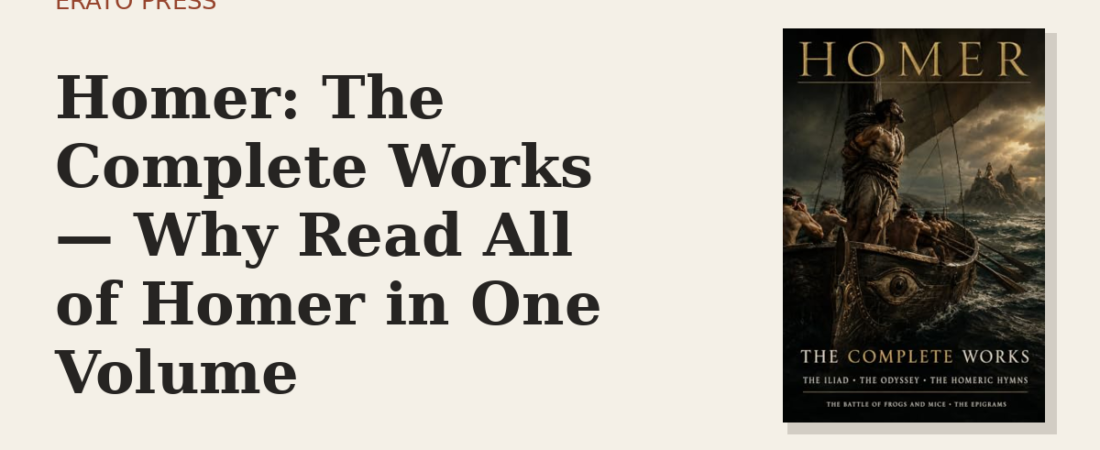
Erato Press has gathered the complete works traditionally ascribed to Homer — both epics, the Hymns, and the comic mock-epic — into one annotated volume, with critical apparatus that treats them as the single world they are. It is the way to read Homer whole, the way antiquity read him.
Read the Erato Press edition →
Enjoyed this piece?
Get the next one — our essays on the classics and news of each new Erato Press edition — straight to your inbox.