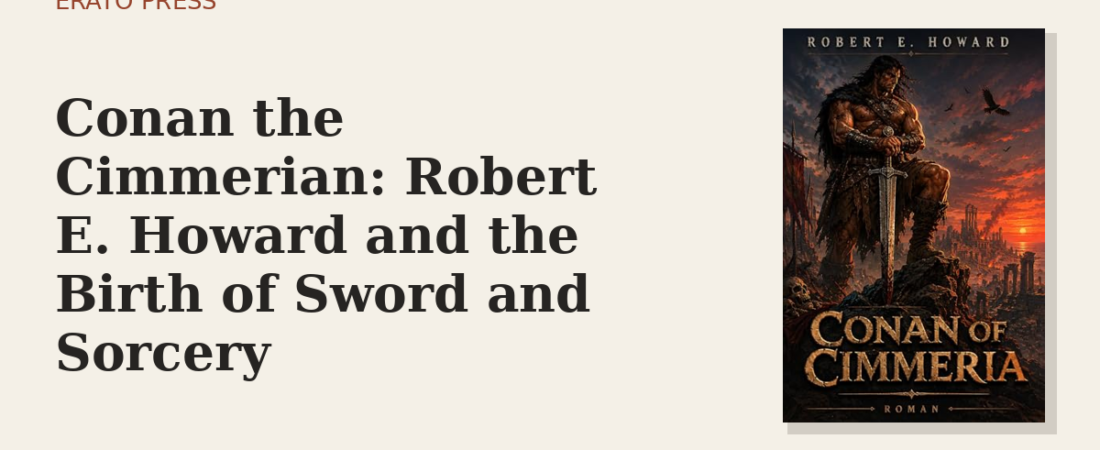
In June 1936, in Cross Plains, Texas, a thirty-year-old man learned that his mother would not wake from her final coma. He walked out to his car, took a pistol from the glove compartment, and shot himself in the head. Robert E. Howard had, by then, written the stories that invented a genre — though no one yet had a name for it, and the man himself would not live to see his barbarian outlast every more respectable writer of his moment. The abruptness of that ending has shaped his reception for nearly ninety years, flattening him into one of two cartoons: the tragic talent cut off before his prime, or the pulp machine grinding out millions of words at a penny apiece. Both contain truth. Both miss what is strange and genuinely original about the work.

Howard sold his first story to Weird Tales in 1925, at nineteen. By the time he introduced Conan in “The Phoenix on the Sword” in 1932 — a story he salvaged from an unsold tale of his earlier hero Kull — he was the magazine’s highest-paid contributor. He wrote at extraordinary speed in a shed behind his parents’ house, sometimes finishing a story in a single sitting, and his range was far wider than the barbarian reputation suggests: westerns, boxing comedies, Crusader historicals researched with real care, horror, poetry. But it is Conan who founded something, and the founding is worth understanding precisely, because “the birth of sword-and-sorcery” is a phrase people repeat without asking what was actually born.
What Howard actually invented
Sword-and-sorcery is not the same thing as the high fantasy that Tolkien was assembling in the same years, and the difference is the key to Howard. Where Tolkien’s Middle-earth was a vast, morally weighted, philologically grounded secondary world built to give England a mythology it lacked, Howard’s Hyborian Age was something rougher, faster, and frankly improvisational. He set the Conan stories in an invented prehistoric epoch — after the sinking of Atlantis, before recorded history — populated by civilizations that map onto real ones with the serial numbers filed off. Aquilonia is Rome before Rome, with its legions and senators and intrigues; Stygia is a sinister Egypt; Zamora is Persia, Khitai is China at the eastern edge of the world, Cimmeria itself is a cold Celtic Iron Age. The trick of this pseudo-history was that it freed Howard from history’s chronology. He could send Cimmerians against Picts, borrow from Crusader chronicles and Mongol campaigns and Celtic myth in the same paragraph, and never produce an anachronism, because the whole edifice was avowedly fictional.
This was a different and lesser kind of world-building than Tolkien’s, and Howard knew it. He drew no precise maps, worked out no economics, let Conan’s age drift and his kingdoms appear and vanish from story to story. The inconsistency frustrates readers who approach fantasy as the construction of a coherent secondary world. It did not bother Howard, because he cared about the story in front of him and deployed the world only when it served that story. What the Hyborian Age provided was not consistency but atmosphere — the overwhelming sense of a planet that is geologically, crushingly old, where civilization is a thin film over an abyss. The ruins Conan blunders into are not merely ancient but pre-human, inhabited by the serpent-folk and elder things of a cycle that predates mankind by eons. Howard had been reading Theosophy and occult history alongside Plutarch and Prescott, and the cosmology that resulted — cyclic, pessimistic about every civilization’s permanence, populated by dying races and indifferent gods — has a real philosophical spine even where the geography is vague. The history of fantasy since 1950 has essentially been a negotiation between two methods invented in the same decade: Tolkien’s depth and Howard’s vitality. You can feel the second every time a contemporary series reaches for warrior heroes and dark sorcery and a world older than its kingdoms; that lineage runs straight back through the best lost-world adventure classics to Cross Plains.
The barbarian as critique
It is easy to read Conan as wish-fulfillment, a fantasy of unconstrained strength, and the most reductive criticism stops there. But Howard’s barbarian is doing more interesting work than that. The recurring structure of the best Conan stories sets civilization against barbarism and finds civilization wanting — not because Howard was a primitivist crank but because the opposition encoded a genuine anxiety he had lived. Cross Plains was no romantic frontier. It was an oil-boom town of perhaps fifteen hundred people in a landscape of cedar and mesquite, surrounded in Howard’s youth by derricks and mud and the transient population of a boom that was also a vision of industrial ugliness. The cowboys and cattle drives he romanticized belonged to a world already historical by the time he was born, surviving in old men’s memories rather than in present fact. Howard was nostalgic for a past he had never lived, escaping in imagination from an actuality that did not match what his reading had taught him to want — and that structure, the flight into a more vivid and dangerous past, is the psychological engine of all his best fiction.
So when Conan, in “Beyond the Black River,” watches the frontier of Aquilonia buckle against the wilderness of the Picts, and the story closes on the grim aphorism that barbarism is the natural state of mankind and civilization unnatural and forever besieged, Howard is not merely flexing. He is dramatizing a conviction that ran through his letters: a fascination with decline, catastrophe, and the cyclical mortality of civilizations, a suspicion of the industrial modernity he watched chew up his own county. Conan is the man civilization cannot tame and cannot do without — the figure who walks into the decadent city, sees through its intrigues with a directness its sophisticates have lost, and walks out again. The barbarian is a critical instrument. He measures what the city has forgotten.
A writer who got better
The myth of Howard as a hack who never lifted his head from the pulps founders on the simplest possible test: the work improves, visibly, year over year, in public. The 1932 debut is competent. The stories of 1934 and 1935 — “Queen of the Black Coast,” “The People of the Black Circle,” “Beyond the Black River,” “Red Nails” — are a different order of accomplishment. The prose is tauter, the structures more sophisticated, and the characterization deepens conspicuously, including of the women, who in the late stories are frequently Conan’s equals rather than his prizes. Bêlit, the pirate queen of “Queen of the Black Coast,” and Valeria of “Red Nails” are warriors in their own right, drawn with a seriousness the genre’s reputation does not lead you to expect. Howard was learning his craft on the job, under deadline, for an editor who paid late.
That editor was Farnsworth Wright, and the world he presided over is inseparable from the achievement. Weird Tales, founded in 1923 and chronically near bankruptcy, paid poverty wages — a cent a word for established hands, and often months in arrears — yet under Wright it published work that is still in print a century later. Howard’s diplomatic letters begging for overdue checks sit alongside the stories as evidence of the economic pressure that both limited his work, by pushing him toward formula, and energized it, by demanding the immediate visceral impact pulp fiction lived on. He was not working alone, even though he met almost none of his peers in person. The great Weird Tales writers formed a creative community that existed almost entirely in the mail: H. P. Lovecraft in Providence building his Cthulhu Mythos, Clark Ashton Smith in California writing his lapidary tales of dying worlds, and C. L. Moore, whose warrior heroine Jirel of Joiry arrived in 1933 and arguably shaped the sword-and-sorcery heroines to come. Howard’s correspondence with Lovecraft — hundreds of thousands of words on each side, arguing history and economics and regionalism and, sharply, race, on which the two disagreed — is one of the great literary correspondences of the century, and it reveals a writer who saw himself not as a genre craftsman but as an heir to a tradition running back through Dunsany and Kipling and Poe to the Icelandic sagas and Homer. He was right about that, and the subsequent history of fantasy has confirmed him.
Reading him now
Two cautions, both of which the work survives. First, Howard’s quality genuinely varied; he wrote mechanical stories assembled from stock parts and sold without revision, and the reader’s task is partly to tell those from the work of real ambition. A good edition does the sorting for you, collecting the stories that justify the attention rather than the full undifferentiated output. Second, Howard was not, by any modern standard, enlightened on questions of race and civilization; his worldview was shaped by social Darwinism and the racial attitudes of the Texas that formed him, and they surface. But the stories are frequently more complicated than their author’s stated views — the Hyborian world as a literary construction has a critical edge its creator may not have fully intended, and the barbarian who sees through every civilization sees through some of Howard’s own assumptions too.
What endures is the thing Howard valued above refinement: energy. He understood, as few writers of his moment did, that landscape is character in adventure fiction — that the smell of an inland sea, the hallucinatory density of a jungle, the menacing openness of a steppe, shape the meaning of what happens on them — and he rendered invented terrain with the same care he gave the battles. He gave the twentieth century a new kind of hero and a new kind of world, dreamed his way out of a small oil town into something older and stranger, and died before he could see how far it would travel. The genre he founded now saturates fiction, film, and gaming. It began in a shed in Cross Plains, at a typewriter, late at night.
Frequently asked questions
What is the difference between sword-and-sorcery and high fantasy?
High fantasy, in the Tolkien mold, builds a deep, internally consistent secondary world with its own languages, history, and moral cosmology, and usually tells an epic story of good against evil. Sword-and-sorcery, which Howard pioneered, is faster, grittier, and more episodic — focused on a roving warrior protagonist, morally ambiguous, improvisational about its world-building, and far more interested in visceral action and atmosphere than in systematic mythology.
In what order should I read the Conan stories?
Many readers prefer publication order, which lets you watch Howard’s craft mature from the 1932 debut to the masterful work of 1934 and 1935. Later editors have sometimes reshuffled the stories into a constructed chronology of Conan’s life, but Howard never wrote them that way, and reading as he published gives you the more honest and more rewarding experience of a writer getting better.
Which Conan stories are the best?
The consensus peaks are the later tales: “Queen of the Black Coast,” “The People of the Black Circle,” “Beyond the Black River,” and “Red Nails.” These show Howard at the height of his powers — tauter prose, more sophisticated structure, and female characters who stand as Conan’s equals.
Erato Press has gathered Howard’s finest Conan stories into a single annotated volume, with critical and biographical essays on the man, the world of Weird Tales, and the invented prehistory of the Hyborian Age — the apparatus that lets you read these tales as the founding documents of a genre rather than mere pulp.
Read the Erato Press edition →
Enjoyed this piece?
Get the next one — our essays on the classics and news of each new Erato Press edition — straight to your inbox.