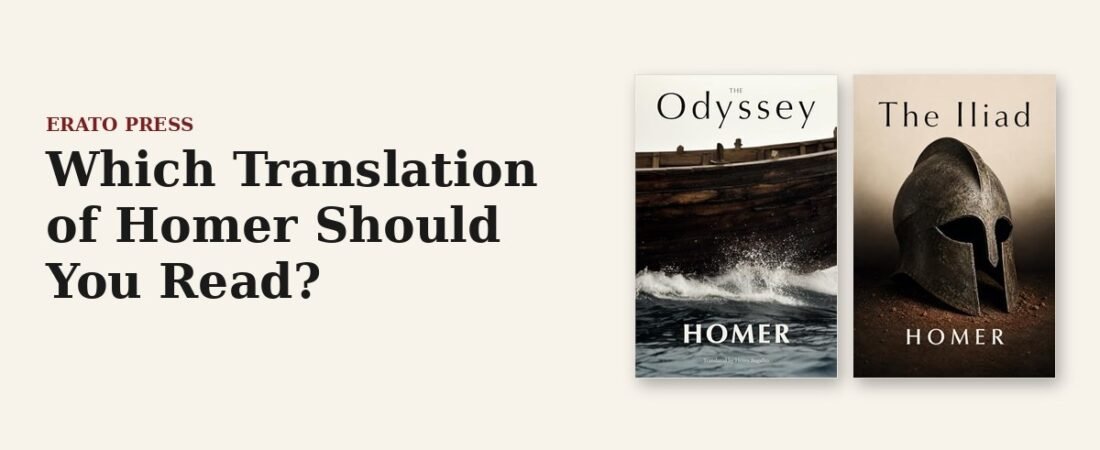
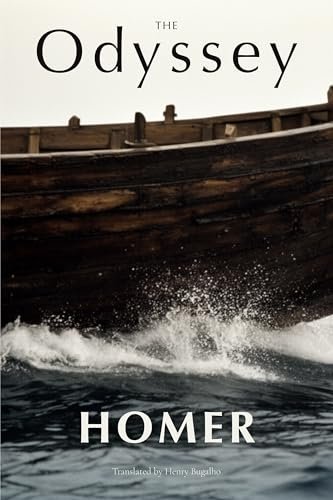
Short answer: There is no single “best” Homer — every translation is a set of trade-offs between accuracy, music, and readability. For a first reading, and especially before Nolan’s film, choose a version that moves: clear, propulsive, and framed with enough context that the strange names make sense. That is exactly what the Erato Press Odyssey and Iliad are built to be.
Why Homer has so many translations
Homer composed in dactylic hexameter, a six-beat line built for oral performance, full of formulas — “rosy-fingered Dawn,” “the wine-dark sea,” “much-enduring Odysseus.” No English meter reproduces it, and no English word carries the freight of the Greek. So every translator must choose what to sacrifice. Verse or prose? The music of the line or the speed of the story? The strangeness of the original or the comfort of the reader? There is no neutral choice. As our Iliad essay notes, the poem you hold “is not, in any sense that would satisfy a philologist, a document with a fixed author” — and the same fluidity runs all the way down to the words on your page.
The four real decisions
- Verse vs. prose. Verse keeps something of Homer’s formality and music; prose keeps the story moving and is far easier for a first read. If you have never read an epic before, prose removes the single biggest barrier.
- Faithful vs. fluent. A literal version preserves the odd epithets and repetitions; a fluent one smooths them into modern English. Scholars want the first; new readers almost always want the second.
- Old vs. new. The grand Victorian translations (Lang, Butcher, Butler) are free and beautiful but can feel archaic. Modern versions read faster but vary wildly in tone.
- Bare vs. framed. Homer assumes you already know his world — the gods, the war, the rules of xenia. A bare text drops you in unaided; a framed edition gives you the introduction, maps, and notes that make the unfamiliar legible. This matters more than any single choice of phrasing.
A quick history of Englishing Homer
The tradition is itself a great story. Chapman’s Elizabethan version is the one that made Keats feel like “some watcher of the skies.” Pope’s eighteenth-century couplets are magnificent and very much Pope. The Victorians produced the stately prose many of us first met. And the modern era — Lattimore’s line-for-line fidelity, Fitzgerald’s and Fagles’s verse, Emily Wilson’s lean recent Odyssey — has reopened every question about how Homer should sound in English. Each generation re-translates Homer because each generation hears him differently; the “afterlife of Homer” in translation is part of what keeps the poems alive.
What to choose for a first reading
If this is your first Homer — and especially if you are reading before the film — optimize ruthlessly for momentum and clarity. You want a version that reads like the page-turner the Odyssey actually is, not one that feels like homework. That means clear, propulsive English and an edition that frames the world for you. The Erato Press editions are made for exactly this reader: Homer in clear prose, with the context that makes the names and the bronze-age world make sense from the first page. Read the Odyssey first; if it takes hold — and it will — the Iliad is the deeper poem waiting behind it. Our essay on reading the Iliad and our piece on why the Odyssey still matters can help you decide where to go.
The Nolan rule of thumb
Here is the simplest test. Christopher Nolan’s Odyssey arrives in July; you want to walk in knowing the story, not slogging through it. So pick the translation you will actually finish — the one that reads fast enough to carry you to Ithaca before the lights go down. A finished plain translation beats an unfinished beautiful one every time.
Start with the Erato Press Odyssey →
Related reading: Why the Odyssey Still Matters · Reading Homer: The Iliad · Greek Classics: Where to Begin
This article contains affiliate links; as an Amazon Associate, Erato Press earns from qualifying purchases.
Enjoyed this piece?
Get the next one — our essays on the classics and news of each new Erato Press edition — straight to your inbox.