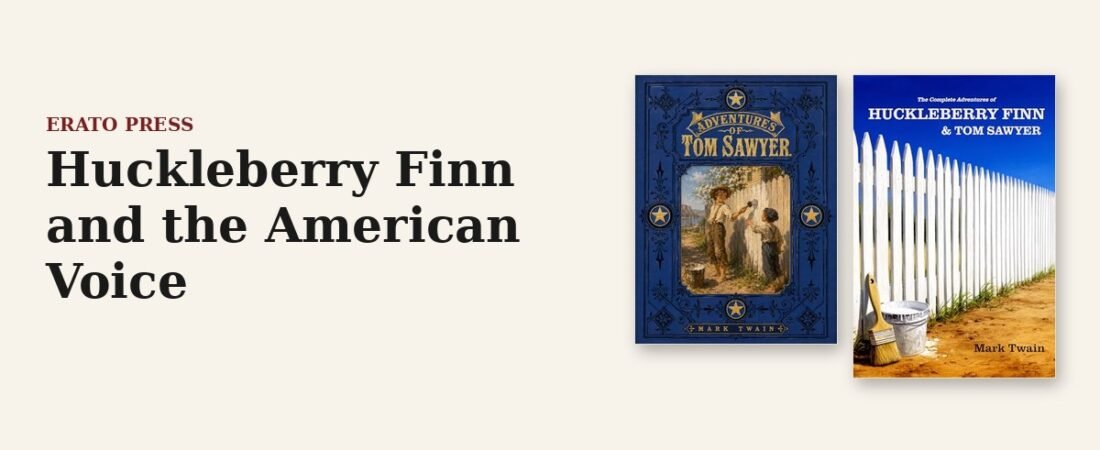
Short answer: Adventures of Huckleberry Finn (1884) is where American literature found its own voice — but the deeper revolution is epistemological. By trapping us inside the consciousness of a boy who does not understand the truth he is telling, Twain invented a new theory of how knowledge is made. “All modern American literature comes from one book called Huckleberry Finn,” said Hemingway, and he meant something precise.
The vernacular as a way of knowing
What makes Huck’s voice revolutionary is not simply that it is vernacular but that vernacularity becomes the condition of a new kind of knowledge. Huck does not know what he knows: this paradox is the engine of the novel. He cannot articulate his moral intuitions in the language of his culture, because that language would require him to recognise Jim as property, a thing, a lesser being. Instead his dialect, his “incorrect” grammar, his logical contradictions become the very medium through which a truer vision of Jim’s humanity emerges. When Huck says “I’ll go to hell,” he speaks a truth that the proper English of Miss Watson or Silas Phelps could never contain. The inarticulate speech carries more moral authority than eloquence would — and his illiteracy is not incidental to that clarity but essential to it. A literate Huck, schooled in the proper doctrines, would likely have been corrupted into accepting slavery as a natural fact.
Why the omniscient narrator had to go
Compare this with The Adventures of Tom Sawyer, published eight years earlier, which uses a third-person narrator standing above the action, commenting and guiding, dispensing moral instruction from a safe height. That is the conventional form inherited from Scott and Dickens, and it assumes that authority resides in the narrator’s omniscience — the power to stand outside events and judge them. Huckleberry Finn explosively rejects that assumption. Its entire moral authority flows from its refusal of omniscience, its commitment to Huck’s limited, confused, contradictory view. We are trapped inside his consciousness with no exit to the novelist’s traditional vantage point of superior knowledge. In the older mode, knowledge is something the narrator possesses and hands down; in Huck’s mode, knowledge emerges from the collision between consciousness and experience. He does not “know” slavery is wrong in any way he could state; he knows it the way one knows a thing through living it, through feeling its weight. That gap — between Huck’s self-understanding and the novel’s revelation of his true moral worth — is the space in which modern American fiction became possible.
The problem of Jim
Jim is the pivot around which the whole moral universe turns, and also the place where it becomes most resistant to a tidy reading. He is rendered with a humanity virtually unprecedented in American literature — and simultaneously through the lens of minstrelsy, the tradition of racial caricature that supplied much of the era’s popular entertainment. This contradiction is not a flaw to be apologised away; it is the essential condition of the novel’s power, and the honest critical task is to sit with it rather than resolve it through celebration or condemnation. In the great middle passages, Jim emerges as fully individual and morally equal to Huck. The fog scene, where Huck plays a cruel trick and Jim answers with a monologue of hurt — “what people call treachery” — grants Jim an interiority no prior character in American fiction had received. When Jim tells of his deaf daughter Elizabeth, of the moment he struck her in ignorance before realising she could not hear, the novel forces any reader to recognise him as a consciousness equal to Huck’s own.
The greatest moral crisis in American fiction
The novel’s central scene is one of the most important in American literature. Huck, raised to believe that helping a slave escape is a sin, writes the letter that would betray Jim — and then, thinking of Jim’s kindness, his protection, his friendship, tears it up: “All right, then, I’ll go to hell.” In that line a boy chooses human loyalty over everything his society has taught him is right, and Twain exposes the monstrous gap between conventional morality and actual goodness. His decision is a triumph of instinct over indoctrination. But the novel does not end there — and that refusal to end on the triumph is what has troubled readers since its first publication.
The ending nobody can settle
The final chapters — the “Evasion,” in which Tom Sawyer arrives and turns Jim’s escape into an elaborate game, when Jim could simply walk away — mark a catastrophic shift in his status: from Huck’s moral equal back to an object to be rescued, a role in a boy’s fantasy. Then comes the revelation that Jim was already free, manumitted in Miss Watson’s will, so that the entire drama collapses into bitter irony. Leo Marx famously argued that these chapters are a structural failure, Twain losing his nerve and retreating into the comic machinery of boy-adventure rather than following the book to its tragic logic. But there is another reading that takes the novel’s refusal of false comfort seriously: that Jim is freed not because he is human, not because slavery is unjust, but because a white woman’s legal document grants it — and that this is the point. Whatever moral victories Huck and Jim win on the river cannot translate into structural change. The Evasion exposes the inadequacy of private sentiment and individual goodness against the institutional machinery of slavery. In that light the ending is not a retreat from American racism but a refusal to console us about it.
Why it still unsettles
The book remains America’s great, troubled argument with itself about race and freedom — admired, taught, and fought over, its language and its ending still debated. That it cannot be read comfortably is part of its greatness: it forces every generation to reckon with the distance between the country’s ideals and its conduct. Read it for the voice, the river, and the boy who chose hell over betraying his friend — then read it again for everything Huck never knew he was telling you.
Related reading: The Great American Novel: A Reader’s Map · Where to Start With Ernest Hemingway · F. Scott Fitzgerald Beyond Gatsby
This article draws on the original critical essay written for the Erato Press edition. This article contains affiliate links; as an Amazon Associate, Erato Press earns from qualifying purchases.
Enjoyed this piece?
Get the next one — our essays on the classics and news of each new Erato Press edition — straight to your inbox.