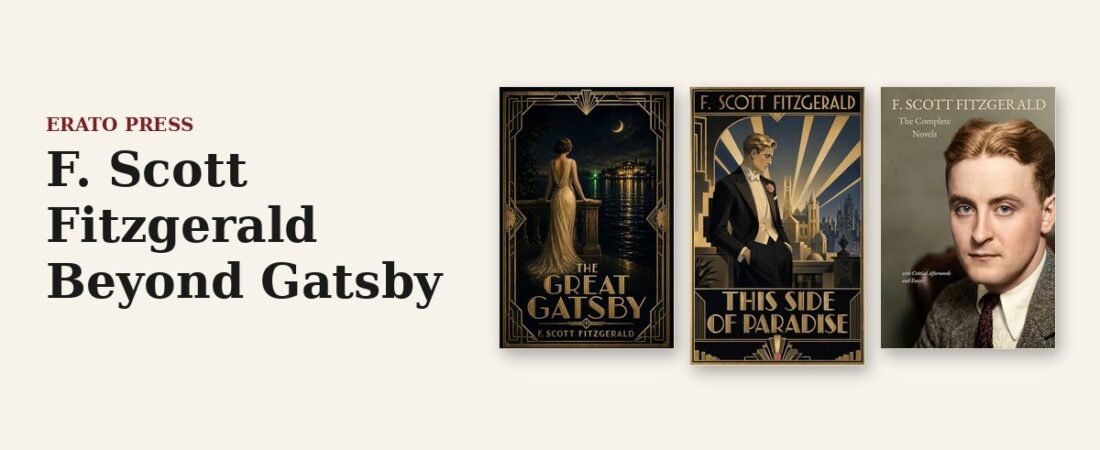
Short answer: If you only know The Great Gatsby, you know Fitzgerald at his most perfect but not his most complete. Read Tender Is the Night next — his sprawling, flawed, heartbreaking novel of glamour and collapse — and start at the beginning with This Side of Paradise. Fitzgerald was the laureate of the Jazz Age and its tragic morning after, and there is far more to him than one green light.
More than the Great American Novel
Gatsby is so perfect — so short, so symmetrical, so quotable — that it has eclipsed the rest of Fitzgerald’s work in the popular mind. That is a loss, because the other novels show a writer of wider range and deeper wounds. Read in sequence, the four novels do not trace the tidy arc of a mind refining its instruments; they repeat a single fundamental problem from different angles, with increasing pressure and decreasing hope: how does one live in America with one’s eyes open — keeping the capacity for wonder while seeing clearly the machinery that exploits it? The answer the novels give grows bleaker each time. And yet the novels themselves are luminous. That contradiction — bleak vision, radiant expression — is the central fact of his art.
This Side of Paradise
His debut made him famous overnight at twenty-three, and it still startles. It reads as if written from inside the consciousness of American youth rather than at a safe distance from it. Formally it is a Bildungsroman — a novel of education — but one that has lost faith in education itself: Amory Blaine’s schooling produces not a formed self but a series of borrowed identities, none fully inhabitable. Its famous structural oddity — the inserted poems, plays, and fragments — is not youthful excess but the texture of a consciousness made entirely of quotation and performance. Amory believes in his own specialness the way Americans are taught to as a birthright, and the book documents the hundred small ways that belief is disappointed without ever quite being destroyed.
Tender Is the Night
His most ambitious novel follows the charming psychiatrist Dick Diver and his wealthy, fragile wife Nicole through a slow, glittering descent on the French Riviera. It is uneven where Gatsby is tight — but it reaches for more, and its portrait of how money corrodes, how charm curdles, and how a marriage can consume one partner to save the other is drawn from the rawest material of Fitzgerald’s own life with Zelda. It is a flawed masterpiece, and the flaws are part of its truth: this is a writer who could not ironise his way out of what he knew, and whose technical imperfections are precisely where the deepest feeling breaks through.
The stories and the crack-up
Don’t miss the short stories — “Babylon Revisited” is as fine as anything he wrote — or the late autobiographical essays in which Fitzgerald, broke and half-forgotten, anatomised his own collapse with terrible clarity: “in a real dark night of the soul it is always three o’clock in the morning.” He called the right to write that way “the authority of failure” — the authority that comes only from having genuinely been broken. That unsparing self-knowledge is his deepest gift, and it is nowhere in the popular image of the party-throwing Jazz Age boy.
Why read beyond Gatsby
Because the full Fitzgerald is the story of the American dream and its hangover, written by a man who lived both, alongside his great contemporary Hemingway in the same expatriate decade. The world wins in these books — old money wins, time wins, intelligence and beauty count for almost nothing against American capitalism’s indifference — and the only redemption available is the writing itself, which preserves in language what cannot be saved in life. Read the complete novels and you get not a single shimmering symbol but a whole arc: the rise, the glamour, the crack-up, and a writer braver about failure than almost any other. To place him in his moment, read him beside the Lost Generation he helped define.
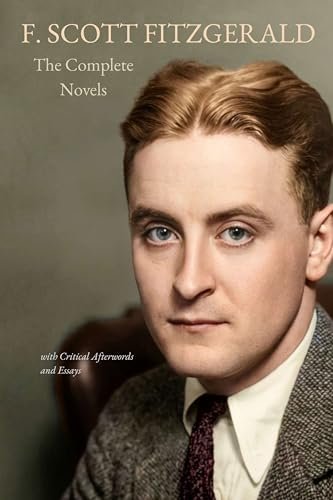
Read the complete novels of F. Scott Fitzgerald →
Related reading: The Great American Novel: A Reader’s Map · Where to Start With Ernest Hemingway · A Farewell to Arms and the Lost Generation
This article draws on the original critical essay written for the Erato Press edition. This article contains affiliate links; as an Amazon Associate, Erato Press earns from qualifying purchases.
Enjoyed this piece?
Get the next one — our essays on the classics and news of each new Erato Press edition — straight to your inbox.