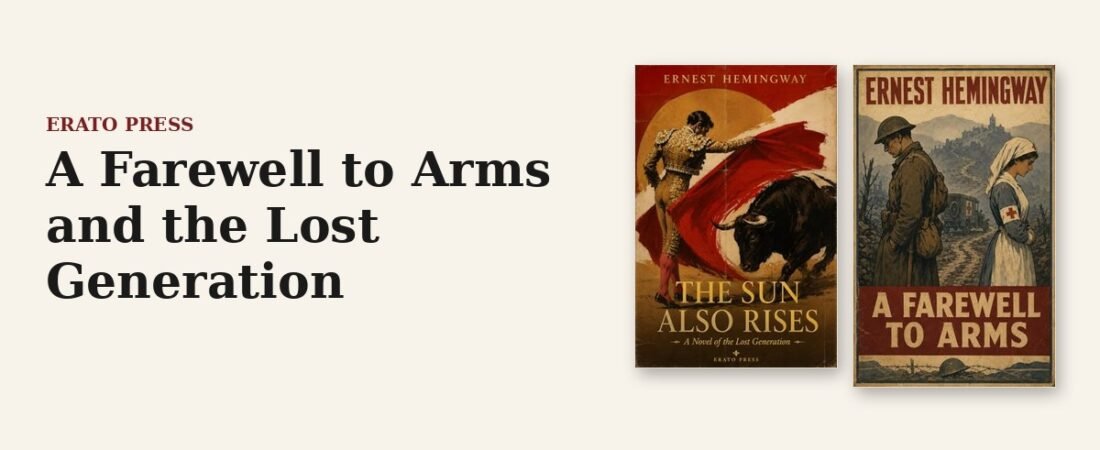
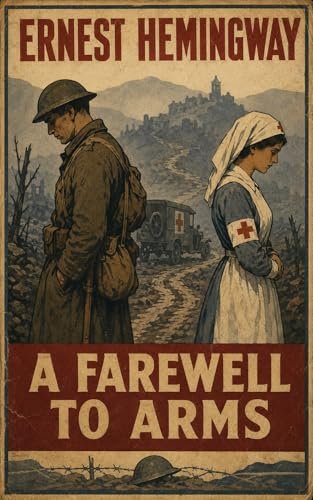
Short answer: A Farewell to Arms (1929) is the defining novel of the Lost Generation not because it describes disillusion but because its very prose is disillusion — a style built on the distrust of big words, calibrated to render death without consolation. It is a love story, but its real subject is what Hemingway learned at nineteen on an Italian riverbank: that death is immediate, casual, and random, and that the only honest response is to describe exactly what happened and leave the grief beneath the surface.
Who were the Lost Generation?
The phrase was Gertrude Stein’s, made famous by Hemingway, and it names the generation that came of age during the First World War and emerged spiritually wrecked. They had been handed the grand nineteenth-century words — honour, glory, sacrifice, country — and then watched those words drown in the industrialised slaughter of the trenches. What remained was a refusal to be lied to. Hemingway’s whole style is the literary form of that refusal: the distrust of abstraction, the retreat to concrete things. The novel contains its own manifesto when its narrator, an American ambulance driver, reflects that he “was always embarrassed by the words sacred, glorious, and sacrifice,” that “abstract words such as glory, honor, courage, or hallow were obscene beside the concrete names of villages, the numbers of roads, the names of rivers.” That is the generation’s creed in a sentence: after the war, only concrete things could be trusted, because the grand abstractions had become lies.
The wound that taught him everything
The style has a precise biographical origin. On the night of July 8, 1918, at Fossalta di Piave, a mortar shell exploded next to the nineteen-year-old Hemingway as he handed out chocolate and cigarettes to soldiers at a forward canteen. The man beside him was killed; Hemingway recovered with some two hundred metal fragments in his body. In that instant he learned what many people never learn and others learn only at the very end: that death is not abstract, not metaphorical, not reserved for the old and the ill, but immediate, casual, and random, capable of arriving on an ordinary afternoon. This knowledge — mortality as something present rather than distant — is the foundation of what he later called the iceberg theory: the conviction that the deepest meaning of a story should stay submerged, that what you leave out is what gives the words their weight.
Love rendered without consolation
Against the ruined backdrop of the Italian front, Hemingway sets a love story between the narrator and the nurse Catherine Barkley, and makes it the only source of meaning in a meaningless world. But he refuses both sentimentality and rescue. What distinguishes his treatment of death from the entire Romantic tradition is precisely this discipline: the death is rendered without the apparatus of consolation, without the elegiac mode’s aesthetic distancing, without religious or philosophical scaffolding. Catherine dies, without warning or ceremony, in a Swiss hospital, as casually as the shell came at Fossalta. Henry walks back to the hotel in the rain. This is what there is. The seventeenth-century poets compared death to sleep, to beautiful landscapes; Hemingway compared it to nothing. The restraint of the final pages — the refusal to weep on the page — is exactly what makes them unbearable, because the grief is seven-eighths below the surface of a sentence that says, simply, what the narrator did next.
“The world breaks every one”
The book’s bleakest sentence is also its truest: “The world breaks every one and afterward many are strong at the broken places. But those that will not break it kills. It kills the very good and the very gentle and the very brave impartially.” Hemingway wrote that in 1929, at thirty. He would spend the next three decades living into it — broken, and broken again, strong at some of the broken places — until in 1961 the breaking became too total and the strength insufficient. The sentence is not consolation; it is diagnosis. Tenderness offers no protection against a universe indifferent at best, and the novel’s honesty about that fact is the source of its permanence.
The world’s first reading
When A Farewell to Arms appeared, it was received with wide enthusiasm and considerable controversy. The frankness of the love story struck many reviewers first — Hemingway had written about the physical dimension of love with a directness English-language fiction had rarely attempted. But the more careful readers understood that the sex was not the subject; it was the surface of a deeper engagement with war and loss, attempted with a combination of emotional fidelity and formal discipline no one had quite managed before. A century on, the novel remains among the handful of American books most often cited as the definitive rendering of the First World War, and “Hills Like White Elephants” sits in nearly every anthology of the American short story. The conversation around the work has changed — the feminist critique of Catherine’s characterisation, the new attention to the historical conditions that produced the iceberg theory — but those conversations have enriched rather than diminished the achievement, sharpening our sense of what it cost and what it carried.
Why it endures
Because it gave permanent form to a modern feeling: the loss of faith in inherited ideals, and the search for something true to hold when the big words have failed. Every disillusioned war story since owes it a debt. It is the fullest expression of Hemingway’s technique within its proper scope — the individual consciousness in the presence of extreme experience — and for that reason it cuts deeper than the imitations it spawned. To place it in its world, read it beside The Sun Also Rises and alongside Fitzgerald‘s record of the same exiled decade. Read it for the love; stay for the unflinching honesty about grief.
Read the Erato Press A Farewell to Arms — with the full critical essay this post draws on →
Related reading: The Great American Novel: A Reader’s Map · Where to Start With Ernest Hemingway · F. Scott Fitzgerald Beyond Gatsby
This article draws on the original critical essay written for the Erato Press edition. This article contains affiliate links; as an Amazon Associate, Erato Press earns from qualifying purchases.
Enjoyed this piece?
Get the next one — our essays on the classics and news of each new Erato Press edition — straight to your inbox.