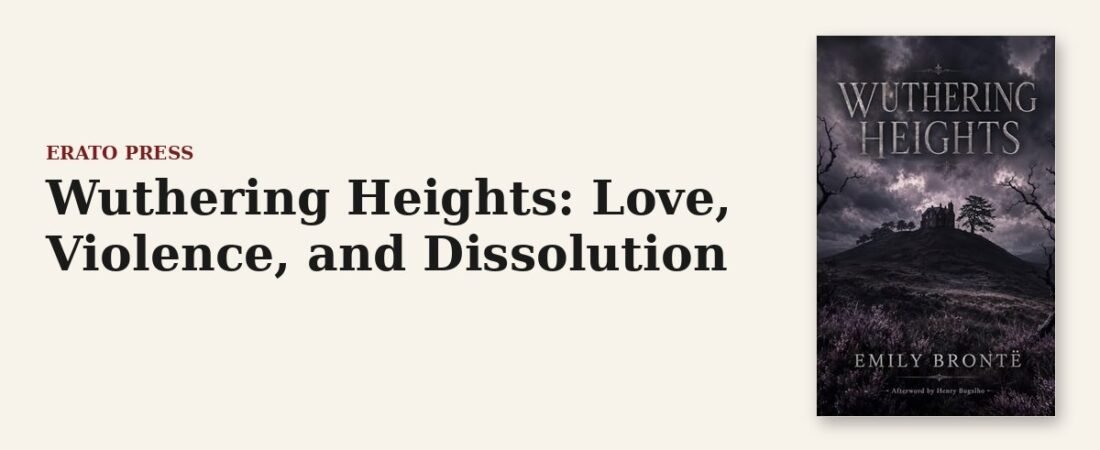
Short answer: Wuthering Heights is the most extreme novel in English — a love story with no morality, no heroes, and no comfort, in which passion is indistinguishable from cruelty and the dead refuse to stay buried. It shocks first-time readers expecting romance because it is not one. Its real subject is dissolution: the systematic collapse of every boundary that makes civilized life possible.
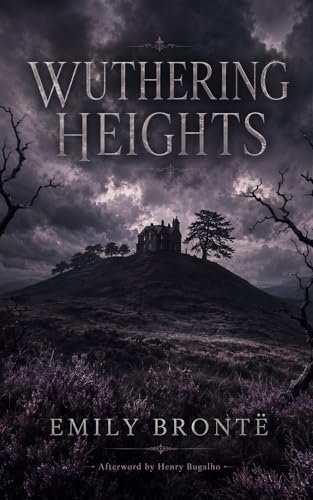
Some books ask to be inhabited, not understood
Wuthering Heights is one of them. Published in 1847 under the male pseudonym Ellis Bell, Emily Brontë’s only novel arrived as a scandal — too brutal, too strange, too savage for Victorian taste. Critics did not know what to make of it. Even Charlotte Brontë, in the preface she wrote after Emily’s death, tried to domesticate it, presenting her sister as a rustic mind unfamiliar with the world. But that excuse is also a confession: there was something in the book the family itself could not name. The novel opens with an intrusion — Lockwood, a London gentleman, calling on his landlord and finding a world he cannot decode — and on his first night he dreams of an ice-cold child’s hand clutching his through a broken window, a voice pleading “Let me in.” It is the book’s founding gesture: what is outside wants in, what is inside wants out, and no boundary holds.
Not a romance — an ontology
The popular image of Heathcliff and Catherine as great romantic lovers misses the book entirely. Their bond is not affection but a kind of fusion. Pressed to explain why she will marry the gentle Edgar Linton when she loves Heathcliff, Catherine reaches for something language can barely hold: “He’s more myself than I am. Whatever our souls are made of, his and mine are the same.” And then, more radically: “Nelly, I am Heathcliff.” This is no metaphor. It is an ontological claim. Catherine does not love Heathcliff as one loves another person; she is him, and to separate them is not to lose a love but to mutilate a being. A love that absolute cannot coexist with marriage, ordinary life, or even kindness. It produces not happiness but devastation — betrayal, a revenge that spans two generations, children warped by their parents’ violence. Emily Brontë wrote a love so total it becomes annihilating, and refused to pretend it was beautiful.
A world without moral guardrails
What disturbs readers most is the absence of any reassuring moral voice. There is no character who stands for decency and wins; cruelty goes largely unpunished. And the absence is built into the form. The story reaches us through nested, unreliable narrators — Lockwood hearing Nelly Dean hearing Catherine hearing Heathcliff — so that the truth of events is finally irrecoverable. Nelly is a servant who took part in what she describes, with her own interests, her own omissions and judgments; Lockwood is a sentimental outsider who understands nothing of what he witnesses. The reader is left suspended between partial testimonies, with no direct access to any consciousness. The narrative structure itself enacts the novel’s deepest theme: the impossibility of ever reaching another person. It is one of the few canonical novels that genuinely declines to tell you how to feel.
Dissolution as the real subject
Beneath the plot, the novel is obsessed with the breakdown of boundaries — between self and other, inside and outside, living and dead, human and natural. The text is saturated with doors, windows, and thresholds, spaces of passage that are also spaces of interdiction. Catherine, in the delirium before her death, tears the feathers from her pillow and names them one by one, partridge and wild duck and pigeon, as if trying to recover the outdoor world the bourgeois bedroom denies her. Her madness is also a kind of clairvoyance: she sees the dissolution of boundaries that others pretend hold firm. And here is the novel’s strangest detail — at the very moments of death, the vocabulary of thresholds simply vanishes from the prose. In the chapter where Catherine dies, not a single door or window is mentioned; the same erasure falls over Heathcliff’s end. What the book theorizes in its content it performs in its texture: at the decisive moments, boundaries cease even to exist as words, and what remains is only the body — and the body, in this novel, appears only when it suffers or when it dies.
Desire works the same way. Catherine and Heathcliff never consummate their love; there is no sex scene, not even a kiss, only a violent convulsive embrace on her deathbed that leaves bruises on her skin. The book is charged with erotic intensity and displaces all of it onto violence — slaps, scratches, clutching hands, bleeding wrists. Desire is everywhere and everywhere forbidden, which is why the novel feels less like a story than a force.
The quiet that may not be quiet
Brontë was far too intelligent to grant a clean ending. The second generation — young Cathy and the brutalized Hareton — appear to reconcile: she teaches him to read, he plants flowers, the cycle of violence seems broken, and, tellingly, the vocabulary of thresholds returns to the prose as they take hold. But the final word goes to Lockwood, the narrator who never understood anything, standing at three graves and concluding that he cannot imagine “unquiet slumbers for the sleepers in that quiet earth.” It is a sentence of peace spoken by someone who does not know how to listen — while the country folk swear they have seen Heathcliff and a woman walking the moors on rainy nights, and even Nelly no longer likes to be alone in the house. The novel ends with a denial that does not deny, a sleep that may not be sleep.
Why read something so bleak
Because nothing else delivers what it delivers: the raw, frightening truth that love can be a destroyer as easily as a redeemer, written by a reclusive parson’s daughter who somehow knew. Emily Brontë died in December 1848, barely a year after the book appeared, thirty years old, having refused medical treatment to the last. She left no letters of consequence, no interviews, no account of what she meant — only this one novel that lives as if conventions, and finally death itself, were merely boundaries to be ignored. Read it not for comfort but for its terrible honesty and its strange, howling beauty. There is no second book like it, because there could not be.
Read the Erato Press Wuthering Heights — with the full afterword this post draws on →
Related reading: The Brontë Sisters: Where to Start · Heathcliff: Hero, Villain, or Something Worse? · The Life of Charlotte Brontë
This article draws on the original afterword “Dissolution as Destiny,” written for the Erato Press edition. This article contains affiliate links; as an Amazon Associate, Erato Press earns from qualifying purchases.
Enjoyed this piece?
Get the next one — our essays on the classics and news of each new Erato Press edition — straight to your inbox.