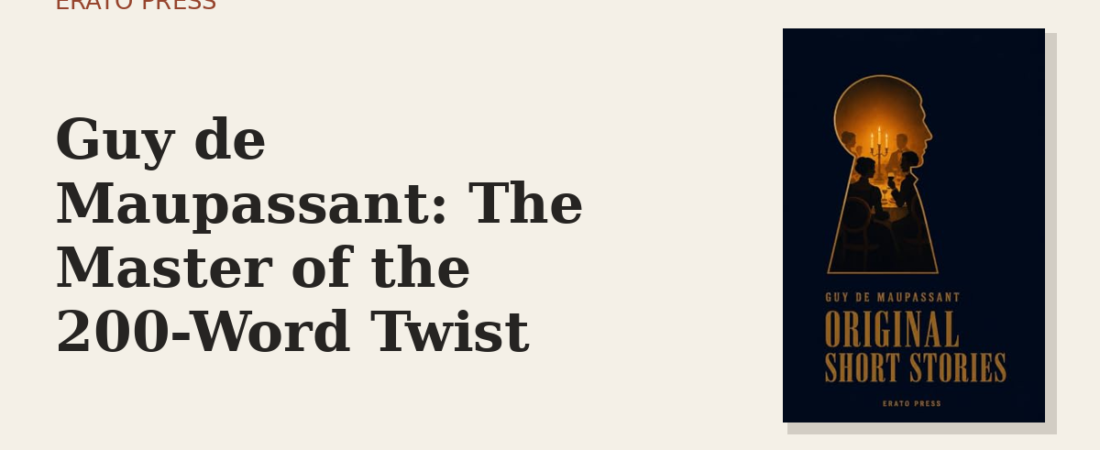

Maupassant wrote nearly three hundred short stories in a career that lasted barely a decade before syphilis destroyed his mind, and he did more than almost any writer in any language to prove that a short story could carry the emotional weight of a novel in a fraction of the pages. The Necklace — a woman who borrows what she believes is a diamond necklace, loses it, and spends ten years of poverty secretly replacing it — is one of the most perfectly engineered twist endings ever written.
But the twist stories are only part of the range collected here. Maupassant, a student and protégé of Flaubert, was equally capable of unadorned, devastating realism about Norman peasants, colonial soldiers, and the Franco-Prussian War, with none of the ironic trapdoor his most famous story relies on.
He’s the direct ancestor of every writer since who’s tried to make a short story do the work of a novel — including, in their own very different registers, Chekhov and Poe.
Read Guy de Maupassant: Original Short Stories →
Enjoyed this piece?
Get the next one — our essays on the classics and news of each new Erato Press edition — straight to your inbox.