Short answer: Start with Pride and Prejudice — the most perfect entertainment in the language — and if it wins you over, read Emma next and save Persuasion for when you want Austen at her deepest. Do not begin with the unfinished or minor works; meet her at full power first, because reading her well is harder, and more rewarding, than her reputation as light romance suggests.
Why Austen is harder to read well than she looks
Jane Austen is the most reread novelist in English and the most underestimated. The covers and the costume adaptations sell her as romance; the novels themselves are something far sharper — comedies of moral education, written in a prose of surgical irony, about the deadly serious business of how a woman without money was to live in a world that gave her almost no choices. Her marriage plots are not whimsy. They are a clear-eyed report from inside a system in which marriage was, for most women, the only available economy, and in which a wrong choice meant a lifetime of dependence. Read her for the love stories and you will enjoy yourself; read her for the irony, the social anatomy, and the moral intelligence underneath, and you will never stop.
Start with Pride and Prejudice
It is the ideal entry: the wit at its most dazzling, the romance at its most satisfying, the social comedy at its most precise. On the surface, Pride and Prejudice is the war of pride and prejudice between Elizabeth Bennet and Mr Darcy; underneath, it is a serious drama about learning to see clearly — to correct one’s own misjudgments. Elizabeth, the sharpest mind in the book, is wrong about nearly everyone who matters, and the plot is the slow, humbling correction of her vision. It earns its happy ending by making both lovers grow up, which is exactly why it has survived two centuries of imitation. Begin here and you meet Austen’s method whole.
Then Emma — and finally Persuasion
After Pride and Prejudice, read Emma, Austen’s most technically dazzling novel — a comedy built around a heroine who is charming and almost always wrong, narrated so slyly that the reader is invited to be deceived right alongside her. Then save Persuasion, her last completed novel, for last: it is quieter, autumnal, and the most emotionally mature thing she wrote — the book of second chances and late, undeserved grace. If you want her full range in between, the early and sharper Sense and Sensibility and the satirical Northanger Abbey round out the picture.
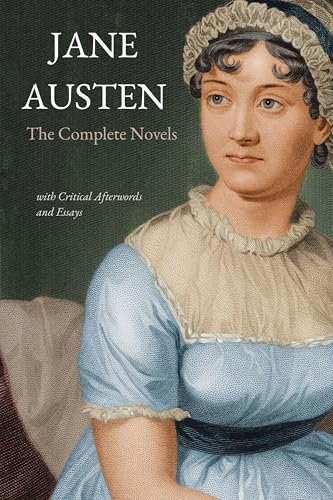
Get the complete novels of Jane Austen →
Read the whole shelf
There are only six finished novels, and every one repays rereading for a lifetime — which is the rarest praise a body of work can earn. Austen famously worked on “two inches of ivory,” a handful of families in a country village, and discovered that a drawing room contains the entire moral universe: ambition, cruelty, self-deception, love, and money, all in miniature and all the more visible for it. The two remaining novels round out the shelf: Mansfield Park, her most morally severe and most debated book, and Northanger Abbey, her sly send-up of gothic romance. Read in any order after the first three, they reward the reader who has learned to hear the steel beneath the wit. The complete Austen is one of the great companionable bodies of work in literature — the kind you live alongside rather than simply finish, returning to a different novel at each stage of your own life.
Related reading: Pride and Prejudice: Why It Still Works · Share this:WhatsAppXFacebook