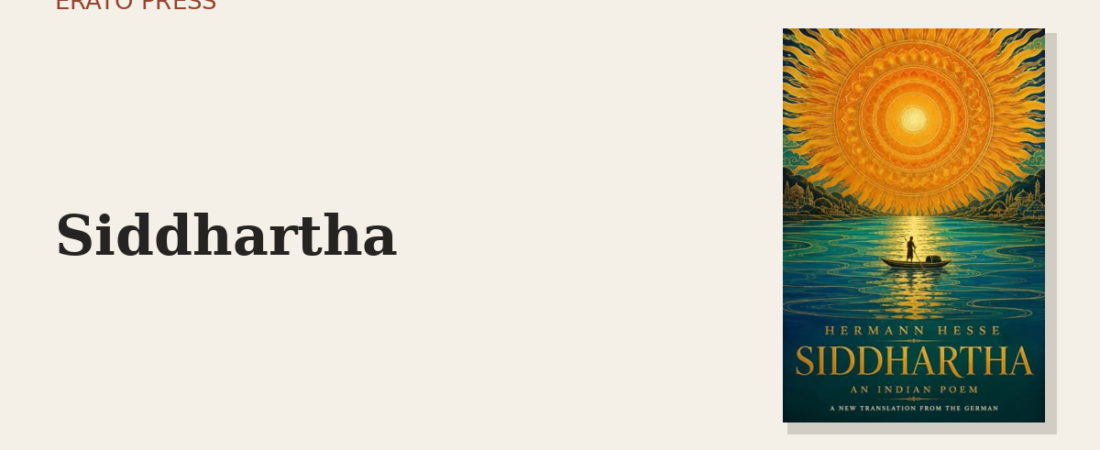

A young Brahmin’s son leaves everything — his father, his caste, his comfort — to find the meaning of existence. He becomes an ascetic, then a rich merchant, then a lover, then a ferryman, and learns, slowly, that wisdom cannot be taught, only lived. Hermann Hesse’s Siddhartha is barely a hundred and fifty pages, and for millions of readers it has been a door into the spiritual life.
Written by a European in the 1920s and set in the India of the Buddha, it became, decades later, the sacred text of the 1960s counterculture — the book passed hand to hand by everyone looking East for what the West had stopped providing. Its lesson is simple and hard: that no teacher, no doctrine, not even the Buddha himself, can hand you enlightenment; that you must walk through desire and loss and folly yourself; and that the answer, when it comes, is not a thought but a way of being — the river that is everywhere at once, the acceptance of the whole of life.
Hesse, who also gave us the divided soul of Steppenwolf, wrote Siddhartha out of his own breakdown and search. It is the gentlest of his books, and the one people press on those they love.
This edition offers a fresh English translation from the German, with a critical study.
Read Siddhartha — the Erato Press edition →
Enjoyed this piece?
Get the next one — our essays on the classics and news of each new Erato Press edition — straight to your inbox.