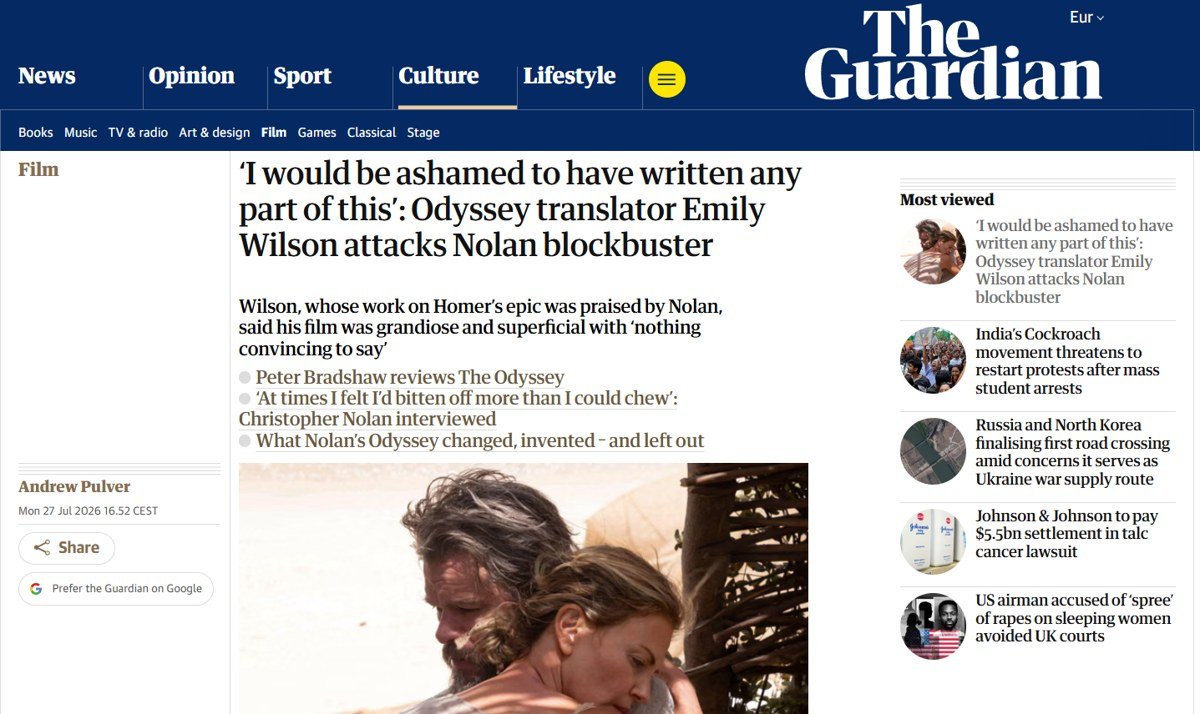
Emily Wilson has seen Christopher Nolan’s Odyssey, and she would like you to know that the food looks horrible.
That is not a paraphrase. In a scathing essay for the London Review of Books — pointedly titled “An Uncomplicated Man,” a jab at her own famous rendering of Odysseus as “a complicated man” — and in interviews that followed, Wilson, professor of classical studies at the University of Pennsylvania and the translator whose 2017 Odyssey Nolan himself had praised in early publicity, took the film apart with a relish that surprised even those inclined to agree with her. The film, she said, “has nothing convincing to say.” It “lacks psychological, emotional, political and ethical depth.” Its structure is “gimmicky,” its writing “abysmal.” And then, the line that traveled: “There are no sex scenes, and all the food looks horrible.” Her verdict on the script Nolan built partly in homage to her: “I would be ashamed to have written any part of this.”
It is, one has to say, a remarkable performance. And it is worth taking seriously — not because it is right, but because of the very particular way it is wrong. Wilson has produced the most articulate possible version of a mistake that we have been watching everywhere this month, made by ordinary viewers and distinguished classicists alike: a fundamental misunderstanding of what a film adaptation actually is, and of what it can possibly owe to the thing it adapts.
The irony at the center
Let us begin with the awkward fact that Wilson, of all people, should be the last to make this argument — because Emily Wilson is herself an adapter, and a famously bold one.
A translation is not a transcription. It is a series of choices, betrayals, and inventions, each of which sacrifices something in the original to save something else in the new tongue. Wilson knows this better than almost anyone alive; she has written eloquently about it. Her Odyssey is celebrated precisely because it refused to be faithful in the pedantic sense. Where centuries of translators reached for archaic grandeur, she wrote plain, quick, contemporary English. Where Homer opens with polytropon — a dense, untranslatable word meaning something like “of many turns,” “much-turning,” “versatile” — she gave us, with a translator’s daring, “a complicated man.” Purists objected. Some classicists thought she had flattened Homer, modernized him, imported a sensibility he never had. Her translation was widely praised and, in exactly the same breath, sharply contested — for doing to the Greek text what she now accuses Nolan of doing to the poem: making choices.
“Complicated man” is a magnificent liberty. It is also, structurally, the same kind of act as everything Nolan does on screen. Wilson took an epic in dactylic hexameter, composed for oral performance nearly three thousand years ago, and rebuilt it in the idiom of the twenty-first century so that a modern reader would feel something. That is adaptation. To then condemn a filmmaker for the crime of adaptation — for failing to deliver a “faithful” Homer — is to forget the nature of one’s own craft. The translator has forgotten that she is a translator.
What an adaptation actually is
Here is the thing that the purist, in every generation, cannot accept: *you cannot put the Odyssey on a screen. Not the actual Odyssey*.
The poem is not a story that happens to be written in verse. It is an oral-formulaic epic, and almost everything that makes it the Odyssey is bound to the medium of sung poetry. The repeated epithets — “rosy-fingered dawn,” “much-enduring Odysseus” — that a modern ear finds quaint were memory-scaffolding for a performing bard. The long catalogues, the digressions nested inside digressions, the ring composition that loops back on itself, the invocations of the Muse, the flashbacks told over dinner across four books — these are features of a form that was never meant to be watched. There is no cinematic equivalent of an epithet. There is no way to film a metrical formula. To move Homer to the screen is not to translate his words; it is to translate his form into a form that shares almost none of its DNA — and that act of translation is, necessarily, a wholesale reinvention.
And that is before we reach the harder problem: the poem’s values. The literal Odyssey is a world of enslaved people treated as furniture, of a hero whose ten-year detour includes years in the beds of goddesses while his wife’s fidelity is the moral center, of a homecoming that climaxes in the mass slaughter of the suitors and the hanging of the enslaved women who slept with them. Film all of that straight, without interpretation, and a modern audience does not experience Homer — it recoils. Every adaptation of the Odyssey must decide what to do with three thousand years of moral distance. There is no neutral choice. There is no faithful film. There are only interesting betrayals and boring ones.
The double bind every adapter walks into
This is the trap, and it is inescapable. If you are faithful, you alienate the audience. If you are unfaithful, you enrage the purists.
Keep the epithets and the catalogues and the ring structure, and the general public walks out after twenty minutes. Keep the archaic value system without comment, and you have made something monstrous. So the adapter modernizes, compresses, invents connective tissue, gives the characters motivations a contemporary viewer can feel — and the moment he does, the classicist rises to say that this is not Homer, that the depth is gone, that the writing is abysmal and the food looks horrible.
Both complaints cannot be satisfied at once, because they are contradictory demands. The purist who wants fidelity does not actually want fidelity; a truly faithful Odyssey would bore and offend the purist too. What the purist wants is the feeling of the poem as they personally experienced it — and that feeling is untransferable, because it was produced by the poem, in its own medium, doing things no other medium can do. The correct question to ask of an adaptation is never “Is it faithful?” It is: “Is this a good betrayal? Does the reinvention illuminate the original, or merely exploit its name?” That is a real question, and a hard one. “The writing is abysmal” is not an answer to it. It is a refusal to ask it.
Where Wilson is right — and where we said so first
None of this makes the film beyond criticism. It is not, and we should be honest, because we published our own long and unsparing review of Nolan’s Odyssey — and we faulted it. We wrote about its lost sunlight, the way its perpetual gloom betrays the solar, Apollonian brightness that is native to Greek myth. We objected, at length, to Nolan’s decision to cut the “Nobody” episode, the pun that triggers Poseidon’s wrath and sets the entire homecoming in motion. So we are not here as Nolan’s apologists. When Wilson says the film can be grandiose and thin, she is sometimes simply right, and we said versions of the same thing.
But notice the difference. To criticize an adaptation for how it adapts — for a muddy palette, a dropped scene, a hollow character — is legitimate, and necessary, and it is the work of criticism. To criticize an adaptation for the fact that it is an adaptation, for failing to be the poem, is a category error dressed up as a standard. Wilson slides between the two, and her genuine aesthetic points get their authority from a demand no film could ever meet. The tone does not help. “I would be ashamed to have written any part of this” and “all the food looks horrible” are not the sentences of someone weighing a work; they are the sentences of someone settling a score.
And yet — to her great credit — Wilson does not end there, and neither should we. In the same breath she grants the thing that matters most: the film “is still an event to celebrate.” It is bringing audiences back to cinemas. Translations of the Odyssey, including her own, are “flying off the shelves.” Perhaps, she says, it will even save a few university literature departments from the axe. “Nolan is doing his best to get the general public reading again, and I am grateful.” That is the true verdict, and it quietly contradicts the rest of the essay. A film that sends people back to Homer has done the one thing an adaptation of Homer most needs to do.
The only way to settle it
Which brings us to the point on which Wilson, Nolan, and Erato Press all secretly agree: read the poem.
You cannot referee this quarrel from the cheap seats. To know whether Nolan’s betrayals are illuminating or empty, whether Wilson’s fury is scholarship or scorekeeping, you have to hold the original in your head — and most of the people arguing about this film, on all sides, have not read the Odyssey since school, if at all. The film is an argument about the poem. You cannot judge an argument having heard only one party.
So read Homer, properly, and make up your own mind. If you want the whole of him in one hand, there is Homer: The Complete Works — the Iliad, the Odyssey, and the Hymns, annotated, in one critical volume. If you want the journey the film adapts, there is The Odyssey in a clear prose translation — including the “Nobody” scene Nolan left out — and, for the war that makes the homecoming necessary, The Iliad. For the whole cycle from the golden apple to the horse, there is The Trojan War: The Complete Saga; for the epic told whole and swift, The Odyssey: A Retelling.
And since this whole affair began with a translator, it is worth remembering that every Odyssey you can buy — Wilson’s, Fagles’s, Lattimore’s, ours — is already an adaptation, a set of choices, a beautiful betrayal of a Greek most readers will only ever meet through someone else’s choices. If you want to understand why “complicated man” was a bold act and not a neutral one, we wrote a guide to the translations and what each of them chooses to sacrifice. Start there, or start with the reasons the poem has outlived every retelling for three thousand years. Then go and see the film, and quarrel with it honestly — which is to say, from the text.
Emily Wilson is right about one thing above all, though not in the way she meant it. The Odyssey is greater than anything anyone will ever make of it — greater than Nolan’s film, and greater, too, than any single translation of it, including hers. That is not an argument against adaptation. It is the reason adaptation never stops.
Enjoyed this piece?
Get the next one — our essays on the classics and news of each new Erato Press edition — straight to your inbox.