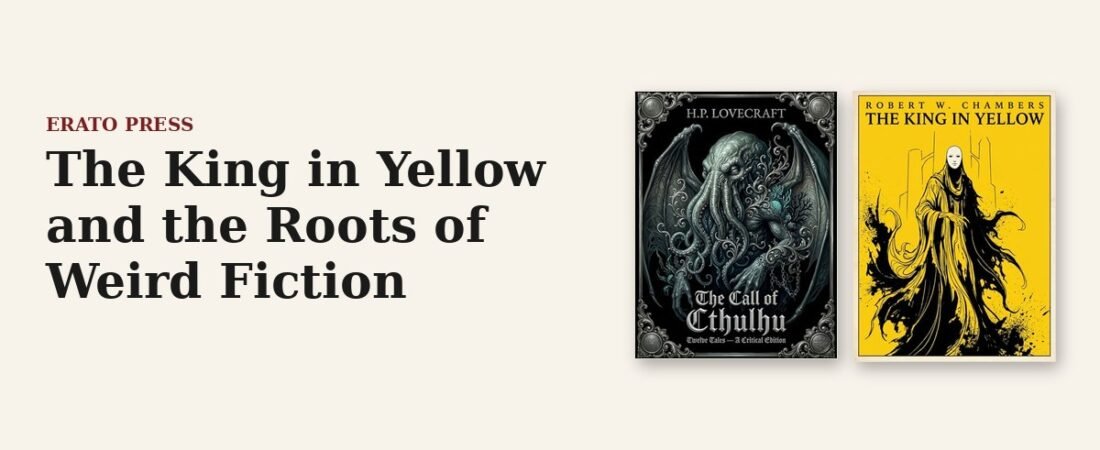
Short answer: The King in Yellow (1895) is a collection of eerie stories linked by a forbidden play that drives anyone who reads it mad. Robert W. Chambers’s strange little book is the missing link between Edgar Allan Poe and modern weird fiction — the soil H. P. Lovecraft grew from, and the reason “cosmic horror” exists at all.
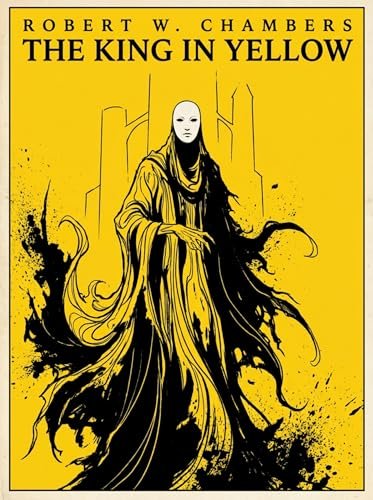
The book inside the book
Chambers’s masterstroke is a thing he never fully shows you: a play, The King in Yellow, whose first act is harmless but whose second act reveals truths so terrible that reading it shatters the mind. By keeping the play mostly off-page — a few quoted lines, a scattering of names like Carcosa, Hastur, and the Yellow Sign — Chambers invented one of horror’s most powerful techniques: the suggestion that some knowledge is itself contagious, that to understand certain things is to be destroyed by them. He borrowed the lost-city name Carcosa from Ambrose Bierce and handed it on, half-furnished, to everyone who came after; the genius is in the withholding. The reader’s own imagination supplies the horror the text refuses to name, which is why no film or illustration has ever matched the dread of the four linked tales that open the book.
From the haunted self to the indifferent cosmos
This is the hinge on which horror turns toward the modern. Poe‘s terror was psychological — the haunted individual, the guilty mind, the grave, reason collapsing in on itself. Chambers points outward, toward a horror that is impersonal and metaphysical: the dread that reality itself contains something monstrous and that human sanity is a thin film over an abyss. That idea — that the universe is not evil but indifferent, and that knowledge of its true nature is fatal — is the seed of everything we now call cosmic or weird fiction. It arrives at the same fin-de-siècle moment as Dracula, but where Stoker’s terror is a foreign body invading a documented world, Chambers’s is the suspicion that the documentation itself is a comforting lie.
The line to Lovecraft and beyond
Lovecraft read Chambers and absorbed the lesson: build a mythology of forbidden texts and unspeakable names, and let the reader’s imagination supply the horror you withhold. The Yellow Sign becomes the Necronomicon; Carcosa becomes R’lyeh. You can trace the inheritance directly into Lovecraft’s own tales, gathered in The Call of Cthulhu, and onward into the present — the first season of True Detective is steeped in Chambers’s imagery, its detectives quoting Carcosa and the Yellow King a century after the book appeared. For a book most people have never read, its fingerprints are everywhere.
Why read it now
Because it’s short, genuinely strange, and unlike almost anything else from the 1890s — a fever dream that feels eerily contemporary. It also captures weird fiction at the exact moment of its birth, before the formula hardened: the later stories in the collection drift into wistful Parisian romance, as if Chambers himself flinched from the abyss he had opened. That unevenness is part of the fascination. You are watching a writer stumble onto something larger than he could control, name it once, and then back away — leaving the door ajar for everyone who came after.
Read the Erato Press King in Yellow →
Related reading: The Essential Gothic Novels: A Reader’s Guide · Dracula: How Bram Stoker Invented the Modern Vampire · Edgar Allan Poe: Where to Start
This article contains affiliate links; as an Amazon Associate, Erato Press earns from qualifying purchases.
Enjoyed this piece?
Get the next one — our essays on the classics and news of each new Erato Press edition — straight to your inbox.