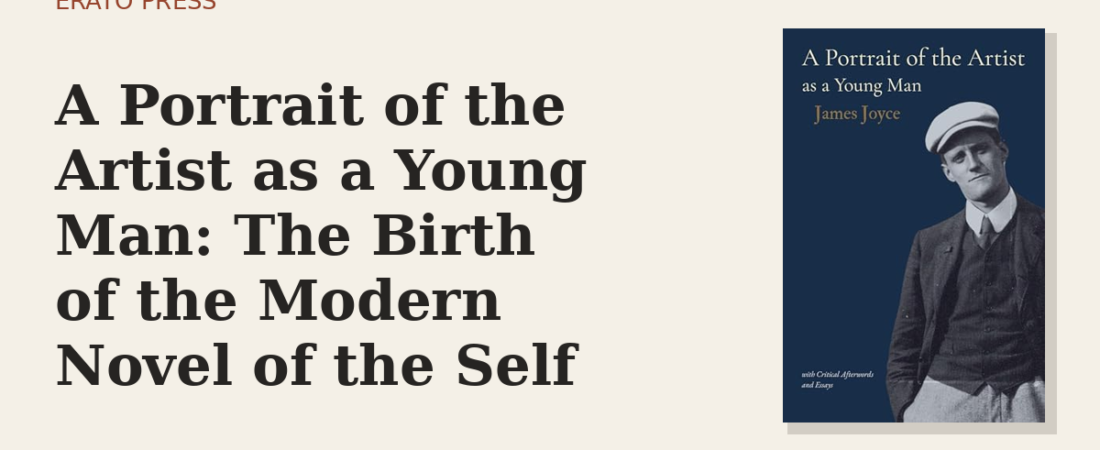
It begins with baby-talk — “Once upon a time and a very good time it was there was a moocow coming down along the road” — because it begins inside the mind of an infant, and it will grow, sentence by sentence, as that mind grows, until it ends in the complex, soaring prose of a young man declaring his vocation as an artist. James Joyce’s A Portrait of the Artist as a Young Man (1916) is the story of a soul waking up: the childhood, schooling, religious terror, and slow intellectual liberation of Stephen Dedalus, told in a revolutionary style that matures along with its hero. It is the great modern novel of the self’s formation, and the crucial bridge between the nineteenth-century novel and the modernist experiment of Ulysses to come.

A style that grows up
Joyce’s central innovation is that the prose itself develops with Stephen’s consciousness. The opening chapters, seen through a small child’s eyes, are made of simple words, fragmentary sensations, half-understood adult mysteries; as Stephen grows, the language grows with him — through the sensual confusion of adolescence, the fire-and-brimstone terror of a Catholic boyhood, and finally the abstract, aesthetic eloquence of a young man discovering his mind and his art. No novelist had so completely fused form and content, made the very texture of the prose enact the growth of the person. It is the technique that would make Joyce the central figure of literary modernism — the writer who taught the novel to render consciousness from the inside, in the language consciousness itself would use.
The hell sermon and the flight of the soul
At the novel’s center is one of the most famous set-pieces in modern fiction: the retreat sermon on hell, pages of relentless, terrifying eloquence describing the eternal torments of the damned, which reduce the sinning adolescent Stephen to abject repentance. Joyce, raised in that same fierce Irish Catholicism, renders its power from the inside — the reader feels the terror as Stephen feels it — and precisely for that reason the novel’s true drama is Stephen’s slow liberation from it: his gradual refusal of the nets of religion, family, and nation that would hold his soul, his decision to “fly by those nets” and forge, as an artist, “the uncreated conscience of my race.” It is a portrait of the birth of an independent mind, and one of the great accounts of a young person breaking free of the forces that formed them.
The bridge to modernism
Semi-autobiographical, Portrait gave literature the figure of Stephen Dedalus, who would reappear in Ulysses, and it perfected the tools — the epiphany, the growing style, the deep interiority — that the great modernists would build on. It stands exactly at the hinge between the old novel and the new: still a coming-of-age story in the classic mould, already a radical experiment in rendering the movement of a mind. For readers approaching Joyce, it is the essential middle step, harder than Dubliners and far more approachable than Ulysses — the book where his genius becomes fully itself.
Why read it now
Because it is the great modern novel of becoming yourself — of a mind waking up and breaking free of the forces that shaped it — and because its revolutionary method, the prose that grows up with its hero, is one of the most beautiful ideas any novelist ever had. It is the perfect way to understand what modernism did and why it mattered, in a book that is also a moving, universal story of youth.
Frequently asked questions
Is Portrait a good place to start with Joyce?
It is the ideal middle step — more challenging than Dubliners but far more accessible than Ulysses. It introduces Stephen Dedalus and Joyce’s key techniques in a moving, readable coming-of-age story.
How autobiographical is it?
Closely — Stephen Dedalus’s Catholic Dublin boyhood, religious crisis, and decision to become an artist mirror Joyce’s own. It is his portrait of the forces he had to escape to become the writer he became.
Why does the writing style change through the book?
Deliberately — the prose matures with Stephen’s consciousness, from infant fragments to a young man’s soaring abstraction. This fusion of style and psychological growth is Joyce’s great innovation and the novel’s central achievement.
Read the Erato Press edition →
and watch a soul, and a style, come of age.
Enjoyed this piece?
Get the next one — our essays on the classics and news of each new Erato Press edition — straight to your inbox.