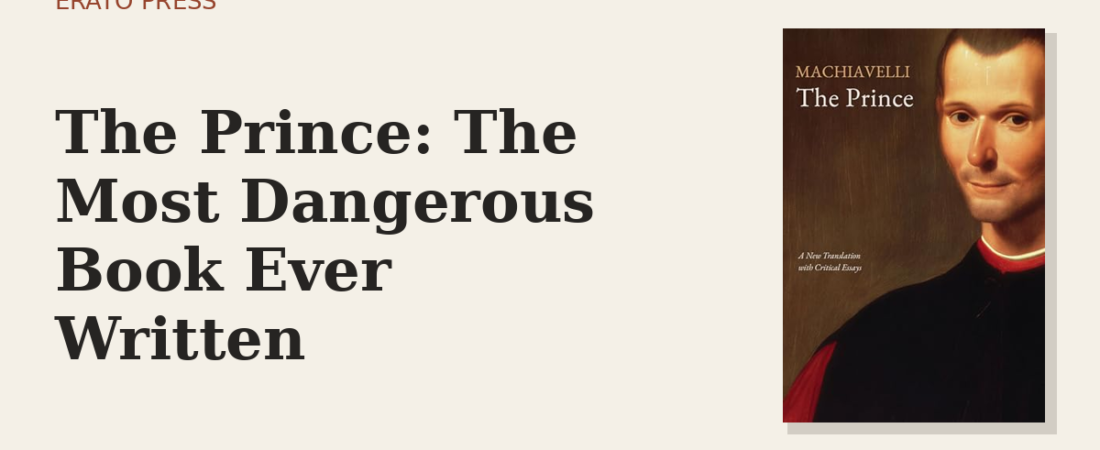
For five hundred years it has been the byword for political wickedness — “Machiavellian” is the only author’s name that became an adjective for evil. Written in 1513 by a disgraced Florentine diplomat hoping to win back favor, The Prince is a short, cold, brilliant handbook of how to seize and hold political power, and it has scandalized every generation since with its willingness to say the unsayable: that a ruler who wants to survive must be prepared to lie, to break faith, to do cruelty efficiently, to be feared rather than loved. But to read it as a mere manual for tyrants is to miss its true, more unsettling achievement. Machiavelli’s real offense was honesty — he described politics as it is actually practiced rather than as moralists pretend it should be, and in doing so he founded modern political thought.

The divorce of politics and morality
Machiavelli’s revolution was to separate the question “what should a ruler do to be good?” from the question “what must a ruler do to succeed?” — and to insist that they are not the same. Every previous writer on statecraft had described the ideal virtuous prince; Machiavelli described the effective one, and observed, coolly, that a ruler who always keeps his word, spares his enemies, and acts with mercy will, in a world full of the unscrupulous, be destroyed. Hence his notorious conclusions: that it is better to be feared than loved if you cannot be both; that cruelties are best done all at once and benefits doled out slowly; that a prince must learn “how not to be good,” and use that knowledge as necessity requires. He was not celebrating evil; he was reporting, with terrible clarity, the actual logic of power — and the horror his book provokes is really the horror of seeing that logic named.
Virtù and Fortune
At the heart of the book is Machiavelli’s bracing vision of the human condition in politics. Half of what happens, he says, is governed by fortuna — chance, the turning of fortune’s wheel — but the other half belongs to virtù, the ruler’s skill, boldness, and decisive energy in seizing the moment. Fortune, he writes, in one of the most quoted and shocking images in political literature, is like a river in flood, and like a woman, to be mastered by the man bold enough to act. It is a philosophy of the will, of seizing the initiative in a dangerous and unpredictable world, and it broke completely with the medieval faith that history unfolds according to divine providence. Machiavelli put human agency, and human ruthlessness, at the center of politics.
The founder of realism
Whatever we think of his conclusions, Machiavelli founded the realist tradition in political thought — the insistence on looking at power as it is, at the actual behavior of states and rulers, rather than at pious ideals. Every later analyst of power, from the theorists of realpolitik to the modern study of how authoritarianism actually operates, works in the space he opened. To read The Prince is to acquire a permanent, uncomfortable clarity about the machinery of power — a clarity that has made it required, and dangerous, reading for five centuries.
Why read it now
Because it is the founding text of realistic political thought and the most bracing antidote ever written to political naïveté — a book that, read honestly, inoculates you against the comforting lies that power tells about itself. Short, sharp, and endlessly quotable, it remains as disturbing and as necessary as the day it was written, in every age that would prefer not to know how power really works.
Frequently asked questions
Is The Prince really evil?
That is the ancient charge, but many readers see it differently — as an unflinching description of how power actually works rather than an endorsement of cruelty. Its scandal lies in its honesty about politics, not in advocacy of evil for its own sake.
Was Machiavelli a cynic or a republican?
Both, complicatedly. He served the Florentine republic and wrote elsewhere in praise of liberty; some read The Prince as bitter realism, even as a covert warning, from a man who loved republics but understood tyranny. The debate is unresolved and part of the book’s fascination.
Is it hard to read?
Not at all — it is short, direct, and vividly written, packed with memorable examples and epigrams. It can be read in an afternoon and remembered for a lifetime.
Read the Erato Press edition →
and learn how power actually works.
Enjoyed this piece?
Get the next one — our essays on the classics and news of each new Erato Press edition — straight to your inbox.