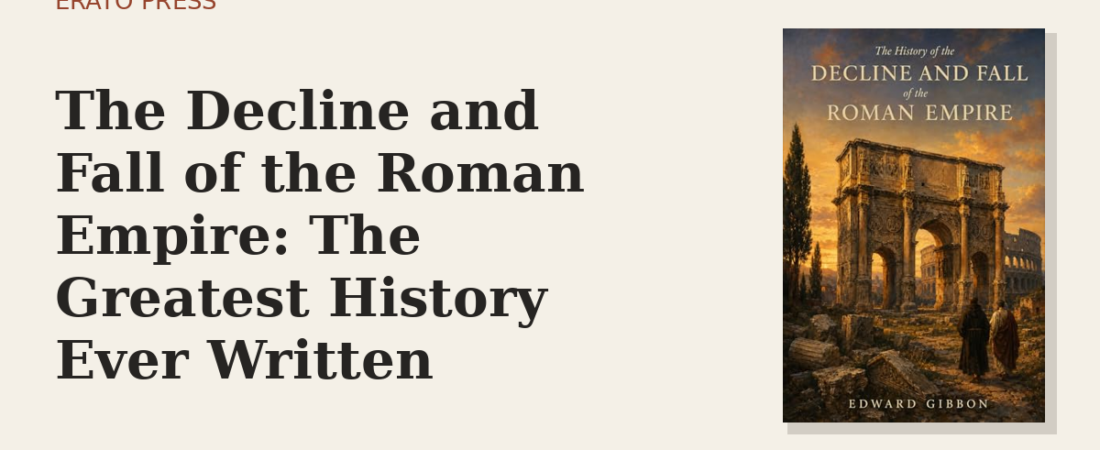
On a October evening in Rome in 1764, sitting amid the ruins of the Capitol while barefoot friars sang vespers in what had once been a temple of Jupiter, a young Englishman named Edward Gibbon conceived the idea of writing the history of the city’s decline. It took him more than twenty years and six volumes, and the result — The History of the Decline and Fall of the Roman Empire (1776–1789) — is not only the greatest work of history ever written in English but one of its supreme literary achievements: a vast, magisterial, endlessly witty chronicle of how the mightiest empire the world had known rotted, fractured, and fell across more than a thousand years. It is history written with the sweep of epic and the sting of satire, and no one has matched it since.

The great question
Gibbon set out to answer the question that has haunted every civilization since: why do empires fall? His Rome does not collapse in a single catastrophe but declines by slow degrees — through the corruption of its politics, the loss of its old civic virtue, the pressures of the barbarians on its frontiers, the exhaustion of its economy, and, most controversially, the rise of Christianity, which Gibbon argued diverted Roman energies from the state to the heavens and helped sap the empire’s martial will. His account of “the triumph of barbarism and religion” scandalized the pious and thrilled the Enlightenment, and it set the terms for two centuries of debate. Whatever one makes of his thesis, the grandeur of the attempt — to trace the death of a world across a millennium — has never been surpassed.
The prose and the irony
What makes Gibbon immortal is not only his scholarship but his voice: the balanced, rolling, magnificent sentences, and above all the famous irony, the dry, devastating wit with which he skewers folly, fanaticism, and human vanity across the centuries. His footnotes are legendary — often funnier and more scandalous than the text — and his portraits of emperors, saints, and barbarian kings are drawn with a novelist’s eye. He is that rare historian who is also a great writer, whose every page is a pleasure to read for the style alone, and whose skeptical, worldly, deeply humane intelligence presides over the whole vast pageant. To read Gibbon is to be in the company of one of the great minds of the eighteenth century.
The warning to every empire
Gibbon’s masterpiece has never stopped being read as a mirror, because every powerful civilization suspects it may be Rome. His analysis of how prosperity breeds softness, how liberty decays into despotism, how a great state can hollow out from within while its frontiers hold — these have been applied to every empire since, and never with more anxiety than in our own age of imperial doubt. His companion in charting the ancient world’s confrontation with the peoples beyond its borders is Tacitus, whose Germania Gibbon knew intimately. Together they frame the enduring drama of civilization and its discontents.
Why read it now
Because it is the greatest history in the language and one of its great prose masterpieces — a book to be read not as a duty but as a pleasure, for its wit, its grandeur, and its unmatched meditation on the mortality of empires. You need not read all six volumes to feel its power; a single chapter reveals why, two and a half centuries on, it remains the standard against which all history is measured.
Frequently asked questions
Do I need to read all six volumes?
No. Decline and Fall can be sampled — its individual chapters and portraits stand on their own, and abridged editions capture the sweep. Even a few chapters convey Gibbon’s genius for narrative and irony.
Is Gibbon’s history still reliable?
Scholarship has revised many of his conclusions, especially on Christianity’s role, but his narrative remains remarkably durable and his work is read as much for its literary greatness as for its history. It is a classic in both senses.
Why is it considered literature, not just history?
For its magnificent prose, its sustained irony, its novelistic characterization, and the commanding intelligence of its narrator. Gibbon is studied by writers as a master of English style, not only by historians.
Read the Erato Press edition →
and watch the greatest empire in history fall, in the greatest history ever written.
Enjoyed this piece?
Get the next one — our essays on the classics and news of each new Erato Press edition — straight to your inbox.