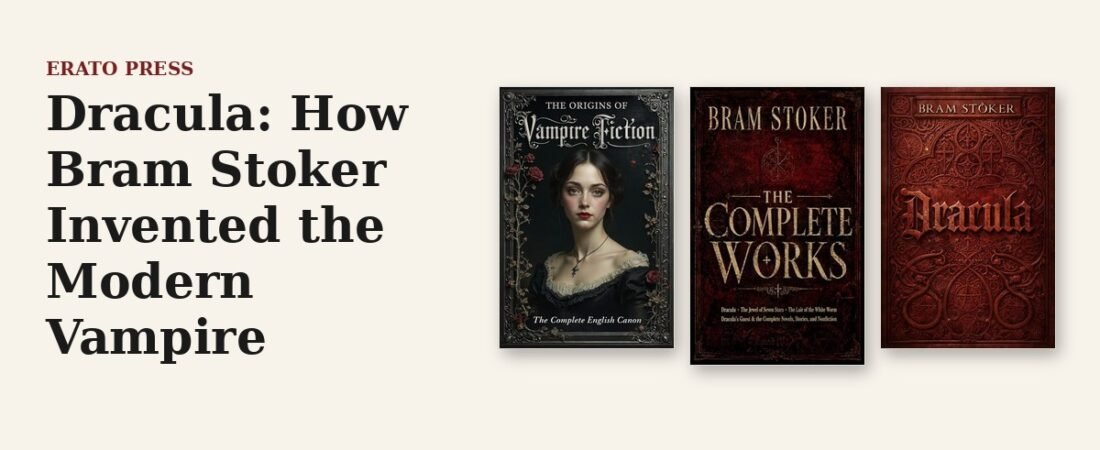
Short answer: Bram Stoker didn’t invent the vampire, but he invented our vampire by doing something stranger than inventing a monster — he imagined evil as the one thing that cannot be filed, and then spent five hundred pages filing it. Dracula (1897) is a war between two bureaucracies: an archaic one written in blood and soil, and a modern one written on typewriters and telegraph forms. The horror that has never dated is not the bite. It is the watcher who falls asleep on duty.
The monster who ate his predecessors
There were vampires before Stoker — Polidori’s aristocratic Lord Ruthven, Le Fanu’s languid Carmilla, the penny-dreadful Varney, the whole shadowy English canon now gathered in The Origins of Vampire Fiction. What Stoker did was synthesize them into a single, total figure and give him a world-historical scale. Count Dracula is not a local ghoul; he is an ancient warlord migrating from the edges of Europe to the heart of modern London — buying property, studying timetables, planning a slow conquest by contagion. Every vampire since is a negotiation with Stoker’s Count.
It begins with a hand
Read closely, Dracula is a book obsessed with one image, and it is not the fang. It is the hand. Jonathan Harker, stepping down at the castle door, feels his own hand taken in a grip “of steel” that is “cold as ice — more like the hand of a dead than a living man.” The first physical contact in the novel is a handshake: welcome and capture, courtesy and force, the social form perfectly preserved around a dead content. Pages later, shaving, Harker feels that same hand on his shoulder — and the mirror shows an empty room. That is the cell from which the whole book grows: the hand on the shoulder that the glass cannot see. Across nearly all of Stoker’s fiction, the most persistent noun is not blood but hand; in Dracula itself the word sleep appears more than twice as often as blood. The vampire is remembered as a drinker. On the page he operates as a sandman. The terror is not exsanguination but unconsciousness — the state in which the body acts, signs, opens windows, receives visitors, while the self is absent and cannot testify.
A war of two bureaucracies
This is the formal genius that keeps the book modern: against the undocumentable, Stoker mobilizes documentation. Dracula has no narrator. It is a file — journals in shorthand, letters, phonograph cylinders, ship’s logs, newspaper cuttings, telegrams, typed in triplicate by Mina Harker, whose typewriter is as essential to victory as Van Helsing’s wafers. The Count, centuries old, keeps no records; he is a record, blood-borne, oral, archaic. The hunters defeat him by out-administering him. The novel’s true horror of invasion is not military but legal: Dracula comes to England not by storm but by conveyancing, studying English law and the Bradshaw railway guide, shipping fifty boxes of his native earth across London by bill of lading. Stoker — who answered fifty letters a day in another man’s name as acting manager of Henry Irving’s Lyceum Theatre — understood before any critic that a modern empire’s weakness is its own circulatory system of contracts and carriers: anything, once properly documented, can be delivered anywhere, including the end of the world to Piccadilly.
The sleeping woman
Strip away the lore and what remains is a series of bedrooms. Lucy asleep with her window open; Lucy in trance while four men open their veins for her; Mina asleep while her husband lies in a stupor beside her and the Count stands over both. The vampire’s approach is never violent; it is intimate — a nocturnal visitation that every adult reader understands without being told. Dracula is, among other things, the first great novel about the impossibility of testifying to abuse: the victim asleep, the evidence two small marks, the diagnosis disbelieved by everyone but the foreign specialist who reads the symptoms against a forbidden archive. And the novel’s most unbearable image is one it can never discuss in plain terms — the Count pressing Mina’s mouth to the wound in his own breast, blood flowing the wrong way, the predator nursing, an act that is rape, forced communion, and obscene maternity at once. “Unclean, unclean!” is Mina’s verdict on herself. But notice where the book lays the blame: it punishes the men’s sleep, not the women’s. Lucy dies because her guardians doze; Mina is violated while Jonathan sleeps beside her. Stoker, the professional keeper of another man’s nights, wrote a book in which the one unforgivable sin is to fall asleep at the bedside.
Two masters, one difference
Every reader feels that Dracula and Van Helsing mirror each other — both old, foreign, accented, learned in forbidden things, both commanding younger men’s obedience, both working by trance and transfusion. The war is not between science and superstition. It is between two masters of the same arts, divided by a single thing: consent. Van Helsing asks; he explains, weeps, begs pardon of the bodies he must mutilate. The Count never asks. On that one hinge — a hand offered versus a hand laid on — the whole moral architecture turns. Around each master stands a structure of service, and Stoker’s most pitiable invention, Renfield, is its dark center: the servant who gave his will to a magnetic superior and was consumed and discarded — the secretary’s nightmare-image of himself.
Why it still has teeth
Because the anxieties never left. Every era rewrites Dracula in its own image — Cold War contagion, AIDS-era dread, immigration panic, the romance of the outsider — precisely because Stoker built a monster empty enough to hold whatever a culture fears and desires. Even the book’s afterlife obeys its own logic: Nosferatu pirated the story, the widow won a court order to destroy every print, and the copies survived anyway — the undocumentable thing, escaped from the file, propagating by night. Read the original and you find it stranger, slower, and more disturbing than any adaptation: a documentary-style dossier that closes by confessing it cannot prove a word of itself. “We ask none to believe us.” The hand that writes has won; what it has written cannot be verified. The whole sweep of Stoker’s career — eight novels, a children’s book set in the afterlife, a study of impostors — is gathered, with this critical essay, in Bram Stoker: The Complete Works.
Read the Erato Press annotated Dracula →
Related reading: The Essential Gothic Novels: A Reader’s Guide · Frankenstein: Mary Shelley and the Birth of Science Fiction · The King in Yellow and the Roots of Weird Fiction · The Woman in White and the Sensation Novel
This article draws on the original critical essay “The Hand and the Trance,” written for the Erato Press edition. This article contains affiliate links; as an Amazon Associate, Erato Press earns from qualifying purchases.
Enjoyed this piece?
Get the next one — our essays on the classics and news of each new Erato Press edition — straight to your inbox.