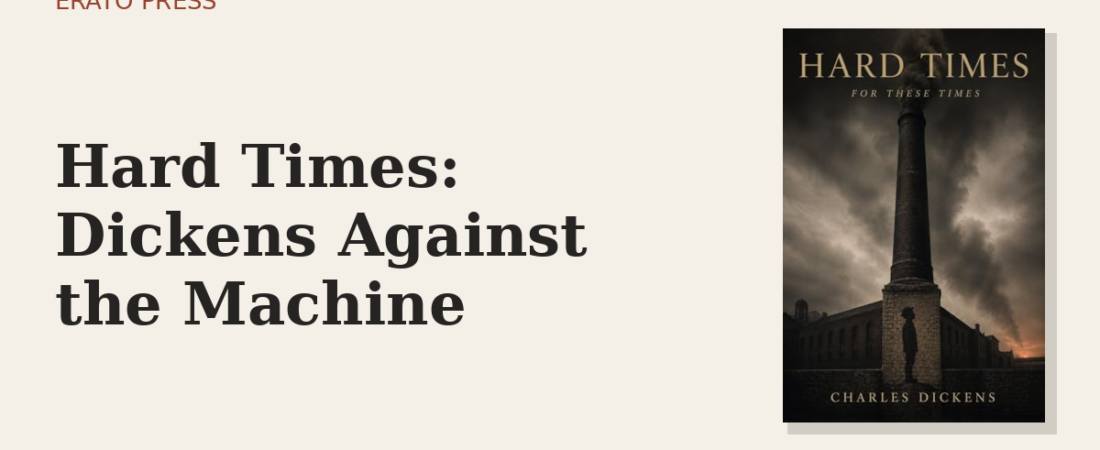
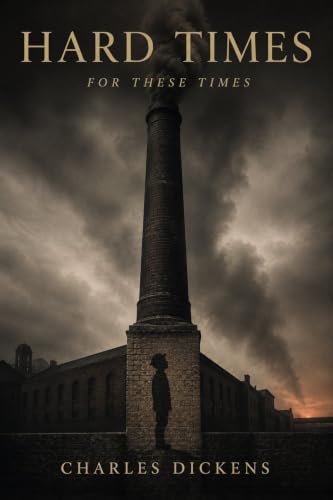
“Now, what I want is, Facts. Teach these boys and girls nothing but Facts.” So begins Hard Times (1854), Dickens’s shortest and angriest novel, with the schoolmaster Gradgrind drilling the imagination out of children in the name of hard, useful fact. It is Dickens’s most direct assault on the spirit of his industrial age — on the philosophy that reduced human beings to units of labor and calculation, that measured everything and valued nothing it could not measure, that starved the heart in the name of efficiency. Set in the grim, imaginary factory town of Coketown, it is a fable, a satire, and a cry of alarm about what a civilization loses when it worships numbers and despises wonder.
The war on the imagination
Dickens’s target is a whole worldview — the hard utilitarian creed that facts and figures are everything and fancy, feeling, and imagination are useless indulgences. Gradgrind raises his own children, Louisa and Tom, on this diet of pure fact, forbidding them fairy tales, wonder, or play, and the novel traces the catastrophe that follows: a daughter emotionally crippled, unable to feel, married off in a loveless calculation; a son turned selfish and criminal. Against the Gradgrind philosophy Dickens sets the despised circus folk — poor, disreputable, gloriously useless — who possess exactly what the fact-worshippers lack: kindness, imagination, loyalty, the capacity for joy. The book’s argument is stark and urgent: a society that trains the wonder out of its children, that treats the human heart as a fact to be managed, is building its own ruin.
Coketown and the workers
Dickens also turns his fury on the industrial system itself — Coketown with its smoking chimneys and its identical streets and its “Hands” (the mill-owners’ word for workers, as if they were only that). He gives us the decent weaver Stephen Blackpool, ground between a cruel employer and a union he cannot in conscience join, destroyed by a system that has no place for an honest man. Dickens’s treatment of the labor conflict is less balanced than Gaskell’s in North and South — his sympathies are all with the suffering workers and his contempt all for the mill-owner Bounderby, the self-made blowhard who is one of his great comic monsters — but the anger is real and earned. He wanted his readers to see the human cost of the smoke and the profit, the people behind the word “Hands.”
The fable form
Unusually for Dickens, Hard Times is short, tight, and schematic — more fable than sprawling novel, without the vast cast and endless subplots of his big books. Some readers miss the usual Dickensian abundance; others find the compression bracing, the argument all the sharper for being stripped down. It is Dickens in polemical mode, writing a tract in the shape of a story, and it works because the polemic is animated by his gift for the vivid grotesque — Gradgrind, Bounderby, the circus master Sleary with his lisping wisdom that “people mutht be amuthed.” For readers exploring the Victorian giant, our guide to where to start with Dickens sets this fierce little book beside his warmer masterpieces.
Why read it now
Because its warning is more urgent than ever: an age that measures everything and values only what it can measure, that treats education as the transfer of data and human beings as resources to be optimized, is exactly the age Hard Times was written to alarm. Short enough to read in a sitting and pointed as a blade, it is Dickens’s most concentrated defense of the imagination, the heart, and the useless, necessary things that make us human.
Frequently asked questions
Is Hard Times a good first Dickens?
It is his shortest and most focused novel, which makes it approachable, but it is also his most polemical and least characteristically abundant. Great Expectations or David Copperfield better show his full range; Hard Times is ideal if you want his social criticism at its sharpest.
What is Dickens attacking?
The utilitarian, fact-worshipping philosophy of his industrial age — its faith that human beings and their education could be reduced to figures and efficiency — and the dehumanizing factory system that treated workers as mere “Hands.”
Why is it so different from his other novels?
It is far shorter and more tightly argued, a fable rather than a sprawling saga. Dickens wrote it for serial publication under space constraints and shaped it as a concentrated polemic, which gives it an unusual sharpness.
Read the Erato Press edition →
and hear Dickens sound the alarm against a world made of facts.
Enjoyed this piece?
Get the next one — our essays on the classics and news of each new Erato Press edition — straight to your inbox.