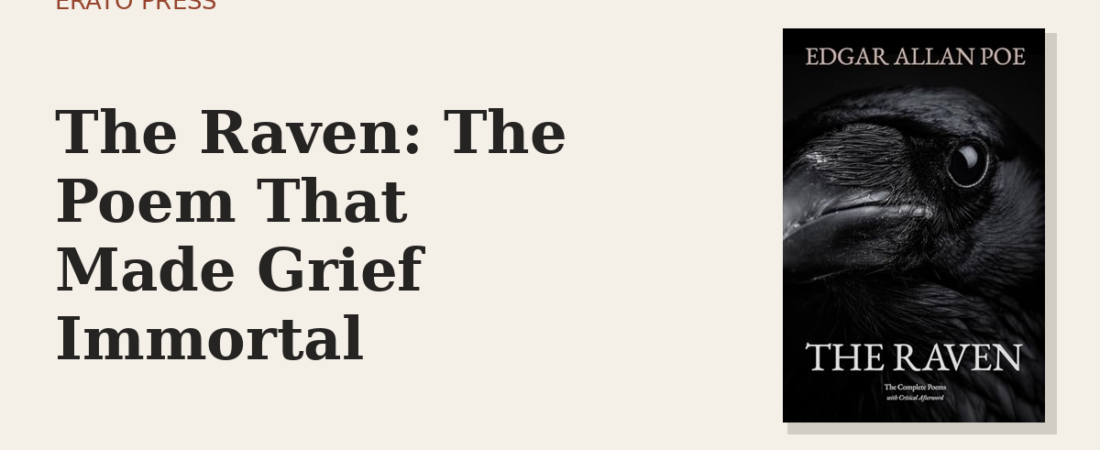
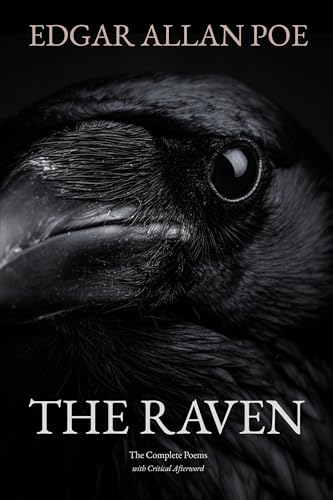
A man sits alone at midnight, half-reading, half-grieving for his lost love Lenore, when a raven flies in through his window and perches above his door, and answers his every desperate question with a single word: “Nevermore.” Edgar Allan Poe’s The Raven (1845) made him famous overnight and became perhaps the most recognized poem in the English language — a hypnotic, musical, remorseless descent into grief and madness. But it is also something rarer: a poem whose author later explained, step by cold step, exactly how he built it to produce its effect. To read The Raven is to feel the heart break; to read it beside Poe’s account of its making is to learn how such heartbreak is engineered.
A machine for melancholy
Poe’s genius was atmospheric and technical at once. The poem’s power lies in its sound — the insistent trochaic beat, the internal rhymes, the tolling repetition of “Nevermore” and its echoing vowels, the whole incantatory music that lodges in the ear and will not leave. He builds the dread in slow, deliberate stages: the midnight, the dying fire, the rustling curtain, the tapping at the door, the bird’s entry, and then the escalating exchange as the narrator, knowing the answer, cannot stop asking the questions that will destroy him — will he ever see Lenore again? is there balm for his sorrow? — each met with the same pitiless “Nevermore.” The reader watches a man deliberately torture himself, using the bird’s one word as an instrument to confirm his own despair, until grief tips into madness. It is one of the great performances of controlled emotional intensity in English verse.
The poet who showed his work
What makes The Raven unique is Poe’s essay “The Philosophy of Composition,” in which he claimed — provocatively, and perhaps not entirely honestly — that he wrote the poem with pure calculation, choosing every element for its effect. He decided, he said, on the ideal length, then the desired tone (melancholy, “the most legitimate of all the poetical tones”), then the most poetical subject in the world (“the death of a beautiful woman”), then the refrain, then the word — “nevermore” — for the mournful sound of its long o, and only then invented a creature that could plausibly repeat it. Whether or not he really composed so coldly, the essay is a landmark: the first great modern statement that poetry is a craft of engineered effects, not merely a spontaneous overflow of feeling. Poe, the master of the calculated shudder, was the first to insist that the artist is a deliberate maker of sensations — an idea that would shape modern poetry and criticism.
The architect of the modern shudder
Poe invented or perfected more of modern popular literature than almost any writer — the detective story, the tale of psychological horror, the modern short story’s unity of effect — and The Raven is the purest distillation of his sensibility: beauty and death and madness fused into an unforgettable object, built with a jeweler’s precision. His influence runs everywhere, from French Symbolist poetry to the whole tradition of gothic and horror writing he helped define. No poem has been more parodied, set to music, memorized, and loved — because none has more perfectly engineered the shiver it sets out to produce.
Why read it now
Because it is the most perfect small machine of melancholy in English poetry, and because reading it alongside Poe’s account of its construction is a masterclass in how art produces feeling. Short enough to read aloud in a few minutes and impossible to forget, it is grief and craft made one — the poem that taught the modern world that a shudder can be built.
Frequently asked questions
What does “Nevermore” mean in the poem?
It is the raven’s single, relentless answer, which the grieving narrator turns into a confirmation of every worst fear — that he will never recover from his loss, never see Lenore again, never find peace. The word’s mournful sound is central to the poem’s hypnotic effect.
Did Poe really write it by pure calculation?
He claimed so in “The Philosophy of Composition,” describing how he chose each element for effect. Scholars doubt the process was quite so cold, but the essay is a landmark statement that poetry is deliberate craft — and reading it beside the poem is illuminating.
Why is Poe so influential?
He shaped modern popular literature more than almost anyone — inventing the detective story, perfecting psychological horror and the short story of single effect, and influencing poetry from the French Symbolists onward. The Raven is the concentrated essence of his art.
Read the Erato Press edition →
and let the raven answer your questions too.
Enjoyed this piece?
Get the next one — our essays on the classics and news of each new Erato Press edition — straight to your inbox.