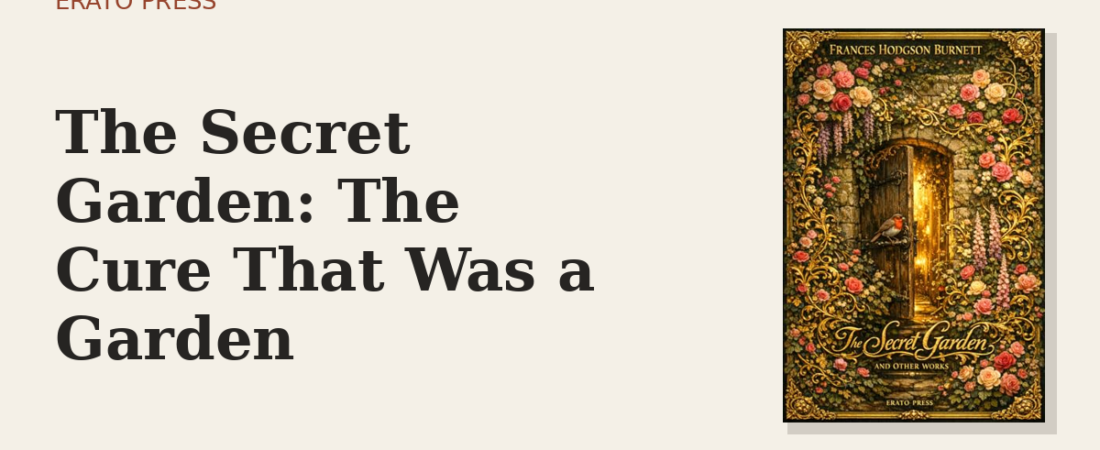
A sour, sickly, unloved orphan named Mary Lennox is sent from India to a gloomy manor on the Yorkshire moors, where she discovers, behind a locked door and a wall of ivy, a garden that has been sealed and abandoned for ten years. In secretly bringing that garden back to life, she brings back to life a hidden invalid cousin who believes he is dying, and — most quietly and most powerfully — herself. Frances Hodgson Burnett’s The Secret Garden (1911) is on its surface a children’s book, and one of the most beloved ever written; underneath it is a myth of healing as deep as any in our literature, a story about how attention, work, and the living world can restore a soul that neglect had nearly killed.

Three unwanted children
Burnett’s daring is that she begins with a heroine no one likes — Mary is “as tyrannical and selfish a little pig as ever lived,” spoiled and unloved, made ugly by neglect. She is not sweetened by an author’s sentimentality; she is changed by the garden and the moor, by fresh air and useful work and the friendship of ordinary, hearty children. And when she discovers her cousin Colin — a hysterical, bedridden boy convinced he will die, as tyrannical in his weakness as Mary was in her sourness — the two damaged children heal each other by the same medicine: not pity, but the bracing demand of the living world, the garden that needs tending, the robin, the moor wind, the plain kindness of the servant boy Dickon who is at home among growing things. Burnett understood, before it was fashionable, that children are made well not by being coddled but by being given something real to love and to do.
The garden as symbol
The garden is one of the great symbols in children’s literature, and Burnett lets it carry a weight that reaches well beyond the nursery. A walled place, locked in grief (it was sealed after the mistress of the house died there), dead-seeming but not dead — and the children’s slow, secret work of clearing and planting and coaxing it back to bloom becomes a visible image of every kind of recovery: from grief, from illness, from the deadness that neglect and self-pity breed in a heart. Burnett, who had suffered the loss of a child and searched among the healing philosophies of her day, poured into the book a genuine faith that life wants to live, that the buried seed will come up if it is only given light and care. The garden heals because it teaches the children to turn outward, to tend something other than their own misery.
The quiet radicalism of the ordinary
What keeps the book from mere sweetness is its earthy realism. The healing agents are not magic but soil, weather, exercise, appetite, and the blunt good sense of the Yorkshire servants who have no patience for a rich child’s tantrums. Burnett grounds her myth of restoration in the plainest things — a boy who can charm animals, a robin who leads the way, a woman’s honest cooking — and insists that the cure for the modern child’s neuroses is contact with the physical, working, growing world. It is a lesson our screen-bound century may need more than Burnett’s did, and it belongs beside the coming-of-age warmth of a book like Little Women in the tradition of novels that take the inner lives of children seriously.
Why read it now
Because it is the most beautiful of all stories about healing — a book that a child can love as an adventure and an adult can read as a profound parable of recovery. Its faith that neglected life, given attention and care, will bloom again is one of the most consoling things in literature, and its garden has never stopped growing in the imagination of everyone who has read it.
Frequently asked questions
Is The Secret Garden only for children?
Not at all. Children love it as a mystery and adventure, but its themes of grief, healing, and the restorative power of nature and work reward adult readers, who often find it more moving than they remember.
Why does the garden heal the children?
Burnett’s idea is that recovery comes from turning outward — from tending something living rather than dwelling on one’s own misery. The physical work, fresh air, and shared purpose of the garden cure both children of the sourness that neglect had bred.
Who is Dickon?
The Yorkshire servant boy who can charm wild animals and who guides Mary and Colin into the healing life of the moor and garden. He embodies the book’s faith in the plain, earthy, living world as the true medicine.
Read the Erato Press edition →
and watch a locked, dead garden — and two dead-seeming children — come back to life.
Enjoyed this piece?
Get the next one — our essays on the classics and news of each new Erato Press edition — straight to your inbox.