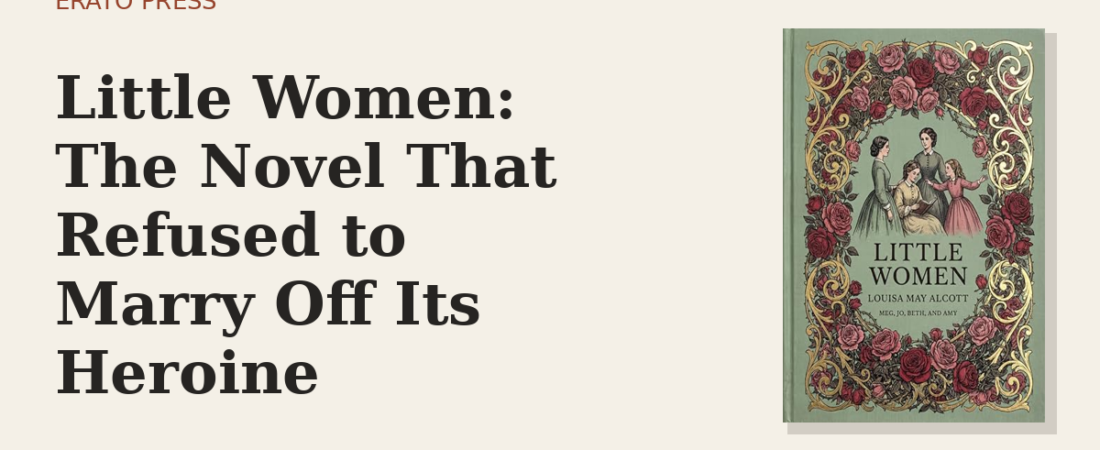
Four sisters — motherly Meg, wild and ambitious Jo, gentle Beth, vain little Amy — grow up in genteel poverty in Civil War Massachusetts while their father is away at the war. On its surface, Little Women (1868) is the coziest of domestic classics, beloved for a century and a half for its warmth, its Christmases, its sisterly quarrels and reconciliations. But under the warmth beats something quietly radical, and it is why the book has never stopped mattering: in Jo March, Louisa May Alcott created a heroine who wanted, more than marriage, to be a writer and to be free — and who has taught generations of girls that a woman might want a life of her own making. It is a domestic novel with a rebel at its heart.

Jo March, and the wish to be more
Jo is one of the most beloved characters in American fiction because she is one of the first to want what girls were not supposed to want. She is impatient with the constraints of nineteenth-century womanhood — the corsets and the calling-cards and the expectation that a girl’s whole story ends at the altar. She wants to write, to earn her own money, to matter in the world, to be, as she says, “free” — and she chafes, gloriously, against every effort to make her a proper little woman. Alcott, who supported her own family by her pen and never married, poured her own rebellion into Jo, and generations of writers, from Simone de Beauvoir to countless novelists, have named Jo March as the character who first told them a woman could have an ambition larger than love.
The marriage plot, resisted
The most famous fact about the book is a rebellion against its own genre. Alcott’s readers, and her publisher, demanded that Jo marry the boy next door, the wealthy, charming Laurie — the ending the marriage plot required. Alcott refused. “I won’t marry Jo to Laurie to please anyone,” she wrote; she would not hand her ambitious heroine the conventional happy ending. She married Jo instead to an older, poorer, unglamorous professor (a compromise she resented having to make at all, having wanted to leave Jo a “literary spinster”), and she gave Laurie to the vain little sister Amy — a swerve that has infuriated and fascinated readers ever since. Whatever one thinks of the outcome, the gesture was radical: Alcott insisted that her heroine’s story was not simply the story of whom she would marry, and in doing so she cracked open the form that had confined the female novel.
The domestic made heroic
What has kept the book beloved, beyond Jo’s rebellion, is Alcott’s genius for making ordinary domestic life feel like the great human drama it is. The small events of the March household — a lost manuscript, a burned dress, a sister’s illness, an act of forgiveness — are given the emotional weight of epic, because Alcott understood that this is where most lives are actually lived and most virtue is actually tested. Beth’s death remains one of the most quietly devastating scenes in American fiction. Alcott dignified the female, domestic sphere as worthy of serious literature at a time when it was dismissed, and in doing so helped make the coming-of-age of ordinary girls a subject the novel could take seriously.
Why read it now
Because it is both the warmest of comfort classics and a quietly revolutionary book — the one that gave girls a heroine who wanted to write, to earn, to be free, and refused to reduce her to whom she married. Generations have grown up with the March sisters and carried Jo with them ever after; it remains one of the most beloved and most quietly subversive novels America has produced.
Frequently asked questions
Why did Alcott refuse to marry Jo to Laurie?
She resisted the conventional romantic ending her readers demanded, wanting Jo’s story to be about more than marriage. She married Jo to the professor as a compromise, having preferred to leave her a “literary spinster” — a genuinely radical wish for 1868.
Is it just a children’s book?
No. It works beautifully for young readers, but its treatment of ambition, poverty, grief, and a woman’s right to her own life rewards adult reading — which is why it has been reinterpreted by feminist critics and filmmakers for generations.
How much is autobiographical?
A great deal. Jo is closely based on Alcott herself, who supported her family by writing and never married; the March sisters are drawn from her own. The book’s emotional truth comes straight from her life.
Read the Erato Press edition →
and meet the heroine who wanted to be more than a wife.
Enjoyed this piece?
Get the next one — our essays on the classics and news of each new Erato Press edition — straight to your inbox.